Tag Archives: Civil Rights

Veterans Day 2018

In 1919, President Woodrow Wilson proclaimed November 11 as Armistice Day:

To us in America, the reflections of Armistice Day will be filled with solemn pride in the heroism of those who died in the country’s service and with gratitude for the victory, both because of the thing from which it has freed us and because of the opportunity it has given America to show her sympathy with peace and justice in the councils of the nations.

November 11 commemorates the armistice agreement Allied powers signed with Germany bringing hostilities to an end on the “eleventh hour of the eleventh day of the eleventh month” of 1918.

In June 1954, Congress passed legislation changing the name from Armistice Day to Veterans Day, a day to honor veterans of all wars. On October 8, 1954, President Dwight D. Eisenhower issued the first Veterans Day Proclamation.

Just six years earlier, President Harry S. Truman signed Executive Order No. 9981 establishing the President’s Committee on Equality of Treatment and Opportunity in the Armed Services. The EO signaled the government’s commitment to integrate the military.

United Service Organizations (USO) policy expressly banned racial discrimination. However, there were separate facilities for African American servicemen in the Jim Crow South and segregated North. In Philadelphia, USO sites for African Americans included Parker Hall and South Broad Street USO. Billie Holiday entertained the soldiers at both locations.
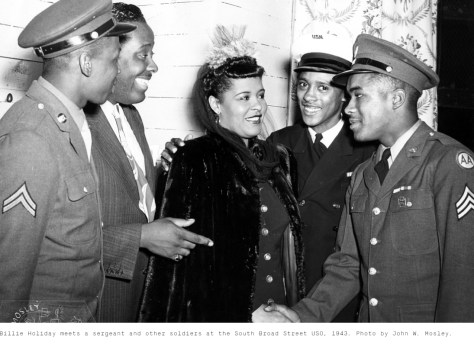
Billie Holiday - South Broad Street USO

Parker Hall was on the top floor of the Parker Building.

Parker Hall - Germantown CDC

The Parker Building is now home to the ACES Museum whose mission is to preserve the history of World War II veterans and restore Parker Hall as a functioning USO for black veterans and their families. The ACES Museum is headquarters of the Philadelphia Chapter of the National Association of Black Veterans.

For more information, visit www.acesmuseum.online.
27th Philadelphia Film Festival

The 27th annual Philadelphia Film Festival kicks off this week with the screening of Ben is Back starring Julia Roberts and Lucas Hedges as mother and son who are grappling with a history of addiction.

The story is ripped from the headlines as Philadelphia struggles to deal with the opioid drama unfolding on the streets of Kensington.

Executive Director J. Andrew Greenblatt said in a statement:

From our powerful, socially relevant and incredibly timely Opening Night screening of Ben is Back to the definitive look at Philadelphia music legend Teddy Pendergrass for our Closing Night selection, and the incredibly diverse line-up in-between, the films premiering in this year’s Festival will be discussed and remembered for a long time to come.

Artistic Director Michael Lerman added:

Andrew and I have been doing this together for ten years and I love that we continue to find fresh, unique films that delight and challenge audiences. I’m so proud of the program the team has put together and I can’t wait to share the adventure we have in store for you.

What’s in store is a lineup of more than 100 films over 11 days. As a curator of art, technology and social change content, my must-see films include:

  • Studio 54
  • If Beale Street Could Talk
  • The Price of Everything
  • Bodied
  • General Magic
  • Empathy, Inc.
  • Green Book

The film is based on a true friendship. Art also imitates life. Before passage of the Civil Rights Act of 1964, African American motorists used the “Green Book” travel guide to vacation without humiliation.

Green Book Collage

The Closing Night film, Teddy Pendergrass: If You Don’t Know Me, tells the untold story of Philadelphia’s legendary R&B singer whose “For Women Only” concerts were the stuff of, well, legends.

To view the full schedule and purchase tickets, go here.

Tribute to the Life and Music of Aretha Franklin

The Queen of Soul will be laid to rest this week. During her final performance in Philadelphia, Aretha Franklin told the audience:

I started, really in Philadelphia. I worked at Pep’s on Broad Street and I worked at the Cadillac Club. I’ve worked all over Philadelphia.

Indeed, she did. Ms. Franklin worked her magic at the Uptown Theater, where on Friday, August 31, the Uptown Entertainment and Development Corporation will host a tribute to the life and music of the Queen of Soul. The event will take place in front of the historic theater.

Uptown Theater Tribute to Aretha Franklin2

The program will begin at 6pm with musical tributes to Ms. Franklin, followed by a candlelight ceremony at 7pm. For more info, contact Linda Richardson at (215) 236-1878.

Art, Jazz and Activism in North Philadelphia

Jazz musicians were about intersectionality before the term was coined. During 2018 Jazz Appreciation Month, I moderated a conversation on art, jazz and activism, curated by Black Quantum Futurism and Icebox Project Space.

Blue Note Salon

The panel discussion and community forum featured artists/activists Josh Graupera,  Stormy Kelsey, Michael O’Bryan and Tieshka K. Smith. The audio is now available on Artblog Radio.

The Jazz Ambassadors

“The Jazz Ambassadors” tells the story of when the U.S. State Department asked jazz icons to travel the world as cultural ambassadors during the Cold War. Their mission was at the intersection of race, civil rights and public diplomacy.

The film premieres on May 4, 2018 on PBS. Check your local listings.

Blue Note Salon

On December 8, 1956, the Miles Davis Quintet, featuring Miles Davis (trumpet), John Coltrane (tenor saxophone), Red Garland (piano), Paul Chambers (bass) and Philly Joe Jones (drums) performed at the Blue Note. The set was featured on the Mutual Network live remote radio broadcast, Bandstand, U.S.A.

That same night, the police raided “the town’s swankiest jazz emporium.” The Blue Note was a “black and tan” club, an integrated nightspot where blacks and whites socialized on an equal basis. As such, it was the target of police harassment.

Philadelphia Tribune - Dec. 11, 1956

From the beginning, jazz was a tool for social change. Jazz musicians’ unbowed comportment created a cultural identity that was a steppingstone to the Civil Rights Movement. In remarks to the 1964 Berlin Jazz Festival, Dr. Martin Luther King Jr. said jazz is “triumphant music”:

Jazz speaks for life. The Blues tell the story of life’s difficulties, and if you think for a moment, you will realize that they take the hardest realities of life and put them into music, only to come out with some new hope or sense of triumph.

This is triumphant music.

Modern jazz has continued in this tradition, singing the songs of a more complicated urban existence. When life itself offers no order and meaning, the musician creates an order and meaning from the sounds of the earth which flow through his instrument.

It is no wonder that so much of the search for identity among American Negroes was championed by Jazz musicians. Long before the modern essayists and scholars wrote of racial identity as a problem for a multiracial world, musicians were returning to their roots to affirm that which was stirring within their souls.

Much of the power of our Freedom Movement in the United States has come from this music. It has strengthened us with its sweet rhythms when courage began to fail. It has calmed us with its rich harmonies when spirits were down.

On April 21, 2018, All That Philly Jazz and Black Quantum Futurism will present the “Blue Note Salon” which pays homage to jazz musicians’ legacy of resistance. The community discussion will feature creative change makers who work on social justice issues. Their work is at the intersection of art, community engagement and social change.

Blue Note Salon

The event is free and open to the public. To RSVP, go here.

Lena Horne Forever

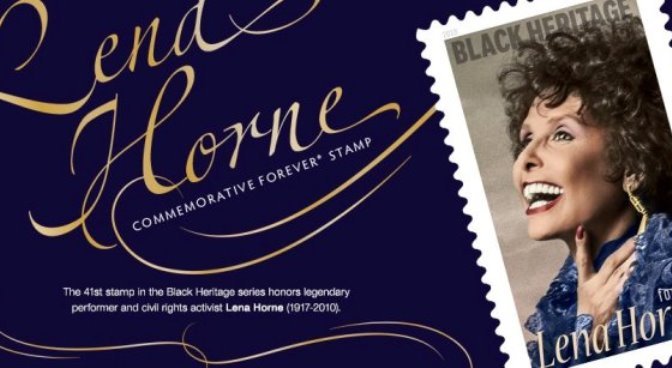
On Tuesday, the U.S. Postal Service will issue the Lena Horne Forever stamp. The 41st issuance in the Black Heritage series honors the legacy of Lena Horne:

Horne began her career as a dancer at Harlem’s Cotton Club and later became a featured vocalist with touring orchestras. The rampant racial discrimination she encountered from audiences, hotel and venue managers and others was so disconcerting that she stopped touring, and in 1941, she made her move to Hollywood. A year later, she signed a contract with MGM — one of the first long-term contracts with a major Hollywood studio — with the stipulation that she would never be asked to take stereotypical roles then available to black actors. Her most famous movie roles were in “Cabin in the Sky” and “Stormy Weather,” both released in 1943.

During World War II, Horne entertained at camps for black servicemen, and after the war worked on behalf of Japanese Americans who were facing discriminatory housing policies. She worked with Eleanor Roosevelt in pressing for anti-lynching legislation. In the 1960s, Horne continued her high-profile work for civil rights, performing at rallies in the South, supporting the work of the National Council for Negro Women, and participating in the 1963 March on Washington.

On Horne’s passing in 2010, President Barack Obama said:

Over the years, she warmed the hearts of countless Americans with her beautiful voice and dramatic performances on screen. From the time her grandmother signed her up for an NAACP membership as a child, she worked tirelessly to further the cause of justice and equality. In 1940, she became the first African American performer to tour with an all white band. And while entertaining soldiers during World War II, she refused to perform for segregated audiences – a principled struggle she continued well after the troops returned home.

From sultry Selina Rogers in “Stormy Weather” …

… to sweet Georgia Brown in “Cabin in the Sky” …

… and Glinda, the Good Witch in “The Wiz,” the legendary performer entertained millions.

Horne’s activism and willingness to speak truth to power inspired millions, including the writer.

Lena Horne Collage2

The trailblazer and civil rights activist will be in the public’s memory forever.

Lena Horne Forever

The First Day of Issue Stamp Dedication Ceremony will be was held at Symphony Space in New York City. The Lena Horne Forever stamp is on sale nationwide at post offices and online at The Postal Store.

National Museum of African American History and Culture Turns One

September 24 marked the first anniversary of the National Museum of African American History and Culture, more affectionately known as my home away from home.

NMAAHC First Anniversary

From Day One, NMAAHC has had the people’s stamp of approval. In its first year, the museum has welcomed more than two million visitors. Lonnie G. Bunch III, founding director of the museum, said:

We are so grateful to America for making this first year unprecedentedly successful. This first anniversary gives us at the Smithsonian the opportunity to thank everyone for this incredible gift and for making it possible to continue our mission to help America grapple with history by seeing their past through an African American lens – and ultimately help Americans find healing and reconciliation.

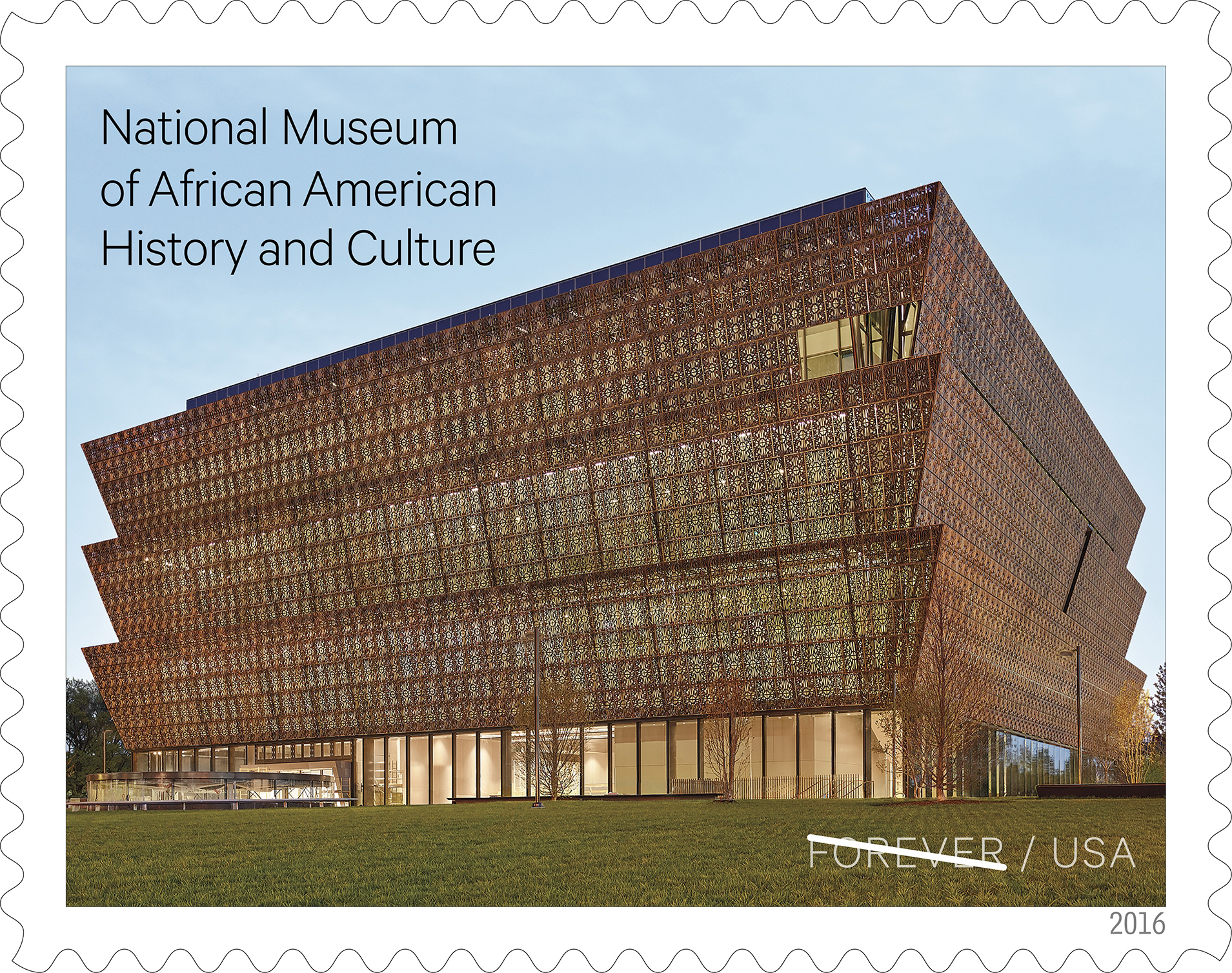
NMAAHC has received the stamp of approval of the U.S. Postal Service which issued the “Celebrating African American History and Culture” Forever stamp.

NMAAHC Forever Stamp

The numbers show that the National Museum of African American History and Culture is a gift to the American people:

  • Almost 2.5 million visitors walked through the 400,000-square-foot building.
  • Of those visitors, 922 were ambassadors.
  • About 10,000 of all 2.5 million people who passed through were between the ages of 4 and 7 years old.
  • About 3,000 objects were on display while NMAAHC’s permanent collection is more than 13 times that size, at almost 40,000 objects.

For more info, check out “NMAAHC’s First Year by the Numbers.”