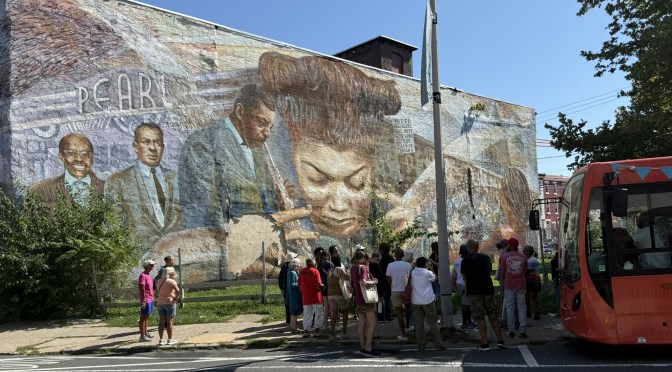
The National Historic Preservation Act was signed into law on October 15, 1966. With Section 106 of the NHPA under attack by the Trump administration, preservationists are not popping bottles. Instead, they are mobilizing and taking action to protect historic places.
As a community preservationist, I used the Section 106 review process to block the Philadelphia Housing Authority from demolishing 2125 Ridge Avenue, the former location of the Checker Café and one of the few extant buildings associated with Philadelphia’s golden age of jazz.
2125 Ridge Avenue is one of the four Philadelphia Section 106 success stories on the National Trust for Historic Preservation’s map.
The Ridge on the Rise Mural at Checker Café is a “community-submitted Section 106 success story”:
The Ridge on the Rise mural on the south-facing wall of the Checker Café is a visual history of Ridge Avenue’s African American cultural, entertainment, and civil rights heritage. In addition to depicting the Pearl Theater, Pearl Bailey and John Coltrane, the mural addresses community protests against Girard College’s segregationist policies. The mural recalls the era when Ridge Avenue functioned as a self-contained commercial and cultural district, with shops, hotel, farmers market, restaurants, theaters, and jazz venues serving the Black community.
For nearly 90 years, 2125 Ridge Avenue has served as a visual anchor for the Ridge Avenue commercial corridor in Sharswood. In the wake of the Great Migration, the demographics of the Sharswood neighborhood changed.
Ridge Avenue became a safe haven for African Americans. 2125 Ridge Avenue was home to the Checker Café, an afterhours jazz club. In the 1930s to the 1950s, the Checker Café was the place to be and be seen. It was popular with entertainers, celebrities, and political figures. Pearl Bailey worked as a singing waitress at the Checker Café in the mid-1930s. The Checker Café was about intersectionality and diversity.
It’s October so the U.S. Supreme Court is back in session. According to the latest Gallup poll, the Court’s approval is 34%, a historic low. As the conservative justices kowtow to President Trump on affirmative action, reproductive rights, voting rights, redistricting and presidential accountability, public trust in the Court has eroded.
The Court’s conservative justices increasingly evoke Pigmeat Markham’s caricature of judicial power running amok.
But what is happening at the Court is no laughing matter. As Democracy Forward notes, “the Court has increasingly become a venue for disputes arising out of the Trump-Vance administration’s actions.”
ThePeople’s Guide to the U.S. Supreme Court, published by Democracy Forward, is a public education resource designed to help ordinary Americans understand the legal questions before the justices and the potential effects of their decisions on everyday life. The guide breaks down complicated court proceedings into accessible explanations that inform public debate and civic engagement.
By explaining the background of cases, the competing legal arguments and the rights and interests at stake, the guide helps readers understand what the Court is deciding and why those decisions matter.
To download ThePeople’s Guide to the U.S. Supreme Court 2026–2027 Term, click here.
John William Coltrane was born on September 23, 1926 in Hamlet, North Carolina, the only child of John and Alice Blair Coltrane. Two months after his birth, his maternal grandfather, the Reverend William Blair, was promoted to presiding elder in the A.M.E. Zion Church. Rev. Blair moved his extended family, including his infant grandson, to High Point, North Carolina where Coltrane grew up.
After the death of his maternal grandfather, father and grandmother, Coltrane’s mother moved to Philadelphia in search of better employment opportunities around 1942. She was part of the Great Migration.
Coltrane stayed in High Point to finish his education at William Penn High School where he was voted “Best Dressed Boy” as a junior, and the “Most Musical” in his class. Coltrane moved to Philadelphia in June 1943 to join his mother. And the rest is history.
City Council designated September 23, 2026 as John Coltrane Day in Philadelphia in recognition of the city’s “central role in shaping his artistic and cultural legacy.”
Trane honed his sound in the clubs on the “Golden Strip” and on Ridge Avenue. He lived in North Philadelphia from 1943 to 1958, first in an apartment building and later in a rowhouse. The John Coltrane House was designated a National Historic Landmark in 1999.
I used AI to bring Coltrane back to the Golden Strip.
Café Society Musical Bar was a popular spot on the Golden Strip. It was located three blocks from Coltrane’s apartment. Café Society is the first stop on my upcoming bus tour, Tracing Trane: A Tour of John Coltrane’s North Philadelphia, on Sunday, September 27, 2026. The tour is presented by Scribe Video Center’s North Philadelphia History Festival: The John Coltrane Edition.
The bus tour is free but reservations are required. You can RSVP here.
Trane’s final performance in Philadelphia was on November 11, 1966 at the last tour stop, Mitten Hall .
John Coltrane joined the ancestors on July 17, 1967.
Gil Scott-Heron’s 1981 release “Is That Jazz?” challenges conventional definitions of jazz and asks who gets to decide what qualifies as jazz music. Scott-Heron posits that jazz is a living tradition rooted in the Black experience, resistance and improvisation.
Jazz bassist and composer Christian McBride is a Philly native and 11-time GRAMMY® winner.
In a recent op-ed published in the New York Amsterdam News, McBride asked: Is this jazz?:
Jazz has always evolved in cycles. In every generation, there are many who believe jazz is either dying or losing its identity, yet it continually absorbs new influences while its central rhythmic language — swing — remains its defining thread.
You might be curious to know what I see in jazz right now, from my vantage point of the jazz world from many angles, as a bassist, an administrator, a broadcaster, a festival curator, and most of all, a fan.
[…]
The ’70s were all about the powerhouse bands. Where did this leave the jazz icons of the older generation? Did Duke Ellington, Ella Fitzgerald, Count Basie, Art Blakey, Sarah Vaughan, Dizzy Gillespie, Oscar Peterson, Betty Carter, Max Roach, Horace Silver, Abbey Lincoln, and the Modern Jazz Quartet just become obsolete and irrelevant overnight?
It depends on whom you ask.
[…]
I’ve found George Wein’s lineups for the Newport Jazz Festival between 1969 and 1973 pretty fascinating from a historical standpoint: Rahsaan Roland Kirk, James Brown, Maxine Sullivan, Sly & the Family Stone, Art Blakey and the Jazz Messengers, Aretha Franklin, Buddy Tate, Sun Ra, Roberta Flack, Freddie Hubbard, Dionne Warwick, B.B. King, Ike & Tina Turner, Sonny Stitt, Donny Hathaway, Dorothy Donegan, Dizzy Gillespie, Curtis Mayfield, Jimmy Witherspoon, Mahalia Jackson, Ornette Coleman, and so many more were featured. As the decade progressed, more of the aforementioned young funk bands were also booked.
From a historical/musical standpoint, I find the musical diversity to be awe-inspiring. Who wouldn’t want to see Sly & the Family Stone and Art Blakey and the Jazz Messengers on the same stage?
There was one serious question that was being asked by a broad number of people, though: Is this jazz?
The National Historic Preservation Act was passed by Congress and signed into law by President Lyndon B. Johnson on October 15, 1966. Section 106 of the NHPA requires recipients of federal funding to review whether their actions will have an “adverse effect” on a property eligible for or listed on the National Register of Historic Places.
Section 106 review mandates that agencies consult with State Historic Preservation Officers, Tribal Historic Preservation Officers, community organizations, and the public. The goal is to identify potential historic resources, assess adverse effects, and explore ways to avoid or mitigate harm before a project proceeds. Section 106 protection applies to housing, transportation, infrastructure, federal properties, community development, and other projects.
Section 106 review saved from complete demolition Carman Gardens (here and here), a 1920 building that started out as a silent movie house and was later converted into a roller skating rink. Roger Lloyd bought Carman Gardens Roller Skating Rink in the mid-1970s. Under Lloyd’s leadership, the rink became a safe space for North Philadelphia’s Black community. He kept the rink open for 46 years.
I was a Section 106 consulting party for the Philadelphia Housing Authority’s Sharswood/Blumberg Transformation Project. I objected to the proposed demolition of 2125 Ridge Avenue, one of the few extant buildings associated with Philadelphia’s golden age of jazz. 2125 Ridge Avenue was home to the Checker Café, an afterhours jazz club. In the 1930s, ‘40s and ‘50s, the Checker Café was the place to be and be seen. The State Historic Preservation Officer agreed with me that 2125 Ridge Avenue is eligible for listing on the National Register of Historic Places.
If 2125 Ridge Avenue had been demolished, we would have lost a building that holds stories of jazz legends like Billie Holiday and Pearl Bailey. We also would have lost the Ridge on the Rise mural painted on the south-facing wall of the Checker Café site.
Section 106 review is under attack by President Trump. The Advisory Council on Historic Preservation has proposed a major rewrite of the regulations governing Section 106 that would narrow the scope of review of federally-funded projects and reduce public participation.
A new coalition of nearly 700 organizations and Tribal Nations, including All That Philly Jazz, is fighting back. We signed an open letter urging Congress to protect and strengthen Section 106 of the National Historic Preservation Act. The national coalition is spearheaded by Cultural Heritage Partners. We asked that Congress:
Reject the Advisory Council for Historic Preservation’s proposed regulatory gutting of Section 106.
Record your opposition during the Office of Information and Regulatory Affairs’ review and the public comment period, now underway.
Reject statutory changes that weaken Section 106, whether advanced independently or as part of a broader permitting package.
Defend Congress’s constitutional authority against executive efforts to narrow, circumvent, or evade the preservation laws Congress enacted.
Seek genuine improvements to Section 106 based on facts and data to make review more valuable and efficient without trading away the rights, voices, and protections that make the process meaningful.
The first National Park Week was observed in August 1991 to commemorate the 75th anniversary of the National Park Service. Since 1994, it has been an annual celebration organized by the National Park Service to highlight America’s national parks and the natural, cultural, and historical resources they protect. This year, the celebration runs from August 22 through August 30, 2026.
The National Park Week soundtrack curated by the National Parks Conservation Association includes James Brown’s “Living in America.”
Today, we are living in an America in which the President’s House, a National Park Service site, was desecrated and whitewashed interpretive panels installed under the cover of darkness.
The National Parks Conservation Association is calling for a Day of Action to defend America’s national parks from attacks on park staffing, funding, public lands, and the preservation of American history. Participants are encouraged to contact government officials, support National Park Service employees, sign petitions, attend demonstrations and community events, and publicly oppose policies that threaten the parks and the stories they tell.
It’s serendipitous that the Day of Action coincides with Avenging The Ancestors Coalition’s mass protest at the President’s House on August 25, 2026.
Attorney Michael Coard, founder of Avenging The Ancestors Coalition, told the Philadelphia Tribune:
We will have local, state and federal elected officials, along with civic leaders, clergy and community activists. We’ve gotten permission from the city to block off the 500 block of Market Street and 6th Street from Market to Chestnut and place a massive stage in the middle of Market Street, This is going to be big. We’re not just rallying to rally. We expect to make history.
[…]
We took a page out of the playbook of our activist ancestors in the civil rights movement of the 1950s and 1960s, They sent attorneys into the courtrooms to raise issues and activists into the streets to raise hell. That’s exactly what we’re doing.
On July 24, President Trump’s bootlickers on the Advisory Council on Historic Preservation voted to gut Section 106 of the National Historic Preservation Act. For six decades, Section 106 has required the federal government to examine whether federally funded, licensed or permitted projects would have an “adverse effect” on properties listed or eligible for listing on the National Register of Historic Places. The protection applies to housing, transportation, infrastructure, federal properties, community development, and other projects.
The proposed changes would dismantle public safeguards by:
Silencing public and community participation;
Weakening consultation with state and local preservation agencies;
Limiting consideration of alternatives that could prevent or minimize damage to historic places;
Giving federal agencies greater power to approve projects with far less public accountability.
The public review process was written into the law because Americans understood that once a historic building is demolished, a community’s cultural heritage is erased and there is no bringing it back.
Section 106 has never been about stopping progress. It is about ensuring that development does not come at the expense of history, culture, and community voices. It guarantees that the public has a seat at the table before the wrecking ball arrives.
The ACHP’s proposed changes to Section 106 will eviscerate the preservation of our shared civic and cultural heritage in the United States.
In 2017, I used the Section 106 review process to block the Philadelphia Housing Authority from demolishing 2125 Ridge Avenue, the former location of the Checker Café. The property is one of the few extant buildings from Philadelphia’s golden age of jazz.
The Pennsylvania State Historic Preservation Office agreed with me that 2125 Ridge Avenue is eligible for listing on the National Register of Historic Places. PHA was forced to stabilize the structure.
In the intervening years, PHA has let the building further deteriorate. Even in its dilapidated state, 2125 Ridge Avenue has more character than the cookie-cutter apartment buildings that now line Ridge Avenue from the former location of the Blue Note to the Checker Café.
The Blue Note and Checker Café are stops on the upcoming Neighborhood Jawnts Tour Series: Jazz in North Philly. I will lead the trolley tour the weekend of August 14-16, 2026.
The trolley tour is free and open to the public. Registration is required. To register, go here.
Since the truth-telling interpretive panels were swapped for President Trump’s Orwellian signs, National Park Rangers and US Police are watching people at the President’s House Site.
In the coming weeks, the Park Service will install Verkada surveillance equipment, including two security camera module trailers, zoom camera, bullet camera, fisheye camera and four-camera multisensor camera.
The Orwellian surveillance system will not be installed to protect the public. According to the National Park Service Incident Reports, there were no incidents at the President’s House Site from 2002-2025. The cameras will monitor peaceful protesters exercising their First Amendment rights.
Without their permission, the faces of people who visit the President’s House or walk pass the site on their way to the Liberty Bell or Independence Hall will be scanned. Their biometric data will be stored and accessible by law enforcement agencies.
Avenging The Ancestors Coalition is convening a “First Amendment: Know Your Rights” town hall via Zoom.
Registration is required. To register, click here.
Saxophonist and vocalist Louis Jordan was born on July 8, 1908 in Brinkley, Arkansas. Jordan relocated to Philadelphia in the early 1930s. While living here, he joined the Charlie Gaines band. In 1936, Jordan moved to New York City where he played saxophone in Chick Webb’s orchestra for two years.
He formed his own band, Louis Jordan & His Tympany Five, in 1938. Jordan wrote and recorded “Caldonia” in 1945. The rest is history. “Caldonia” was inducted into the National Recording Registry of the Library of Congress in 2013.
Jordan was inducted into the Rock and Roll Hall of Fame in 1987. On the centennial of his birth, the U.S. Postage Service issued a stamp memorializing “the King of the Jukebox.”
NMAH is in the crosshairs of the Trump administration. Jordan was on my mind as I read the 162-page report, “Saving America’s Story,” that the White House Domestic Policy Council released on the Fourth of July.
When it comes to American history, ain’t nobody at the White House but some chickens. President Trump and his sycophants are too chicken to accept the full story of the nation’s complex history.
The propagandists accuse NMAH of “ideological capture” and an “anti-white agenda”:
This anti-white agenda also helps explain why NMAH seeks to erase Christopher Columbus, the Founding Fathers, and the Pilgrims from American history. Portraying such history and historical figures at all, no matter how pivotal, let alone accurately, would be, in the eyes of NMAH, to perpetuate the oppressive “white supremacy culture” that the Smithsonian and broader museum profession is currently working so hard to undo.
While there will always be room for improvement, this report is not a fair characterization of the work and totality of the National Museum of American History. At the Smithsonian, our work is driven by scholarship, accuracy, and an uncompromising commitment to tell the fullness of America’s story. As public servants and the keepers of this institution, we are charged with helping a nation find understanding, hope, and clarity and as part of that duty, we are dedicated to excellence, reflection, and growth.
We remain focused on what grounds us: a steadfast commitment to scholarship, nonpartisanship, independence, accuracy, and integrity. For nearly 180 years, the Smithsonian has worked alongside partners across government—from the White House to Congress to our governing Board of Regents—guided by our enduring mission to increase and diffuse knowledge. That purpose remains: to pursue knowledge with rigor and to serve the American public with clarity and care.
“Saving America’s Story” is part of a broad attempt to return the nation to a vision of America that never actually existed and that serves the ends of superficial patriotism. The White House seeks to impose a narrow, singular, and celebratory narrative of American greatness populated by a mythologized set of heroes. Crucially, the proposed narrative would erase the conflict, struggle, and diversity—the complexity—that have always defined the American experience. The report insists that history itself is essentially, for Americans, a special and providential story of triumph.
Make no mistake: the report represents an attempt to turn back the clock to a time when U.S. history was taught as the history of white Christian men who conquered a continent, U.S. military leaders who rarely lost a battle, and U.S. presidents who were single-handedly responsible for national greatness, all under the cover of “anti-DEI” and “anti-woke” crusading.
If the Smithsonian’s National Museum of American History adopts the approaches recommended in the new report, the majority of Americans, including women, workers, people of color, people with disabilities, immigrants, LGBTQ+ people and more, will not see themselves represented. America’s rich and diverse history will be reduced to shallow and simple-minded stories and tropes. Reports of this ilk reveal less about the museums they target than about the anxieties of their authors. They reveal the White House’s fear that an accurate and complete telling of American history that includes hard lessons alongside proud ones will somehow puncture a nostalgic and fragile self-image of American exceptionalism. The report’s complaints that National Museum of American History exhibits are insufficiently celebratory are a demand for history according to a single political party’s line; pretending to call the report a defense of accuracy or a restoration of narrative balance is both disingenuous and dangerous for American democracy.