Palais Royal

Opened in 1919. the Philadelphia Tribune described the Palais Royal as “the finest colored ball room in America.”

Palais Royal - 711 S. Broad Street - Arrow

On May 4, 1937, the Chick Webb Orchestra, featuring Ella Fitzgerald, played a dance here.

Palais Royal Cropped

In the 1940s, the Palais Royal was the home of the Elate Ballroom, the Elate Club and the Sydney King School of Dance.

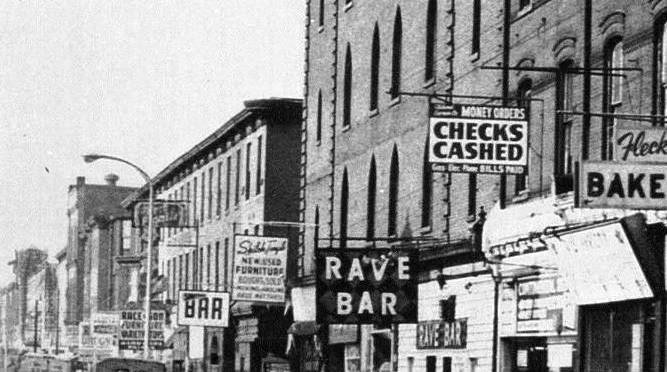
Rave Musical Bar

The Rave Musical Bar was located on the “Golden Strip.” According to The John Coltrane Reference, John Coltrane did a couple of gigs here with Daisy Mae and Her Hepcats in 1956.

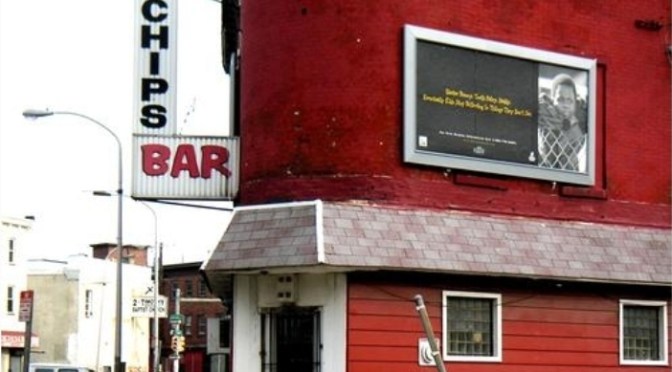
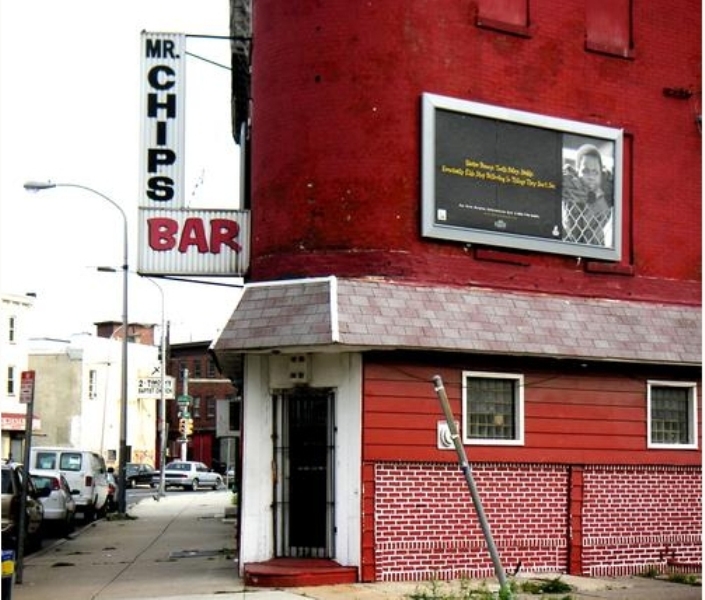
Mr. Chip’s Bar

Popular in the mid ‘90s, Mr. Chip’s Bar was located at 22nd Street and Ridge Avenue.

Mr. Chip's Bar

In a 1996 interview with the Philadelphia Inquirer saxophonist Jimmy Oliver recalled the bar was across from the former location of Irene’s Café:

I looked over there and thought to myself that it only took me 50 years to get across the street.

Oliver was a regular at Irene’s, along with Pearl Bailey.

King Cole Club

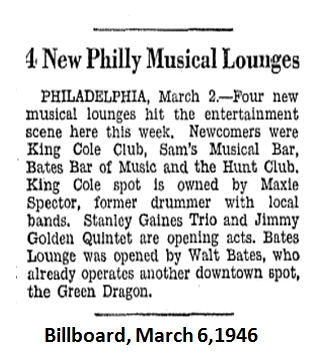
Located on the “Golden Strip,” Maxie Spector’s King Cole Club opened in March 1946.

King Cole Club, Columbia Avenue

Bill Hollis and his trio, the Hollis Hoppers, played there in July 1946.

Nite Cap

The Nite Cap was located at Ridge Avenue and Brown Street, near the legendary Blue Note.

Nite Cap Jazz Club - Cropped

Saxophonist Robert “Bootsie” Barnes, former Assistant Secretary of Union Local 274, played here.

Joe Pitts’ Musical Bar

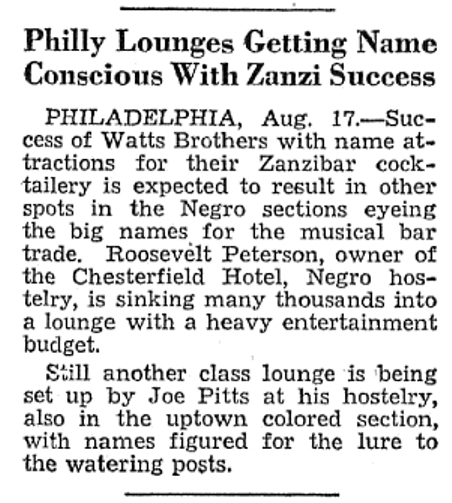
Joe Pitts’ Musical Bar was located in his “hostelry,” the Pitts Hotel. Joe Pitts’ and Watts’ Zanzibar were mentioned in the August 24, 1946 issue of Billboard.

Joe Pitts' Musical Bar

From Jazz.com:

Ray Bryant and [Benny] Golson played regularly in late 1946 with bassist Gordon “Bass” Ashford. They performed one night a week at Joe Pitt’s Musical Bar, and weekends at the Caravan Republican Club, for as long as six months at a stretch.

Read more

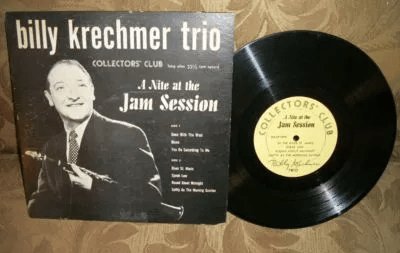
Billy Krechmer

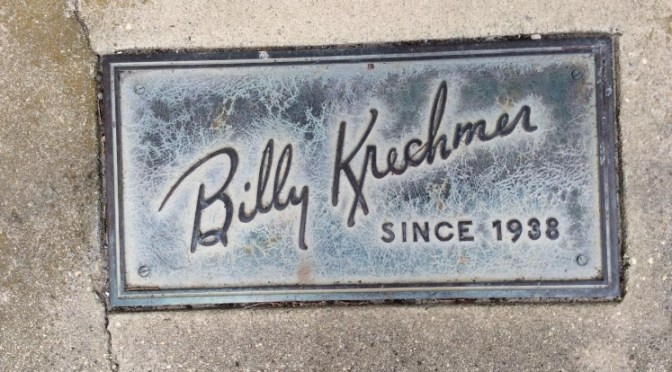
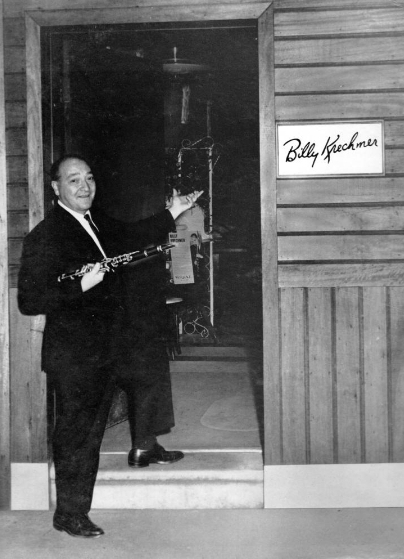
Jazz clarinetist Billy Krechmer opened his eponymous jazz club on November 3, 1938.

Photo courtesy of Carole Krechmer

Located in Center City, over the course of its nearly 30-year history (it closed in 1966), the tiny club was also known as Billy Krechmer’s Music City and the Jam Session.

In a piece for Hidden City Philadelphia, jazz historian and archivist Jack McCarthy wrote:

Krechmer’s club was known as a swing room in the early years. It was a place where big name jazz stars, regardless of color, would come to jam between sets or after their gigs at the major venues in town. Though, as the Dixieland revival took hold in the 1950s–and jazz began moving in directions that were less appealing to mainstream audiences–Krechmer’s became a bulwark of Dixieland. If you wanted to hear the latest in jazz from Dizzy Gillespie or Miles Davis, you had to go to clubs like Pep’s or the Showboat. If you wanted to hear Dixieland, you went to Billy Krechmer’s.

The original Krechmer’s was quite small–11 1/2 feet wide by 52 feet long, with a capacity of about 50 people. It was not a fancy place. In 1959, Krechmer purchased the adjacent property and broke through the walls, doubling the club’s size. He also added balcony seating. The club was very popular in the 1950s and early 1960s, often filled to capacity and attracting well-known players and fans of Dixieland.

Read more

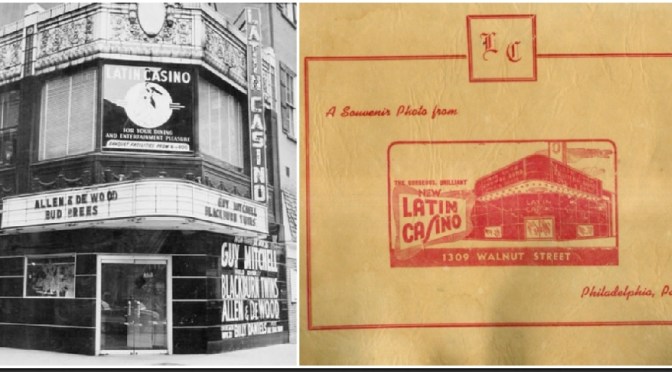
Latin Casino

The Latin Casino opened in 1951. Its expansive lower level seated 500 people and hosted a constellation of stars, including Harry Belafonte, Sammy Davis Jr., Dean Martin, Richard Pryor, Jerry Lewis, Milton Berle, Lena Horne, Pearl Bailey, Louis Armstrong, Lionel Hampton, Johnny Mathis and Joey Bishop. At the time, it was Center City’s most sophisticated nightspot

Latin Casino2

Latin Casino

In 1960, owners David Dushoff and Daniel “Dallas” Gerson moved the Latin Casino to Cherry Hill, New Jersey in response to customers’ complaints about parking and Philadelphia’s “blue” laws which banned the sale of alcohol after midnight Saturday.

Philadelphia Tribune columnist Alonzo Kittrels recalled:

Even if you never attended a show at the Latin Casino, I know its name brings to mind images of live entertainment. There were appearances by people such as Richard Pryor, the Temptations, Frank Sinatra and other members of the Rat Pack, Tom Jones, the Supremes and many other stars who made our evenings at this popular venue. The great R&B singer Jackie Wilson will always be associated with the Latin Casino because that was where he was stricken with a massive heart attack during a Dick Clark show. This happened while he was singing “Lonely Teardrops” and he never performed again.

Read more

Rendezvous Room

The Rendezvous Room was located on the first floor of the Hotel Senator. It was operated by Irvin Wolf from 1947 to 1955.

RendezVous Room - Featured Image

In a piece for the Tri-state Jazz Society, Rabbi Lou Kaplan wrote:

Located at 915 Walnut Street in the Hotel Senator, the Rendezvous was owned by jazz enthusiast Lee Guber. It opened January 22, 1947. After entering, one saw a long U-shaped bar on the right, behind which the bandstand was situated. To the left were tables for customers. More tables were available in the back of the room than in the narrow front section. A large photomural blowup of Pablo Picasso’s Three Musicians painting dominated a corner wall.

Many singers who later became big names made their first or an early start in the Rendezvous: Rosemary Clooney, Eydie Gorme, Joni James, Patti Page, to list a few. Later came such well-known vocalists as Thelma Carpenter, Ella Fitzgerald, Ella Mae Morse, Maxine Sullivan, Sarah Vaughan, and Lee Wiley. (I recall marveling one night at how Billie Holiday’s relaxed, syncopated phrasing reshaped each number.) Booked, too, were folk singers Harry Belafonte, Burl Ives, and Josh White; actor John Carradine; musicians Earl Hines, Gene Krupa, Meade Lux Lewis, Charlie Parker, and Artie Shaw; and many other “greats.”

While the Rendezvous engaged various types of entertainment, most prominent was Dixieland jazz. The number one jazz attraction was Bechet, who, for instance, was featured four times in one 12- month period, each for a minimum of two weeks. Actress Tallulah Bankhead, a Bechet devotee and friend, came to the club whenever possible if he was playing. One night she asked Guber, “Would you like to sell twice as much whiskey?” After the owner’s obvious reply, Bankhead, in her husky baritone voice, laughingly advised, “Well, try filling up the glasses!”

READ MORE

Ridge on the Rise

Back in the day, Ridge Avenue was a vibrant commercial corridor. The heart and soul of North Philadelphia was also an entertainment district. The Blue Note was at 15th Street and Ridge Avenue.

Blue Note

The Bird Cage Lounge was one block up at Ridge and 16th Street. I don’t know whether it was named after him, but Charlie “Bird” Parker played there. The legendary Pearl Bailey began her singing and dancing career at the Pearl Theater, which was at Ridge and 21st Street.

Pearl Theater Collage

Some of the jazz giants who roamed Ridge Avenue likely stayed at the Hotel LaSalle, which was close to the Pearl Theater. The hotel was listed in the The Negro Motorist Green Book. The Crossroads Bar at Ridge and Columbia Avenue (now Cecil B. Moore Avenue) was at the western tip of the storied “Golden Strip.”

Ridge began its steep decline in the aftermath of the 1964 Columbia Avenue race riots and construction of the Norman Blumberg Apartments public housing. Fast forward 50 years, Ridge is on the rise.

In 2014, the Philadelphia Housing Authority announced that transformation of the Blumberg/Sharswood neighborhood was its top priority. The Sharswood Blumberg Choice Neighborhoods Transformation Plan is a massive $500 million project that would, among other things, revitalize the Ridge Avenue corridor.

In an op-ed piece published in the Philadelphia Inquirer, PHA President and CEO Kelvin A. Jeremiah wrote:

The redevelopment of a community is about turning ideas into public policy and putting policy into action.

PHA’s revitalization efforts are a targeted, coordinated development model designed to maximize the economic benefits of neighborhood revitalization, not the piecemeal dispersed development model of the past. To transform communities into neighborhoods of choice, there must be good schools for every child, quality affordable housing for all families, and a vibrant small business commercial corridor. The challenge is turning the ideas and rhetoric into policy and practice.

In remarks before the National Trust for Historic Preservation’s recent conference, Marion Mollegen McFadden, Deputy Assistant Secretary for Grant Programs, U.S. Department of Housing and Urban Development, noted a community has both tangible and intangible assets:

I see preservation’s efforts to recognize and honor the cultural heritage of minority and ethnic groups as a valuable component of strong communities, in particular many of the communities that HUD serves. And I don’t just mean preservation of buildings and places, but also of diverse cultural ties and traditions, the intangible dimensions of heritage that together enrich us as a nation.

McFadden concluded with a quote from HUD Secretary Julián Castro:

History isn’t just a subject for books and documentaries. It’s alive and well in buildings, sites, and structures that shape our communities. They tell us who we are and where we come from – and it’s critical that we protect our past for present and future generations.

The Sharswood/Blumberg Choice Neighborhoods Transformation Plan raises the question: Does PHA value the area’s tangible and intangible assets that give the neighborhood its identity? If so, will a transformed Ridge Avenue preserve the neighborhood’s cultural heritage for current and future generations?