In 1979, President Jimmy Carter decreed that June would be Black Music Month. Each president since then has signed a proclamation recognizing the contributions of African American musicians and music. In 2009, President Barack Obama rebranded the annual celebration as “African-American Music Appreciation Month”
The legacy of African-American composers, singers, songwriters, and musicians is an indelible piece of our Nation’s culture. Generations of African Americans have carried forward the musical traditions of their forebears, blending old styles with innovative rhythms and sounds. They have enriched American music and captured the diversity of our Nation. During African-American Music Appreciation Month, we honor this rich heritage.
There’s no better place to get the celebration started than at the mecca of African American culture, the world famous Apollo Theater.
Philadelphia is the birthplace of the American democracy and a City of Firsts. While there are thousands of places that matter, only two percent of historic buildings are listed on the Philadelphia Register of Historic Places. Without historic designation, buildings can be demolished with impunity.
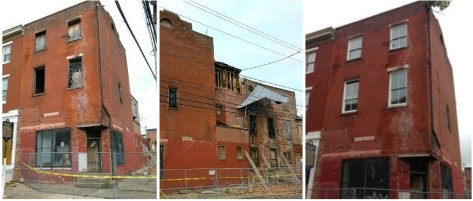
Sadly, historic designation provides little protection from demolition by neglect. Without court intervention, that fate may await the Robert Purvis House. Built circa 1859, this is the only extant home of the cofounder of the American Anti-Slavery Society and the Library Company of Colored People. Because of its association with a leading abolitionist, the house is a significant resource within the Spring Garden Historic District.
In October 1838, the voters of Pennsylvania approved a new state constitution that limited the power of the governor, prohibited the legislature from granting special favors to corporations, and ended life tenure for judges. The new constitution also stripped black Pennsylvanians of their right to vote, a right guaranteed under law since 1790. African Americans had since then lost the ability to vote in some Pennsylvania counties, including Philadelphia. But the constitutional disenfranchisement of black voters was yet another ominous sign of the rising power of the slaveocracy in the United States and of the growing fears of black political and economic power in the state of Pennsylvania.
The appeal quoted above was penned by Robert Purvis, then fast emerging as one of Philadelphia’s most prominent abolitionists. The year before, Purvis was the principal organizer of the Vigilant Association of the Philadelphia, founded to promote the anti-slavery movement and “to create a fund to aid colored persons in distress.” In the decades that followed he and his wife Harriet would use their home to harbor slaves escaping to Canada along the Underground Railroad and Purvis would act as a tireless leader in the struggle not just for the rights of African Americans, but for the equal rights of all Americans, regardless of their race, nationality, or sex.
Noris and Miguel Santiago purchased the Robert Purvis House on December 19, 1977. The couple did not maintain the historic landmark; instead, they racked up years of building code violations.
The slumlords have fought efforts to save the Robert Purvis House. Barbara Wolf has served on the board of the Spring Garden Community Development Corporation since its inception. Wolf said in an email:
The owners of this historic property have repeatedly and persistently failed to take the basic necessary steps, even when court ordered, to maintain and secure this building. Through willful neglect, they have caused the rear of the building to collapse, with resultant city’s demolition because of immediate safety concerns. The son of the owners in a recent court hearing even boldly stated that he wanted the remaining front block of the building to be demolished. This building survived in solid shape for over 100 years before the owners’ purchase in 1977. In a little over 40 years, the rear ell wall has collapsed and the remaining front is seriously deteriorated in an “unsafe” condition.
Wolf’s petition for the appointment of a conservator to restore the Robert Purvis House is supported by the City of Philadelphia. But right now, the property is tangled in a legal morass in federal bankruptcy court. As the result of neglect by financially and morally bankrupt scoundrels, a building that holds stories of organized resistance to slavery may be erased from public memory.
“The Jazz Ambassadors” tells the story of when the U.S. State Department asked jazz icons to travel the world as cultural ambassadors during the Cold War. Their mission was at the intersection of race, civil rights and public diplomacy.
The film premieres on May 4, 2018 on PBS. Check your local listings.
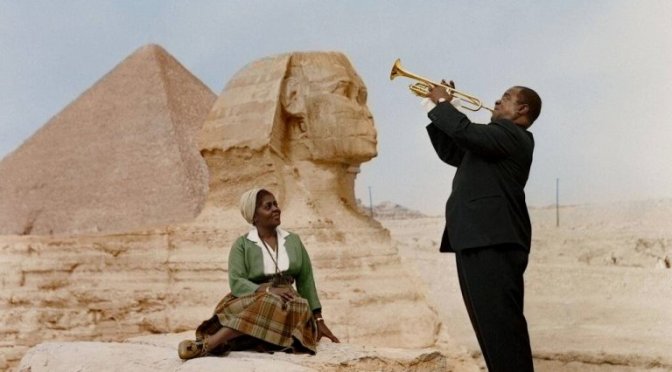
During the Jim Crow era, Louis Armstrong asked, “What did I do to be so black and blue?”
In 2018, men in blue uniforms arrested two African Americans whose only sin is in their skin. Their offense – waiting while black at Starbucks.
@Starbucks The police were called because these men hadn’t ordered anything. They were waiting for a friend to show up, who did as they were taken out in handcuffs for doing nothing. All the other white ppl are wondering why it’s never happened to us when we do the same thing. pic.twitter.com/0U4Pzs55Ci
While implicit bias led to the 911 call, Police Commissioner Richard Ross is complicit in the criminalization of black men. In a video posted on Facebook, Ross said:
They did a service that they were called to do. And if you think about it logically, that if a business calls and they say that someone is here that I no longer wish to be in my business, [police officers] now have a legal obligation to carry out their duties.
There is nothing logical about implicit bias.
In an open letter, Starbucks CEO Kevin Johnson said the arrest was “reprehensible”:
By now, you may be aware of a disheartening situation in one of our Philadelphia-area stores this past Thursday, that led to a reprehensible outcome.
I’m writing this evening to convey three things:
First, to once again express our deepest apologies to the two men who were arrested with a goal of doing whatever we can to make things right. Second, to let you know of our plans to investigate the pertinent facts and make any necessary changes to our practices that would help prevent such an occurrence from ever happening again. And third, to reassure you that Starbucks stands firmly against discrimination or racial profiling.
In the coming days, I will be joining our regional vice president, Camille Hymes—who is on the ground in Philadelphia—to speak with partners, customers and community leaders as well as law enforcement. Most importantly, I hope to meet personally with the two men who were arrested to offer a face-to-face apology.
I am heartbroken to see Philadelphia in the headlines for an incident that — at least based on what we know at this point — appears to exemplify what racial discrimination looks like in 2018.
However, Kenney is not “heartbroken” enough to launch an independent investigation of the incident. Instead, the Philadelphia Police Department is investigating itself. A fact noted by the Washington Post:
Kenney said little about the response of his police force beyond mentioning an ongoing review from Police Commissioner Richard Ross.
In his Facebook monologue, Ross said the police department sends all new recruits to the National Museum of African American History and Culture and the United States Holocaust Memorial Museum because “we want them to know about the atrocities that were, in fact, committed by policing around the world.”
The Commissioner encouraged us to “make our own value judgment.” So here’s mine — Negro, please! Did you send new recruits to visit the African American Museum in Philadelphia’s exhibit, “Arresting Patterns: Perspectives on Race, Criminal Justice, Artistic Expression, and Community?” The museum is located one block from police headquarters.
Ross declared his “officers did absolutely nothing wrong” in arresting two black men whose only offense is the color of their skin. But he will not have the last word.
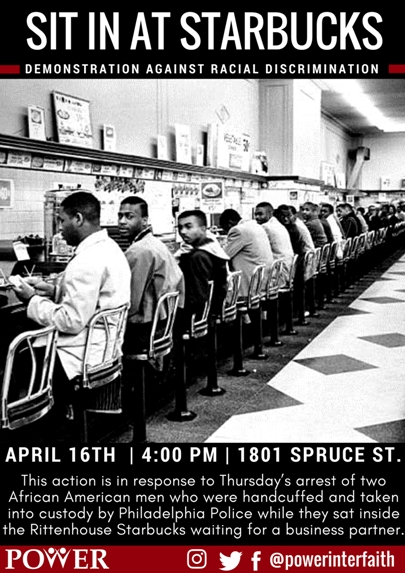
POWER, a coalition of clergy leaders representing more than 50 interfaith congregations in Southeastern and Central Pennsylvania, will hold a march and sit-in on Monday, April 16. Protesters will gather at 3:30pm at The Philadelphia Ethical Society, 1906 Rittenhouse Square. From there, they will march and occupy the Starbucks located at 1801 Spruce Street from 4-6pm.
Commissioner Ross, just so you know, they will not make any purchases. So get your paddy rollers ready.
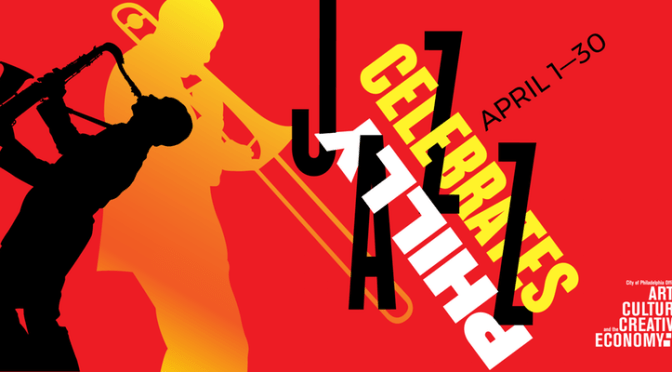
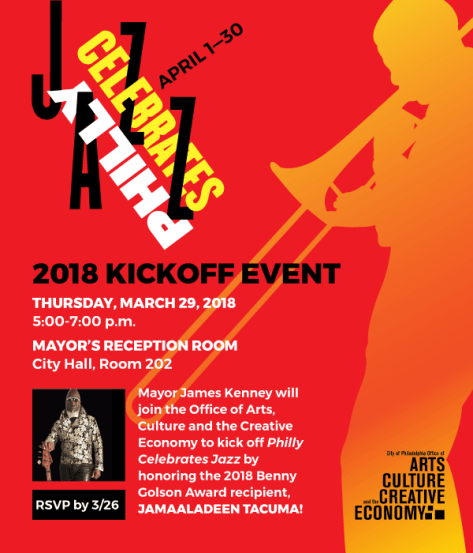
April is Jazz Appreciation Month. There is a lot of appreciation for jazz in the City of Brotherly Love and Sisterly Affection so Philly is getting the party started early. On March 29, Mayor James Kenney will join the Office of Arts, Culture and the Creative Economy to kick off Philly Celebrates Jazz by honoring the 2018 Benny Golson Award recipient, fashion-forward bassist Jamaaladeen Tacuma.
Jamaaladeen Tacuma is celebrated internationally for his creatively free and funky approach to the electric bass. His innovative style caught Ornette Coleman’s ear, and he became the first bassist in Coleman’s electric band, Prime Time, touring and recording with the group throughout the 1970’s and 80’s. Viewed as one of the most distinctive bassists of his generation, Tacuma is credited for redefining the potential of the instrument. Tacuma debuted as a bandleader, composer, and arranger in 1983 with the album Showstopper, going on to develop compositions that blend Prime Time’s elaborate harmonies with engaging melodies. His 1988 album Jukebox was nominated for a Grammy Award in 1989; in 2011 his ongoing achievements were recognized by the award of a Pew Fellowship in the Arts; he is the 2017 recipient of Philadelphia Clef Club of Jazz Best Bassist Award. Tacuma’s artistic and experimental approach to jazz music has been and continues to be a source of great pride for the Philadelphia jazz scene.
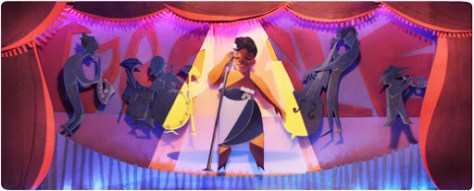
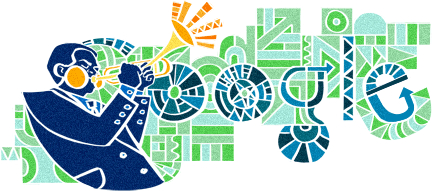
We all have seen Google Doodles. The drawings “celebrate holidays, anniversaries, and the lives of famous artists, pioneers, and scientists.”
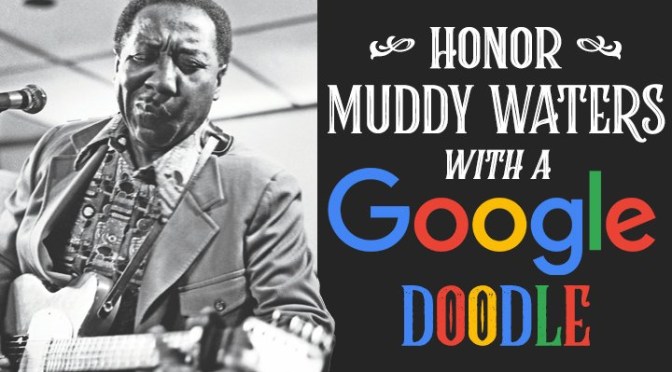
Google accepts suggestions from the public. You can help one of the most celebrated bluesmen, Muddy Waters, get a Google Doodle.
American Blues Scene, a popular website, is petitioning Google to create a Muddy Waters doodle:
No figure has inspired an international music explosion quite like blues musician McKinley “Muddy Waters” Morganfield, who left a log cabin in a Mississippi cotton field to break much greater ground with his inimitable guitar and vocal style. After more than 100 years, Muddy Waters’ continuing impact has proven the blues singer to be one of the most significant figures in the history of American Music, inspiring generations of artists and cultural movements like Folk, Chicago Blues, and Rock n Roll.
You can sign the petition here. You can also email Google at proposals@google.com and tell them about the “Hoochie Coochie Man.”
The blues master is memorialized on a Chicago high-rise.
With your help, Muddy Waters will be immortalized for all Google users.
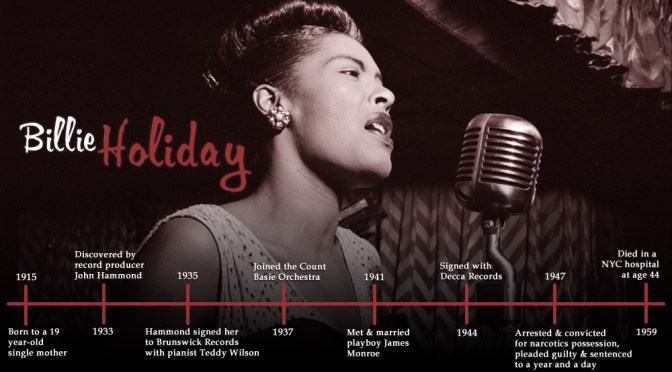
March is Women in Jazz Month, a time to celebrate the contributions of women to jazz. Few – male or female – have contributed more to the jazz canon than Billie Holiday. In the decades since her death, Lady Day has been celebrated in film, song, books, fashion and art.
ClickitTicket, a resale marketplace, has created a timeline of Billie Holiday’s life, beginning with her birth in Philadelphia in 1915 and ending with her death in a New York City hospital in 1959.
An excerpt:
Billie Holiday’s voice was a little thin and somewhat limited. She had no technical training; she couldn’t even read sheet music.
Yet, Holiday is one of the greatest vocalists of all-time.
What she lacked in power and tone, she made up for it with the ability to tell a story and emote. Every song she sang she made her own.
Holiday was a true artist who had a profound impact on both jazz and pop music.
She made a huge impact on countless artists including Frank Sinatra.
“Lady Day is unquestionably the most important influence on American popular singing in the last twenty years,” explained Ol’ Blue Eyes to Ebony magazine in 1958.
Despite personal demons, abusive romantic relationships, and the specter of racism, Holiday achieved commercial and artistic success during her lifetime.
Since her death in the late 1950s, generations of musicians have turned to her recordings for inspiration and enlightenment.
On November 11, 1966, John Coltrane gave his final performance in Philadelphia at Mitten Hall.
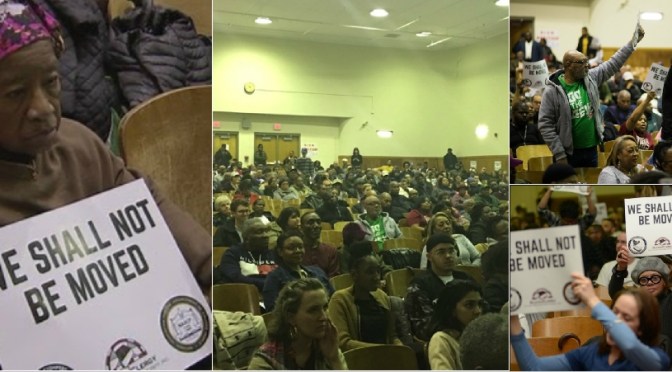
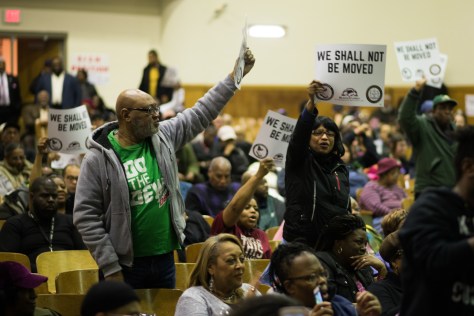
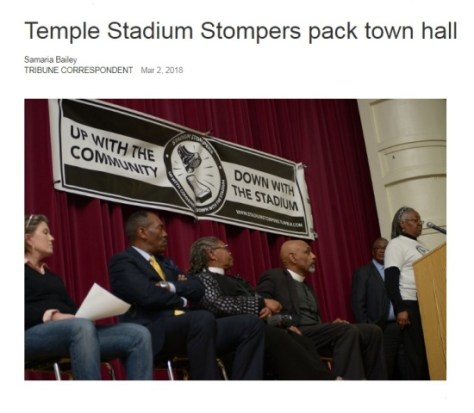
Mitten Hall will again be filled with joyful noise as the community tells Temple University: We Shall Not Be Moved.
Some background: On March 6, Temple will hold an “informational town hall” to discuss its proposal to put a 35,000-seat football stadium in the heart of an African American residential neighborhood. Temple has been planning this project for nearly two years. President Richard Englert claims Curtis J. Moody, lead architect with Moody Nolan, met with community members “to hear their concerns and has worked to integrate those comments into the designs.” Unless Moody has designed a stealth stadium, there is no way he has integrated the concerns of a community that understands a football stadium is displacement by design.
Temple’s first-ever public forum comes on the heels of a community town hall meeting convened by Black Clergy of Philadelphia and Vicinity, Philadelphia NAACP and Stadium Stompers.
Between chants of “We Shall Not Be Moved,” there was testimony from diverse stakeholders, including Mary Stricker, a sociology professor. Prof. Stricker noted the Faculty Senate passed a resolution by a 24-1 vote opposing Temple’s fantasy football scheme:
I really think this is a bad idea not only because it is a financial risk, but also because it’s in the worst interest of the surrounding community. Temple owes something to the community that has been hosting it for all these years.
Stricker added:
Temple Faculty say no new stadium. We are strong, united and determined in this fight.
Pastor Jay Broadnax, president of Black Clergy of Philadelphia and Vicinity, said:
We love football but we’re calling a timeout. We love football but the people in this community will not be a football, passed, punted, kicked and carried across the city line in order for institutions to score profit points or get land grab wins.
For 40 years, they have disinvested in North Philadelphia. You couldn’t get a mortgage. You couldn’t get a loan. You couldn’t get a home improvement loan. You couldn’t get a loan to start a business. But however today, they got all the money to make a stadium right in your backyard.
There’s something wrong with that. Whenever they start to pour money into a neighborhood, they want to push out black folks. … Race is dug deep in this thing. Race is a factor in this thing. This stadium is about moving black folks from North Philadelphia.
Rev. William Moore, pastor of Tenth Memorial Baptist Church, captured the mood of the hundreds who turned out in the rain for the community meeting. Echoing a local resident who said the stadium design is akin to “putting a whale in a goldfish bowl,” Rev. Moore said:
If it doesn’t fit, you must acquit. If it doesn’t fit, don’t force it.
Like Philadelphia, Pittsburgh once had a robust jazz scene with legendary venues, including the Granada Theater and the Crawford Grill.
Pittsburgh produced jazz greats such as Art Blakey, Billy Strayhorn, Mary Lou Williams, George Benson, Ahmad Jamal, Stanley Turrentine, Billy Eckstine and Kenny Clarke.
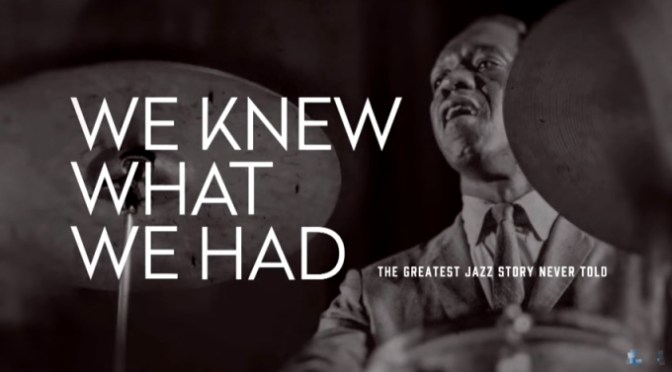
Thanks to a new documentary, “We Knew What We Had: The Greatest Story Never Told,” the world will know what Pittsburgh had.
The one-hour documentary includes live performance clips of the Jazz Masters, interviews and archival photographs. As important, the filmmakers contextualize Pittsburgh’s jazz culture by exploring social conditions and historical events.
“We Knew What We Had: The Greatest Story Never Told” will air in February. For more information and air dates, visit their website.











 All That Philly Jazz