The Church of the Advocate became a center of activism for the Civil Rights Movement embracing the cause of African American and women’s rights. It was the site of several nationally significant events, including the National Conference of Black Power (1968) and the Black Panther Convention (1970).
In the 1960s, Father Paul Washington invited musicians to come to the church for jam sessions which were held weekly on Tuesday. Tenor saxophonist Bootsie Barnes said the Church of the Advocate would be packed.
A collection of murals records the “stations” of the Civil Rights Movement.
These murals draw on Old Testament verses to dramatically illuminate parallels in African American history. Together, the medieval revival presentation of the building and the modern murals document the critical social role played by America’s inner city churches.
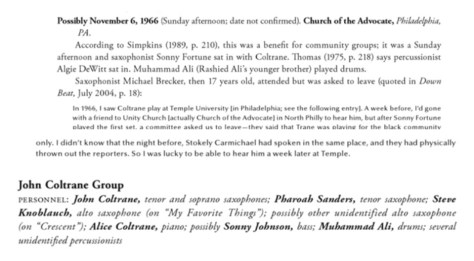
John Coltrane’s next-to-last performance in Philadelphia was held here on November 6, 1966. In an interview with DownBeat, Michael Brecker said he was asked to leave because the concert was for the black community.
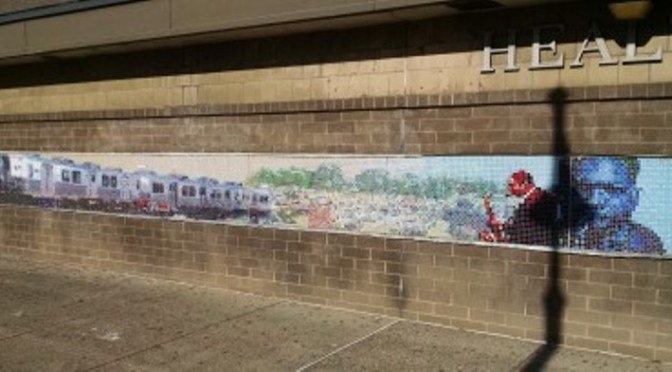
Giant Steps depicts seven key album covers, tracing John Coltrane’s career from his work with Miles Davis to his own compositions, and his great masterpiece A Love Supreme. Each mosaic was preceded by a multimedia educational program presented by the John Coltrane Cultural Society.
When 18 year old John Coltrane moved to Philadelphia, in 1943 the nation’s third largest city, he entered a fundamentally different world from his hometown of High Point, N.C. Like many African-Americans who migrated to major cities of the North, Coltrane joined older family members and friends already settled there. They lived in an apartment at 1450 N. 12th Street between Jefferson and Master Streets in an area since demolished for the Yorktown Urban Renewal project.
In 1952, at the age of twenty-six, with the benefit of a G.I. loan, John Coltrane bought for himself, his mother, his aunt and his first cousin the North 33rd Street property. Coltrane lived here from 1952 until 1958. It was a big, rowhouse, built for a well-to-do middle class at the turn of the 19th century and a huge step up from the cramped quarters in a deteriorating area of town where the family had been living. Coltrane owned and lived in this home longer than any other during his legendary career as a composer and saxophonist.
In 1999, the John Coltrane House was designated a National Historic Landmark, a recognition accorded to places that have “exceptional value or quality in illustrating or interpreting the heritage of the United States.”
The recognition attests to the value of the house. The building is structurally sound but it needs some repairs. Money is needed to preserve the John Coltrane House for current and future generations.
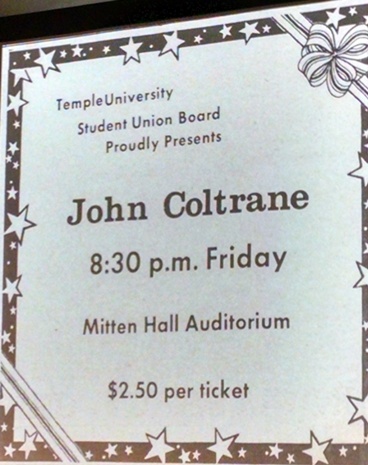
Yasuhiro Fujioka, founder of the John Coltrane House of Osaka, uncovered the long lost audiotape of John Coltrane’s last performance in Philadelphia. The November 11, 1966 concert was aired live on WRTI, Temple University’s then-student run radio station.
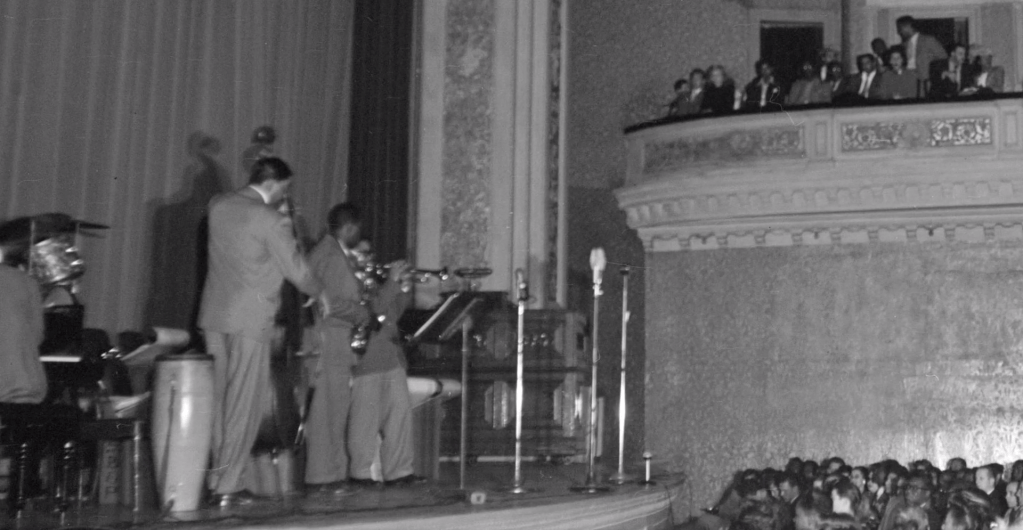
Opened in 1857, the Academy of Music is the country’s oldest concert hall and opera house. The “Grand Old Lady of Broad Street” has welcomed jazz, blues and R&B legends, including Duke Ellington, Billie Holiday, Lee Morgan, Count Basie, Louis Armstrong, Miles Davis, Shirley Horn, Ray Charles, Aretha Franklin and James Brown.
On June 5, 1945, the Dizzy Gillespie Quartet, featuring Charlie Parker, was in the house. Seated in the next-to-last row were Benny Golson and John Coltrane.
When we heard – John and I, when we first heard Charlie Parker and Dizzy Gillespie] – I told you he was sounding like Johnny Hodges – our lives changed that night. We had never heard any music like that. Never. We were screaming like these Beatles groupies, when they used to hear the Beatles. They played this Latin tune. We never heard any Latin tune like that in our lives. The Latin tunes that we played were like Lady of Spain, the stock arrangements, My Shawl. But this Latin thing, we had never heard it. Then they played an interlude, and they made a break, and Charlie Parker made a pickup by himself. Usually it was two bars, but he did it four bars, double-time. We were going crazy. We almost – of course we were up there with the cheap seats – we almost fell over the balcony. It was A Night in Tunisia. We never heard that before. Oh my goodness.
Golson expounded on that fateful night in his autobiography, Whisper Not: The Autobiography of Benny Golson:
The concert was staged at the Academy of Music, home of the Philadelphia Orchestra. We took our places, greatly excited, in the cheap seats in the uppermost level. Diz’s band kicked off with the strangest Latin-sounding tune we had ever heard. John thought it sounded “like snake charmer’s music”: Dizzy’s “A Night in Tunisia” was weirder than anything we had heard before, but intriguing. The band moved through the melody, dove into an interlude, then opened into a bravura set of riffs, or glissandi, a sustained high-octane break by the alto player, Charlie Parker. To us, the sound was way out there. Parker was dressed in a double-breasted suit with all of the buttons closed. He looked like an adult stuffed into his grade school graduation suit. …
We both nearly fell over the balcony rail, all the cells and nerves in our bodies wild with abandon. Their music was crazy and we went into an exuberant delirium, doubtless a form of higher awareness and pure joy. John tried to crawl up my gyrating body while I was grabbing onto him with barely contained amazement. We were both screaming like schoolgirls. We had heard strong performances in our young lives, but nothing like this. This was beyond “good.” It was completely new, innovative, and profound. We were drunk with happiness and bewilderment. I felt like crying. We didn’t know then, but our musical world changed that night.
Published by Temple University Press, Golson’s autobiography is available for purchase here.
The Woodbine Club was a private membership club that held regular weekend entertainment. The club was located on North 12th Street between Thompson and Master, less than 500 feet from John Coltrane’s apartment on North 12th Street.
Regular bars were open from 9pm to 2am. Jazz musicians would hang out at the Woodbine Club from 3am to 7am. Musicians would have jam sessions where they would hone their craft and network to get gigs.
I think the first time I heard Trane was around 1954. There was a place on 12th Street called the Woodbine Club. During that period people like Jimmy Oliver, Jimmy Heath, Red Garland, Shuggie Rose, Philly Joe Jones, those were the pioneer musicians during that period. And it was a place, an after hours place where they had entertainment, say from say twelve o’clock until around five in the morning. That was like Friday, Saturday, and Sunday. It was a sort of collaboration place where all of the musicians would come and exchange ideas and jobs. So this particular night it was Hassan Ibn Ali, Donald Bailey – some very fine percussion. They had sort of invited me along to go with them. And Trane, Jimmy Oliver, Jimmy Heath, Wilbur Cameron, Bill Barron, all of the musicians came there after they got off work and that was the most enlightened experience in my whole life, I think, of seeing so many wonderful musicians come together collectively and exchange ideas as well as perform.
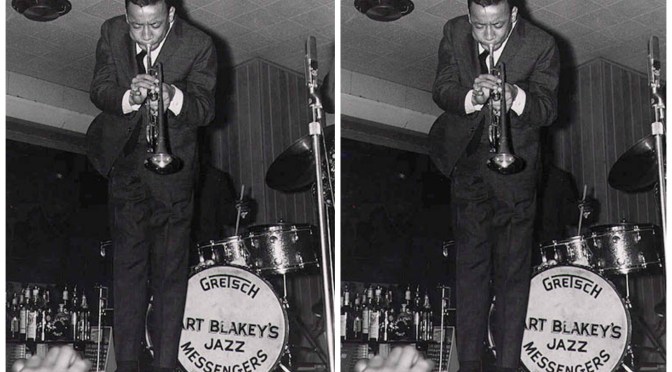
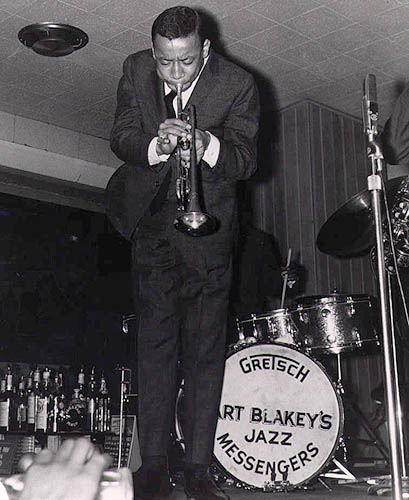
Back in the day, musicians used to “walk the bar.” Philly native Lee Morgan was among those “honking and stepping.”
In an interview with the Smithsonian Jazz Oral History Project, NEA Jazz Master and Philly native Benny Golson said: “I caught my boy John Coltrane on the bar.” In a 2009 piece, jazz critic Marc Myers also shared the story:
In 1954, Coltrane’s expanding heroin and alcohol addiction cost him playing jobs, most notably a significant one with alto saxophonist Johnny Hodges. After moving back to Philadelphia, Coltrane was forced to play with local R&B bands to make ends meet. In some of these bands, he had to honk away on the tenor while walking along the bar. One night, he saw childhood friend and tenor saxophonist Benny Golson enter the club. Mortified, Coltrane climbed off the bar and walked out for good.
The Smithsonian interviewer asked Golson where the tradition was started:
I don’t know where it started. It didn’t start with the jazz artists, per se. It started with one of the entertainers. An entertainer’s plot is to do or to second-guess what the audience wants to hear. Yeah, I got involved in that. I did some crazy stuff when I was doing all that stuff. You do what you think is going to entertain them. It’s going to bring acclaim to what you’re doing. Yeah, what’s more ridiculous than getting up on the bar where the drinks are and start playing your low B-flats no matter what key you’re in, just honking. We call that honking and stepping. They’re applauding. Ain’t nothing happening. Stepping over those drinks.
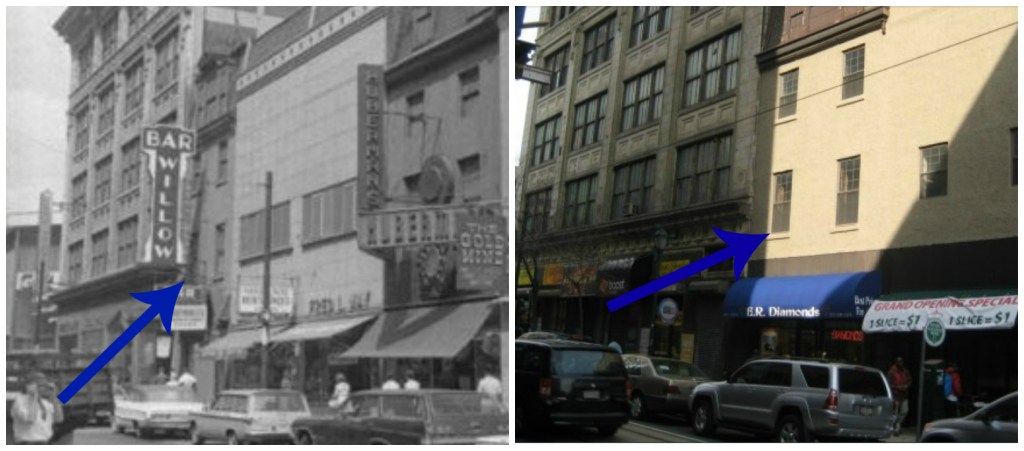
Located on the second floor above the Willow Bar, the Down Beat Swing Room was the first racially integrated jazz club in Center City. The building in which the Down Beat was located is still there.
The Down Beat was owned by jazz impresario Nat Segall. It was open from 1939 to circa 1948. Charlie Parker came in from New York City “every other week or so.” He was paid $25 a night to jam with Dizzy Gillespie and other jazz greats-in-the-making.
Jazz musicians would hang out at the Down Beat between shows at the Earle Theater.
In his autobiography, You Only Rock Once, Jerry Blavat, “the Geator with the Heator,” recounted:
Nat had owned a club called Downbeat around the corner from the Earle Theater, where Billie Holiday, Charlie Parker, and other giants of jazz performed. After Holiday was busted for narcotics one night, the police started raiding the place on a regular basis, and Nat was forced to close it down—but not before he and Bob [Horn] produced a series of jazz shows at the Academy of Music.
In a Smithsonian jazz oral history interview, National Endowment for the Arts Jazz Master and Philly native Benny Golson shared a story about the Downbeat and drummer Philly Joe Jones:
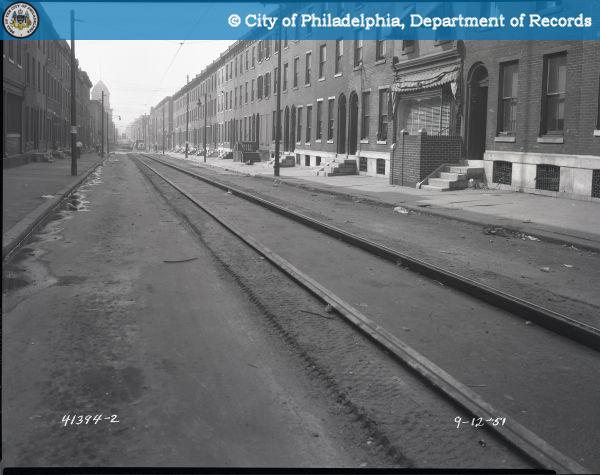
For a while they had a policeman on every street car, stand up at the front with his gun and stuff. It was so bad. During that time – because they said, you don’t have any black motormen and conductors on the streetcar. Philly Joe got a job.
Do you remember that? He got a job as a motorman, driving a streetcar. Route number 23. The longest route in Philadelphia, from south Philadelphia, all the way through north Philadelphia, all the way through Germantown. Max Roach used to come over and ride a route with him, and talk.
Philly Joe’s route came right up 11th Street, where the Down Beat Club was, on 11th Street. Philly came up one night, stopped the car in front of the Down Beat, opened the doors, got off, and went up, and took a club. Now all the people on the streetcar, they’re going crazy. He goes up into the – no, he’s not going to stay and hear a set, but he went up to do something. When he came back, boy, they were irate. He got on the streetcar and started up like he did – never heard it – like this was a matter – who would do something like that? Stop a streetcar and get off and go into a club, and everybody’s on the streetcar, waiting. Only Philly Joe would have done something like that. Only Philly would have done that.










 All That Philly Jazz