Tag Archives: #BlackCultureMatters

Black History Month 2016

Here at All That Philly Jazz, we celebrate black history 365. Outside the African American community, black history is recognized, if at all, in February, the shortest month.

For the first time, the New York Times is sharing unpublished photos from its archives:

Hundreds of stunning images from black history, drawn from old negatives, have long been buried in the musty envelopes and crowded bins of the New York Times archives.

None of them were published by The Times until now.

Were the photos — or the people in them — not deemed newsworthy enough? Did the images not arrive in time for publication? Were they pushed aside by words here at an institution long known as the Gray Lady?

[…]

Photographers for The Times captured all of these scenes, but then the pictures and negatives were filed in our archives, where they sat for decades.

This month, we present a robust selection for the very first time.

Every day during Black History Month, we will publish at least one of these photographs online, illuminating stories that were never told in our pages and others that have been mostly forgotten.

It’s better late than never.

For more information, visit Unpublished Black History.

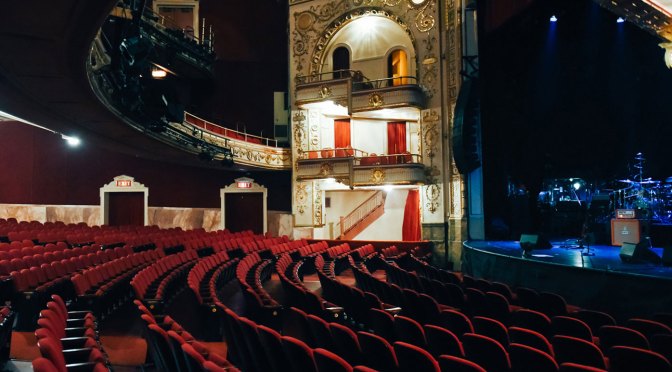
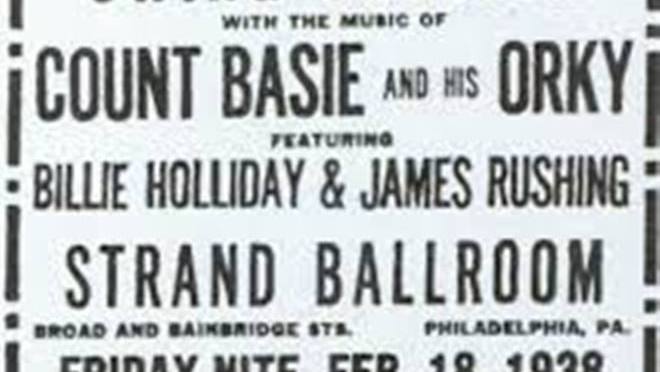
Strand Ballroom

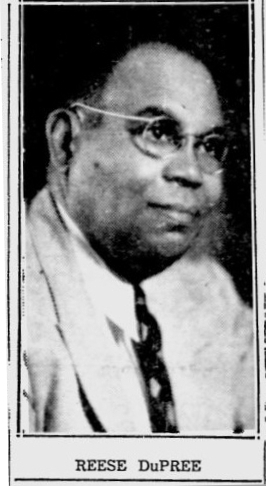
Located at Broad and Bainbridge Streets, the Strand Ballroom was managed by legendary dance promoter Reese DuPree in the 1930s and ‘40s.

Created with GIMP

In 1938, Bill Doggett and his orchestra played here every Tuesday to Saturday.

Elate Ballroom

The Elate Ballroom was located on the second floor of 711 S. Broad Street. The Elate Club Ballroom was on the ground floor.

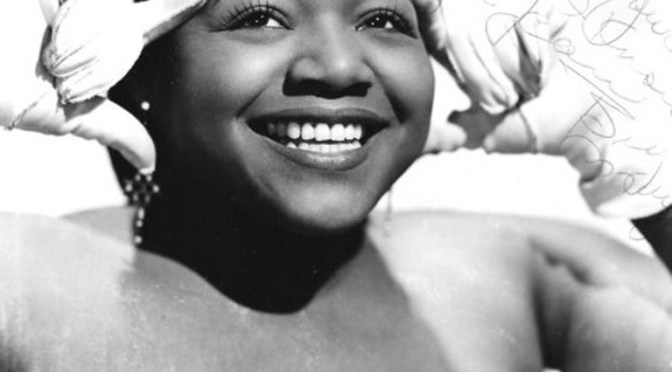
Joe Webb and his Decca Recording Orchestra featuring Big Maybelle played here at the “Shine on the Harvest Moon Dance” presented by legendary dance promoter Reese DuPree.

Elate Ballroom - Reese DuPree v2

John Coltrane biographer Lewis Porter wrote:

Coltrane was hired when [Joe] Webb played for dancers in Philadelphia’s Elate Ballroom at 711 South Broad Street on Friday, September 13, 1946. Cal Massey (1928-72), a trumpeter from Pittsburgh, called “Folks” after his mother’s maiden name, happened to walk by when the band was playing and he ended up in the trumpet’s section. A lifelong friendship between Massey and Coltrane began as the two toured the country with the Webb band.

Porter, Lewis. John Coltrane: His Life and Music. Michigan: The University of Michigan Press, 1998.

Palais Royal

Opened in 1919. the Philadelphia Tribune described the Palais Royal as “the finest colored ball room in America.”

Palais Royal - 711 S. Broad Street - Arrow

On May 4, 1937, the Chick Webb Orchestra, featuring Ella Fitzgerald, played a dance here.

Palais Royal Cropped

In the 1940s, the Palais Royal was the home of the Elate Ballroom, the Elate Club and the Sydney King School of Dance.

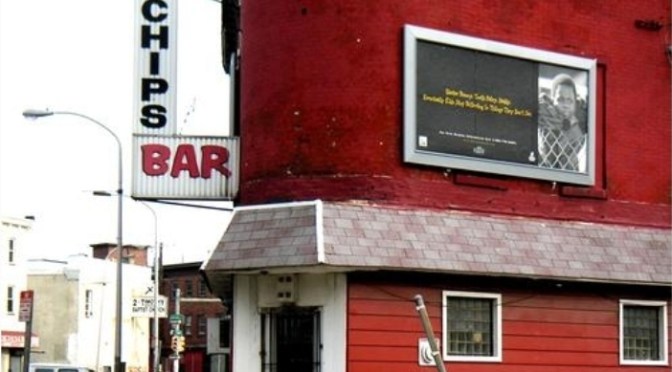
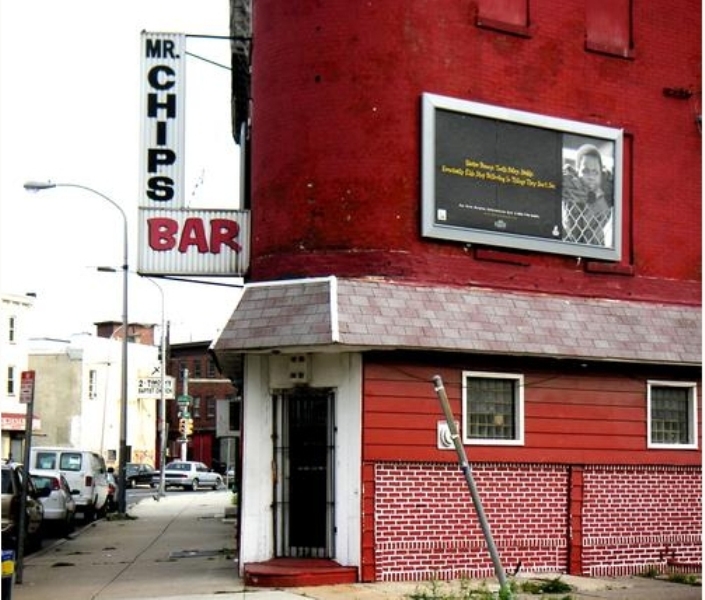
Mr. Chip’s Bar

Popular in the mid ‘90s, Mr. Chip’s Bar was located at 22nd Street and Ridge Avenue.

Mr. Chip's Bar

In a 1996 interview with the Philadelphia Inquirer saxophonist Jimmy Oliver recalled the bar was across from the former location of Irene’s Café:

I looked over there and thought to myself that it only took me 50 years to get across the street.

Oliver was a regular at Irene’s, along with Pearl Bailey.

King Cole Club

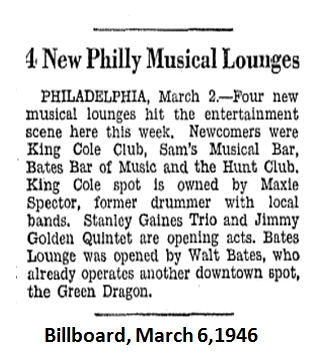
Located on the “Golden Strip,” Maxie Spector’s King Cole Club opened in March 1946.

King Cole Club, Columbia Avenue

Bill Hollis and his trio, the Hollis Hoppers, played there in July 1946.

Nite Cap

The Nite Cap was located at Ridge Avenue and Brown Street, near the legendary Blue Note.

Nite Cap Jazz Club - Cropped

Saxophonist Robert “Bootsie” Barnes, former Assistant Secretary of Union Local 274, played here.

Joe Pitts’ Musical Bar

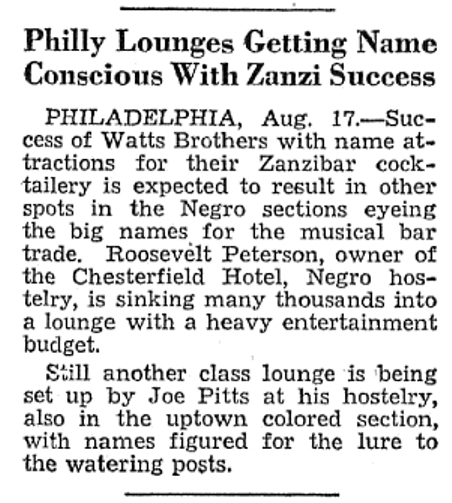
Joe Pitts’ Musical Bar was located in his “hostelry,” the Pitts Hotel. Joe Pitts’ and Watts’ Zanzibar were mentioned in the August 24, 1946 issue of Billboard.

Joe Pitts' Musical Bar

From Jazz.com:

Ray Bryant and [Benny] Golson played regularly in late 1946 with bassist Gordon “Bass” Ashford. They performed one night a week at Joe Pitt’s Musical Bar, and weekends at the Caravan Republican Club, for as long as six months at a stretch.

Read more

Latin Casino

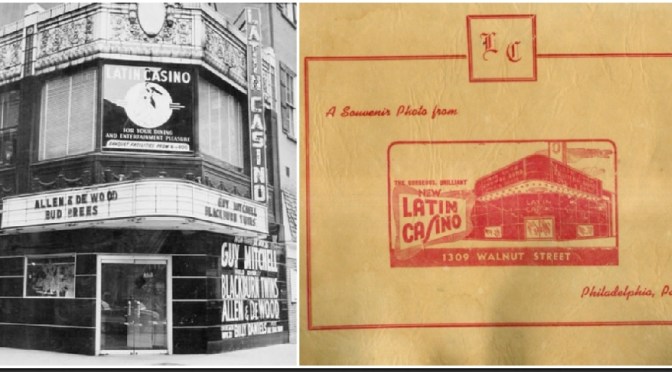
The Latin Casino opened in 1951. Its expansive lower level seated 500 people and hosted a constellation of stars, including Harry Belafonte, Sammy Davis Jr., Dean Martin, Richard Pryor, Jerry Lewis, Milton Berle, Lena Horne, Pearl Bailey, Louis Armstrong, Lionel Hampton, Johnny Mathis and Joey Bishop. At the time, it was Center City’s most sophisticated nightspot

Latin Casino2

Latin Casino

In 1960, owners David Dushoff and Daniel “Dallas” Gerson moved the Latin Casino to Cherry Hill, New Jersey in response to customers’ complaints about parking and Philadelphia’s “blue” laws which banned the sale of alcohol after midnight Saturday.

Philadelphia Tribune columnist Alonzo Kittrels recalled:

Even if you never attended a show at the Latin Casino, I know its name brings to mind images of live entertainment. There were appearances by people such as Richard Pryor, the Temptations, Frank Sinatra and other members of the Rat Pack, Tom Jones, the Supremes and many other stars who made our evenings at this popular venue. The great R&B singer Jackie Wilson will always be associated with the Latin Casino because that was where he was stricken with a massive heart attack during a Dick Clark show. This happened while he was singing “Lonely Teardrops” and he never performed again.

Read more