Jazz Appreciation Month 2015 is now in the archives. From Philadelphia to Paris, fans turned out to celebrate America’s classical art form.
But there are early warning signs that all is not well. According to Nielsen‘s 2014 Year End Report, jazz is tied with classical music as the “least consumed” music in the U.S. Jazz represented just 0.3% of all music streamed in 2014, a reflection of its aging audience.
To expand the audience for jazz, it’s not enough to simply showcase young artists. In an interview with JUMP magazine, Philadelphia Jazz Project Director Homer Jackson observed:
The point about young people that is really critical, is that if we have so many young artists working in jazz, why aren’t they able to engage young people themselves? Most young artists I know do not have a huge youth audience themselves. That’s really critical because at some point the elders are gonna be gone and so who is going to be in the audience? So, I challenge young artists to come up with some strategies and I challenge the curators to come with strategies to help young artists to be able to present their stuff.
If we just add some ingredients from the rest of the entertainment world, people will view jazz as fun once again, and they will come back. If millions didn’t love the music today, there wouldn’t be what we call a catalog, and my father, Thelonious Sphere Monk, Louis Armstrong, Ella Fitzgerald, Miles Davis, Dave Brubeck, John Coltrane, Buddy Rich and so many more, would have disappeared. We wouldn’t have had an International Jazz Day concert streamed to 1.2 billion people in 2013, and 2.5 billion people in 2014. None of that would be possible if there wasn’t an inherent love of this music, ironically by Americans. We often love ourselves, and don’t know it.
So I say to all my friends in jazz — musicians, promoters, club owners, listeners, and everybody — let’s bring back the fun. Let’s go big. That will bring the attention, and the money will follow.
To borrow a phrase, your audience just wanna have fun.
In November 2011, the United Nations Educational, Scientific and Cultural Organization (UNESCO) officially designated April 30 as International Jazz Day in order to highlight jazz and its diplomatic role of uniting people in all corners of the globe. International Jazz Day is chaired and led by Irina Bokova, UNESCO Director General, and legendary jazz pianist and composer Herbie Hancock, who serves as a UNESCO Ambassador for Intercultural Dialogue and Chairman of the Thelonious Monk Institute of Jazz.
The Institute is the lead nonprofit organization charged with planning, promoting and producing this annual celebration.
The official trailer for the Netflix-produced documentary “What Happened, Miss Simone?” is now available:
The two minute clip is a veritable bombardment of vintage Nina Simone footage, and suggests the feature will come loaded with amazing scenes of her in concert, before the recording studio’s mic, on tour and in the streets, fighting tirelessly for the justice she so knew to be so necessary. What we’re promised by the trailer is a portrait of the artist as an imperfect woman–a genius musician and freedom fighter chased by terrible demons. Nina Simone was a woman who suffered, in spite of the joy and knowledge she brought to so many around her.
In 1936, Victor H. Green, a postal worker and civil rights activist, published the first edition of The Negro Motorist Green Book, a travel guide to navigate Jim Crow laws in the South and de facto segregation in the North.
The “Green Book,” as it was called, lists hotels, tourist homes, restaurants, nightclubs, beauty parlors, barber shops and other services. Philadelphia hotels in the 1949 edition include the Attucks, Chesterfield and Douglass.
The list of clubs includes Emerson’s Tavern, the setting for the Tony Award-winning play, “Lady Day at Emerson’s Bar and Grill,” Café Society and Watts’ Zanzibar.
In the wake of the landmark 1964 Civil Rights Act which outlawed racial discrimination, the last edition of the “Green Book” was published in 1966-67.
UPDATE: A documentary, “The Green Book Chronicles,” co-produced by Calvin Alexander Ramsey and Becky Wible Searles, is in production.
There was no Internet back then to get the Green Book, this was put together with love from black people for each other to keep each other safe. The Green Book to me was a love letter of sorts. There was a time when we loved each other so much that we would open our homes just to keep another black person safe. You could be a superstar, a singer, an artist and in those days still have no place to stay, eat or bathe while on the road, so this book was about the love and ability to preserve our dignity.
Show Ramsey and his team some love and make a donation to help them complete “The Green Book Chronicles.”
In Jimmy Heath’s autobiography “I Walked with Giants,” drummer Roy Haynes recounted:
I met Jimmy around 1946 when I was with Luis Russell and we played the Earle Theater in Philadelphia. A lot of the big bands would come through the Earle. We stayed at the Douglas Hotel, which was in South Philly. That was the hotel where a lot of the big black bands stayed.
The building is still there. The historical marker out front notes that Billie Holiday “often lived here” when she was in town.
The safe space was not just a place to lay one’s head. The legendary Showboat was located in the basement. John Coltrane recorded a live album here in 1963.
After the Showboat, the space became the Bijou Café. Grover Washington Jr. recorded “Live at the Bijou” in 1977.
The Douglass Hotel is a stop on the Green Book walking tour which will be held on Saturday, October 12, 2024, 10am to 12pm. Tickets are $25 per person.
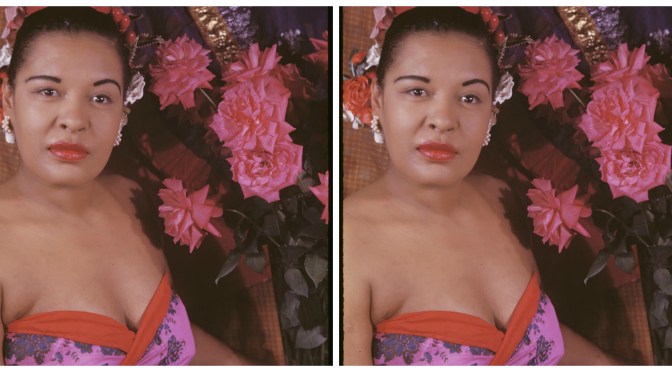
Today is the centennial of the birth of Billie Holiday. Contrary to popular belief, she was not born in Baltimore. Lady Day was born on April 7, 1915 at Philadelphia General Hospital.
The misapprehension about Holiday’s place of birth may account for why she hasn’t been inducted into the Walk of Fame. Despite her arrests and conviction in Philadelphia, she had love for her hometown. It was, after all, the place where she could work in the nightclubs. After her conviction, she lost her New York City cabaret card and could not work in places where alcohol was sold. So she could perform at a sold-out Carnegie Hall, but couldn’t get a gig at a hole-in-the-wall in Harlem.
Parenthetically, Holiday was inducted into the Apollo Theater’s Walk of Fame yesterday.
Yes, there’s a historical marker noting that when Lady Day was in town, she often lived at the Douglass Hotel.
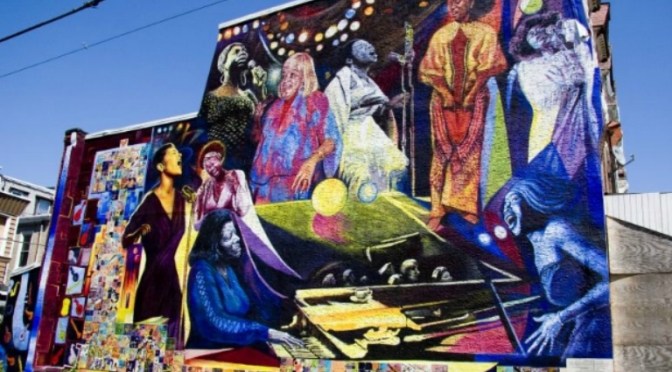
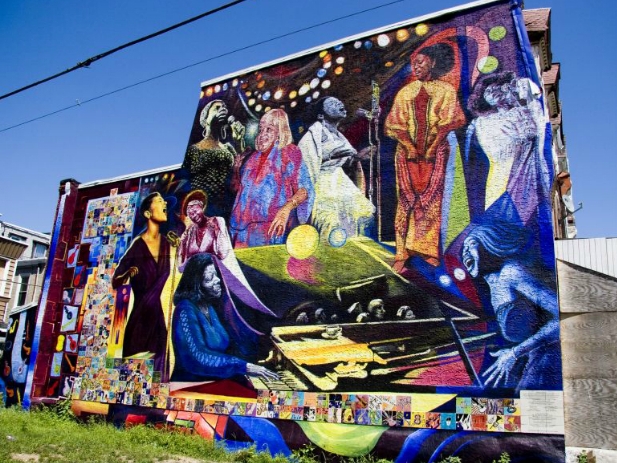
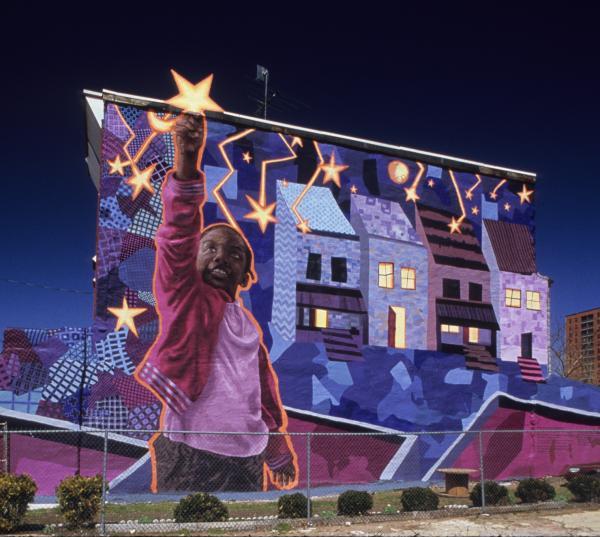
Holiday is depicted in the Women of Jazz mural in Strawberry Mansion. But the mural is scheduled to be demolished by the Philadelphia Housing Authority.
The Walk of Fame plaque is the highest honor Philadelphia bestows on a musician:
The Music Alliance is best known for the Walk of Fame along Broad Street’s Avenue of the Arts. This series of over 100 bronze commemorative plaques honors Philadelphia area musicians and music professionals who have made a significant contribution to the world of music. The Walk of Fame is the City’s most impressive public monument to the people who have made Philadelphia a great music city.
It’s never too late to do the right thing. So I nominated Billie Holiday for induction into the Walk of Fame.
Happy birthday, Lady Day. We love you more than you’ll ever know.
UPDATE: The Philadelphia Music Alliance announced that “as a special birthday gift,” Billie Holiday is the newest inductee into the Walk of Fame. In a statement, Chairman Alan Rubens said:
The Philadelphia Music Alliance wanted to present what we think is a ‘perfect’ birthday gift to an extraordinary vocalist, Billie Holiday, and announce her induction on her 100th birthday. It will be an absolute pleasure to be able to walk down Broad Street and see her name where it rightfully belongs, on the Philadelphia Music Walk of Fame, with other homegrown jazz giants like John Coltrane, Dizzy Gillespie, McCoy Tyner, and Grover Washington, Jr.