Here at All That Philly Jazz, we celebrate black history 365. Outside the African American community, black history is recognized, if at all, in February, the shortest month.
For the first time, the New York Times is sharing unpublished photos from its archives:
Hundreds of stunning images from black history, drawn from old negatives, have long been buried in the musty envelopes and crowded bins of the New York Times archives.
None of them were published by The Times until now.
Were the photos — or the people in them — not deemed newsworthy enough? Did the images not arrive in time for publication? Were they pushed aside by words here at an institution long known as the Gray Lady?
[…]
Photographers for The Times captured all of these scenes, but then the pictures and negatives were filed in our archives, where they sat for decades.
This month, we present a robust selection for the very first time.
Every day during Black History Month, we will publish at least one of these photographs online, illuminating stories that were never told in our pages and others that have been mostly forgotten.
I had a visceral response to news that City Councilman Mark Squilla introduced a bill that would impose new rules for a “special assembly occupancy” license. Among other things, applications for an SAO license must be approved by the Philadelphia Police Department. Promoters and venue operators would be required to provide the police department with the “full name, address and phone number of all performance acts scheduled to perform during the promoted event or special event.”
There is concern the bill is racially motivated, i.e., it’s targeting venues that promote hip-hop artists. Capt. Francis Healy, the PPD’s legal adviser, told the Philadelphia Inquirer Squilla’s bill has “nothing to do with race,” adding:
I could see where it could be [interpreted as such].
The police department has a sordid history with black musicians. During Philly’s jazz heyday, clubs were under police surveillance. Jazz venues would be raided because black and white patrons were fraternizing. In a piece for Hidden City Philadelphia, Jack McCarthy shared a news report from 1949:
A preholiday raid by… detectives… once again smacks of racial prejudice on part of the law enforcers… [The] Downbeat is the favorite hangout for the be-bop fans and is the only downtown spot which never has discriminated against Negro patronage. In fact, crowds here have been interracial in character, attracting everybody from the intelligentsia to the rabid be-bop fan.
Nat Segall, former owner of the Downbeat who originally established the room, gave it up a year ago rather than give in to certain political powers who urged he adopt a segregation policy for the room. When he refused to give in, Segall, a former musician now in the booking business, was pestered by police raids and finally sold out.
Charges of underage drinkers at the Downbeat, basis for the raid, is a weak one when you see the patronage of purity-white places… you’ll find teenagers any night of the week in practically every night club in town.
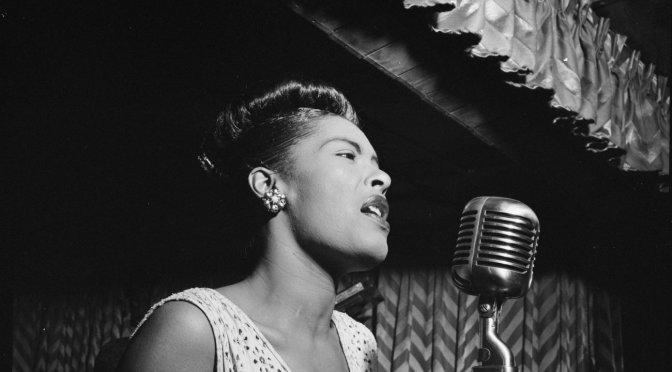
Police harassment put the legendary club out of business. Philadelphia police and federal narcotics agents hounded Billie Holiday. Indeed, Lady Day was the first casualty of the War on Drugs.
On Nov. 17, 1955, Ray Charles and his entire band were arrested on drug charges. Although the charges were later dropped, Brother Ray vowed to never again perform in Philadelphia.
Sixty years later, there are echoes of Ray Charles’s concern about the climate for musicians. As currently written, the police department would maintain a registry of performers. Musicians are posting on social media that if Squilla’s bill passes, they will skip Philly.
Heard enough? Then take note and join the protest against Bill No. 160016 at City Hall on Thursday, Feb. 4 at 9 a.m. For more information, visit March for Musicians Against Bill #160016 on Facebook.
The Rendezvous Room was located on the first floor of the Hotel Senator. It was operated by Irvin Wolf from 1947 to 1955.
In a piece for the Tri-state Jazz Society, Rabbi Lou Kaplan wrote:
Located at 915 Walnut Street in the Hotel Senator, the Rendezvous was owned by jazz enthusiast Lee Guber. It opened January 22, 1947. After entering, one saw a long U-shaped bar on the right, behind which the bandstand was situated. To the left were tables for customers. More tables were available in the back of the room than in the narrow front section. A large photomural blowup of Pablo Picasso’s Three Musicians painting dominated a corner wall.
Many singers who later became big names made their first or an early start in the Rendezvous: Rosemary Clooney, Eydie Gorme, Joni James, Patti Page, to list a few. Later came such well-known vocalists as Thelma Carpenter, Ella Fitzgerald, Ella Mae Morse, Maxine Sullivan, Sarah Vaughan, and Lee Wiley. (I recall marveling one night at how Billie Holiday’s relaxed, syncopated phrasing reshaped each number.) Booked, too, were folk singers Harry Belafonte, Burl Ives, and Josh White; actor John Carradine; musicians Earl Hines, Gene Krupa, Meade Lux Lewis, Charlie Parker, and Artie Shaw; and many other “greats.”
While the Rendezvous engaged various types of entertainment, most prominent was Dixieland jazz. The number one jazz attraction was Bechet, who, for instance, was featured four times in one 12- month period, each for a minimum of two weeks. Actress Tallulah Bankhead, a Bechet devotee and friend, came to the club whenever possible if he was playing. One night she asked Guber, “Would you like to sell twice as much whiskey?” After the owner’s obvious reply, Bankhead, in her husky baritone voice, laughingly advised, “Well, try filling up the glasses!”
Back in the day, Ridge Avenue was a vibrant commercial corridor. The heart and soul of North Philadelphia was also an entertainment district. The Blue Note was at 15th Street and Ridge Avenue.
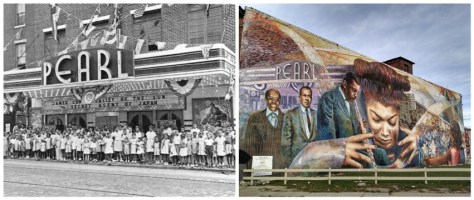
The Bird Cage Lounge was one block up at Ridge and 16th Street. I don’t know whether it was named after him, but Charlie “Bird” Parker played there. The legendary Pearl Bailey began her singing and dancing career at the Pearl Theater, which was at Ridge and 21st Street.
Some of the jazz giants who roamed Ridge Avenue likely stayed at the Hotel LaSalle, which was close to the Pearl Theater. The hotel was listed in the The Negro Motorist Green Book. The Crossroads Bar at Ridge and Columbia Avenue (now Cecil B. Moore Avenue) was at the western tip of the storied “Golden Strip.”
Ridge began its steep decline in the aftermath of the 1964 Columbia Avenue race riots and construction of the Norman Blumberg Apartments public housing. Fast forward 50 years, Ridge is on the rise.
In 2014, the Philadelphia Housing Authority announced that transformation of the Blumberg/Sharswood neighborhood was its top priority. The Sharswood Blumberg Choice Neighborhoods Transformation Plan is a massive $500 million project that would, among other things, revitalize the Ridge Avenue corridor.
In an op-ed piece published in the Philadelphia Inquirer, PHA President and CEO Kelvin A. Jeremiah wrote:
The redevelopment of a community is about turning ideas into public policy and putting policy into action.
PHA’s revitalization efforts are a targeted, coordinated development model designed to maximize the economic benefits of neighborhood revitalization, not the piecemeal dispersed development model of the past. To transform communities into neighborhoods of choice, there must be good schools for every child, quality affordable housing for all families, and a vibrant small business commercial corridor. The challenge is turning the ideas and rhetoric into policy and practice.
In remarks before the National Trust for Historic Preservation’s recent conference, Marion Mollegen McFadden, Deputy Assistant Secretary for Grant Programs, U.S. Department of Housing and Urban Development, noted a community has both tangible and intangible assets:
I see preservation’s efforts to recognize and honor the cultural heritage of minority and ethnic groups as a valuable component of strong communities, in particular many of the communities that HUD serves. And I don’t just mean preservation of buildings and places, but also of diverse cultural ties and traditions, the intangible dimensions of heritage that together enrich us as a nation.
McFadden concluded with a quote from HUD Secretary Julián Castro:
History isn’t just a subject for books and documentaries. It’s alive and well in buildings, sites, and structures that shape our communities. They tell us who we are and where we come from – and it’s critical that we protect our past for present and future generations.
The Sharswood/Blumberg Choice Neighborhoods Transformation Plan raises the question: Does PHA value the area’s tangible and intangible assets that give the neighborhood its identity? If so, will a transformed Ridge Avenue preserve the neighborhood’s cultural heritage for current and future generations?
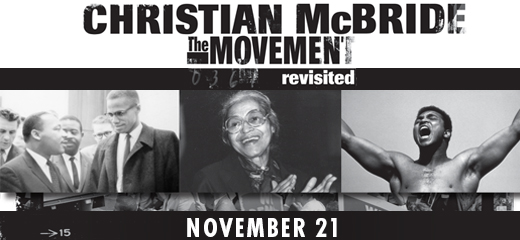
On Saturday at the Merriam Theater, bassist Christian McBride performed like it was 1969. McBride’s “The Movement, Revisited” is centered around the words of four Civil Rights icons, Rev. Martin Luther King Jr., Malcolm X, Rosa Parks and Muhammad Ali.
McBride and his 18-piece band were joined by the Philadelphia Heritage Chorale, and four narrators – Rev. Alyn Waller as Rev. Martin Luther King Jr., Dion Graham as Muhammad Ali, Samuel Stricklen as Malcolm X, and Sonia Sanchez as Rosa Parks.
McBride shared that he grew up reading Jet and Ebony which gave him a history lesson in the black experience. The four icons stood out for him. “The Movement, Revisited” stems from a commission by the Portland Arts Society to compose a piece for Black History Month:
The genesis for this project began in 1998 when McBride was commissioned by the Portland (ME) Arts Society to compose THE MOVEMENT, Revisited, a two-part composition for small instrumental group and gospel ensemble. This year, McBride envisioned a project of wider scope on the same theme and it has grown into a full-scale, 90-minute production.
The narrators brought to life the personality and passion of their character. I particularly enjoyed McBride’s exuberant “Rumble in the Jungle.” The choir evoked the spirit of the Freedom Singers with “I’m So Tired” and “Freedom, Struggle.”
I don’t want to predict anything, but the magnitude of the piece – why it was written, what it was about – I can’t imagine I’ll ever write something as monumental on this scale again. I do get overwhelmed playing it, and every time I do, it feels new. Sometimes, I play this piece and still go, “Wow, did I really write this?”
If the standing ovation is any indication, the audience was wowed by the piece.
McBride’s message music harkens back to earlier generations of jazz greats who were inspired by the struggle for racial justice. In 1929, Louis Armstrong asked, “(What Did I Do to Be So) Black and Blue.” Composed by Fats Waller, it is considered the first American popular song of racial protest.
Billie Holiday told the world about the horrors of lynching.
Both Armstrong and Holiday are featured in an exhibition at the Library of Congress, “The Civil Rights Act of 1964: A Long Struggle for Freedom.” The multimedia exhibition explores the events that shaped the Civil Rights Movement. It includes manuscripts like Dr. Billy Taylor’s “I Wish I Knew How It Would Feel to Be Free,” composed in 1954 and popularized by Nina Simone in the 1960s.
In 1959, bassist Charles Mingus composed “Fables of Faubus,” a satirical protest against Arkansas governor Orval Faubus who had deployed the Arkansas National Guard to Little Rock Central High School to prevent nine African American students from entering the segregated school.
Jazz has an element of freedom. It is that freedom that allowed jazz musicians to use their platform to sound a message of defiance and resistance. From John Coltrane’s “Alabama” to Max Roach’s “We Insist! Freedom Now Suite,” jazz was a soundtrack to the Civil Rights Movement.
I am an accidental preservationist. For this lifelong activist, the movement to save diverse places is about social justice. It’s about staking African Americans’ claim to the American story.
In his remarks before the National Trust for Historic Preservation’s annual conference, Bryan Stevenson, founding director of the Equal Justice Initiative, spoke eloquently about the ways in which the built environment reflects social inequalities:
Identity matters. You can tell the identity of a nation by looking at what they honor. . . . There is power in memorialization. You preserve the things that matter. . . . We do an injustice when we tell stories about history that are incomplete.
From the Civil War to Civil Rights, Philadelphia’s historic resources tell a more complete American story. But in Philly, only two percent of historic properties are protected. Incredibly in the 1950s, City Hall narrowly escaped the wrecking ball. Much to the chagrin of city leaders, including Edmund Bacon, then-head of the Planning Commission, rehabilitation cost less than demolition. In other words, it was “cheaper to keep her.”
Fast forward to today, gentrification lays bare Philadelphia’s culture of demolition. As I write this post, a developer is demolishing the church where Marian Anderson learned to sing and the congregation nurtured her talent. The world renowned contralto helped pave the way for the Civil Rights Movement.
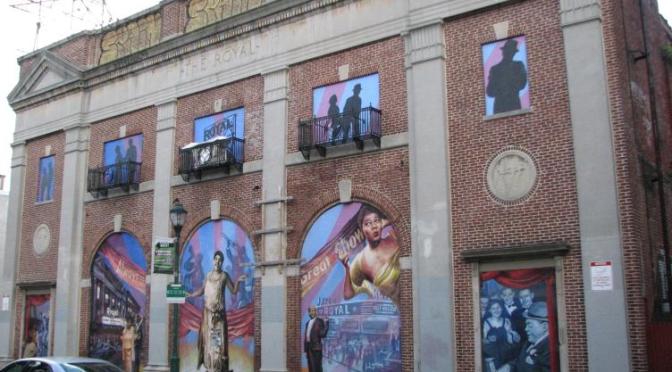
The Royal Theater was a center of the African American community from the 1920s to the 1950s. It was Philly’s first and largest movie theater to cater exclusively to African Americans. Although it’s listed in the National Register of Historic Places and the Philadelphia Register, the historic property is about to undergo a “facadectomy.”
These places are at the intersection of historic preservation and social justice. The buildings’ social history of resistance and triumph is connected to contemporary issues, including gentrification, displacement, income inequality and social inequity. Truth be told, developers are deciding which places are important.
In Los Angeles and Phoenix, adaptive reuse is a matter of public policy. Philadelphia’s culture of demolition has been exacerbated by the 10-year residential tax abatement which provides a perverse incentive for developers to tear down historic buildings.
To bring about policy changes, we must engage and empower accidental preservationists to become stewards of historic resources assets in their neighborhood.
“The Girls in the Band” is a documentary that tells untold or stories of female jazz and big band instrumentalists, including Mary Lou Williams and the International Sweethearts of Rhythm. Originally released in 2013, the Collector’s Edition DVD is now available.
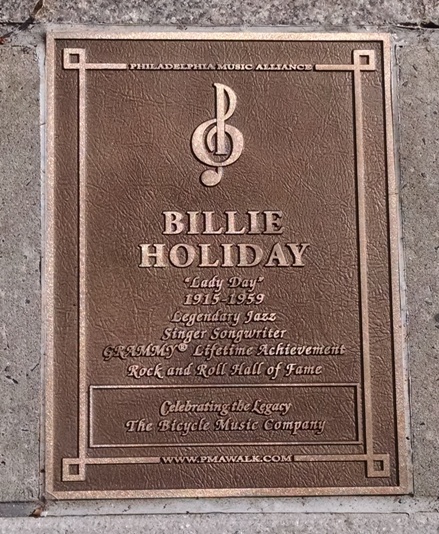
Billie Holiday was born in West Philly 100 years ago. This morning, her star will be reborn as Lady Day is inducted into the Philadelphia Walk of Fame.
I am proud to have played a role in making this happen.
For me, it was personal. After a failed romance when I was in college, I started my day by playing “Good Morning Heartache.” My best friend would ask me, “Why are you always listening to that junkie?” I ignored him. We now know Lady Day was an early victim of racial profiling.
Billie helped me get through a rough patch. It will be my pleasure to help keep her bronze plaque clean.
UPDATE: Billie Holiday’s Walk of Fame plaque unveiled. It’s located in front of the Kimmel Center.
Coltrane was into cultural heritage preservation before it was cool. His composition, “Alabama” was in response to the Sept. 15, 1963, bombing of the 16th Street Baptist Church that killed four young girls. His mournful tribute captured the zeitgeist of the Civil Rights Movement.
Philadelphia shaped and nurtured Coltrane. On June 5, 1945, the Dizzy Gillespie Quartet, featuring Charlie Parker, performed at the Academy of Music. Coltrane and Benny Golson were seated in the next-to-last row. In an interview with the Smithsonian Jazz Oral History Project, NEA Jazz Master Golson recalled:
When we heard – John and I – when we first heard Charlie Parker and Dizzy Gillespie – I told you he was sounding like Johnny Hodges – our lives changed that night. We had never heard any music like that. Never. We were screaming like these Beatles groupies, when they used to hear the Beatles.
Coltrane kicked his heroin habit at his home in Strawberry Mansion, a neighborhood in North Central Philly. The Mural Arts Program, in collaboration with the community, honored a former neighbor. On or about Sept. 15, 2014, Pennrose Company demolished the Tribute to John Coltrane mural.
Pennrose has not contributed a dime to replace the tribute to an American icon. The cultural resource was paid for, in part, by taxpayers. After being called out, a company rep lied about “ongoing discussions.”
I know they lied because I was part of the only discussion that has taken place. At the March 10, 2015, meeting with Mural Arts, Lopa Kolluri, Pennrose’s Vice President of Operations, asked for a “menu of options.” Mural Arts sent a proposal and several follow-up emails to which Pennrose has yet to respond.
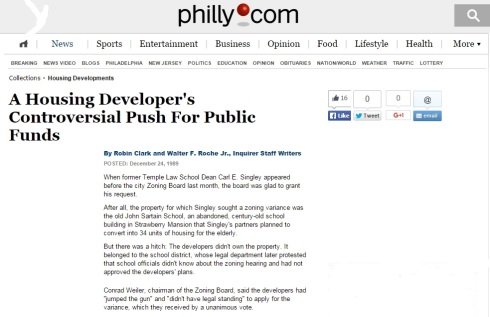
Pennrose’s arrogance is particularly galling given the company has feasted on public subsidies seasoned with political donations for nearly 40 years. In 1989, a Philadelphia Inquirer story noted the company’s reliance on government subsidies.
Pennrose doesn’t think our stories matter, but we do. It’s our responsibility to remember the ancestors and preserve their legacy for present and future generations.
On Saturday, Aug. 15, 2015, Beech Community Services will present the 9th Annual “Jazz on the Ave.” The free community festival will stretch along four blocks on Cecil B. Moore Avenue, between Broad and 17th Streets.
Ken Scott, president of the Beech Companies, said:
Each year, this concert continues to grow with thousands attending from the Tristate area and beyond. From local celebrities, like Bernard Hopkins, to longtime community members, this concert continues to be one of the must attend summer concerts of the year.
During Philly’s jazz heyday, the “Ave” was known as Columbia Avenue. The four blocks were part of “The Golden Strip,” which stretched from 8th Street to 23rd Street. Columbia Avenue was chock-a-block with jazz joints, including such legendary spots as Cafe Society, Watts’ Zanzibar and the Web.











 All That Philly Jazz