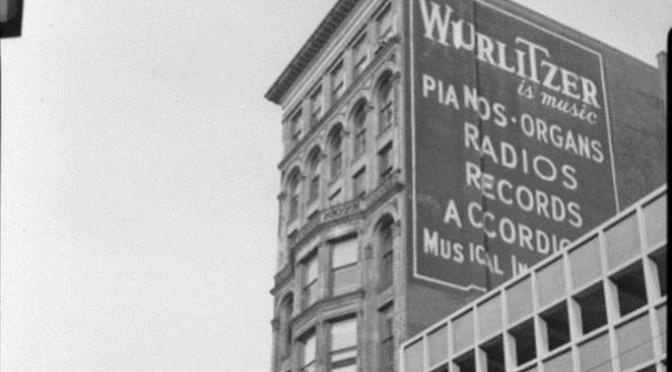
E.U. Wurlitzer was a musical instrument store located in the Watkins Building in Center City.
During an appearance on “The Dick Cavett Show” in 1973, Philly native Bill Cosby recounts buying a drum set and taking lessons at Wurlitzer’s. The erstwhile drummer provides a snapshot of the jazz scene back in the day.
Jazz is perhaps the most honest reflection of who we are as a nation. Because after all, has there ever been any greater improvisation than America itself? We do it in our own way. We move forward even when the road ahead is uncertain, stubbornly insistent that we’ll get to somewhere better, and confident that we’ve got all the right notes up our sleeve.
That “honest reflection of who we are as a nation” became an instrument of cultural diplomacy during the Cold War. Jazz musicians-turned-cultural ambassadors toured in more than 35 countries in Africa, Asia, Eastern Europe, Latin America and the Middle East. Jazz diplomacy was intended to win hearts and minds and promote a positive view of America as the land of freedom.
The irony of being ambassadors of freedom was not lost on jazz musicians who were treated as second-class citizens at home and subject to racial segregation.
Dizzy Gillespie was the first Jazz Ambassador. The legendary Adam Clayton Powell Jr. was the catalyst behind the tour. His son, Adam Clayton Powell III, President of the Public Diplomacy Council, recently wrote:
Americans underestimate the impact of jazz on audiences around the world. And in a way that contributes to the power of international tours by U.S. jazz musicians, including and especially tours sponsored by the U.S. State Department.
[…]
During the Cold War, America’s most prominent “jazz ambassadors” included Dizzy Gillespie and Louis Armstrong – at a time when segregation was the law of the land in much of the U.S. and the civil rights movement was at its peak. And that created a conflict for many of musicians.
“You had people being hosed down with fire hoses and dogs sicced on them, and you had these reports going out across the world,” said [Willard] Jenkins. “So it did create a real issue for many of the African American musicians who were selected to make those tours.”
Then Jenkins read from instructions given to musicians by the State Department: “‘Remember who you are and what you represent. Always be a credit to your government.’”
All good things must come to an end. Jazz Appreciation Month is going out on a high note. On Saturday, April 30, America’s classical music will be celebrated across the globe, from Afghanistan to Zimbabwe.
UNESCO Director General Irina Bokova said in a statement:
Jazz was born in the U.S. and traveled the world as a music of tolerance, freedom and human dignity. This is why UNESCO created International Jazz Day and we are extremely pleased that in 2016 Washington, DC has been designated the host city for this global celebration, with a unique All Star Concert at the White House, hosted by the President of the United States Barack Obama and First Lady Michelle Obama. This event reminds us Jazz is more than music – it is a universal message of peace with rhythm and meaning.
UNESCO Goodwill Ambassador Herbie Hancock added:
We are thrilled that President Obama and Michelle Obama are hosting the International Jazz Day All-Star Global Concert at the White House, and are truly grateful for their commitment to jazz and its role in building bridges and uniting people around the world. Over the past five years, the innovation and creativity of Jazz Day has been a beacon of light to millions of people who find common ground and communicate through the values inherent in jazz. On April 30th, people of all ages in all corners of the globe will participate in International Jazz Day. A wide range of momentous events will take place in thousands of neighborhoods – and the streets will be alive with the sounds of peace and freedom.
The all-star global concert will air on ABC-TV at 8pm ET.
Known as the “queen of the organ,” Shirley Scott was one of several Philadelphians who developed the electric Hammond B-3 into a viable instrument for a soulful, bluesy style of jazz. With dozens of recordings to her name, she was already a major voice when she became the leader of the house band at Ortlieb’s Jazzhaus. Among the young players who timidly found their way onto the stage at Ortlieb’s were Warfield and Stafford — and, in doing so, they got a lot more than they bargained for.
The 4th annual BlackStar Film Festival gets underway on Thursday, July 30.
The four-day film fest is “a celebration of cinema focused on work by and about people of African descent in a global context. BlackStar highlights films that are often overlooked from emerging, established, and mid-career directors, writers and producers working in narrative, documentary, experimental and music video filmmaking.” The program also includes panel discussions and workshops.
Powell had frequent gigs in Philly in the 1940s and ‘50s. He performed in such legendary jazz spots as Watts’ Zanzibar, Downbeat and The Point. While in town, Powell shared his genius with young musicians, including Lee Morgan, at the Heritage House Jazz Workshop.
The festival runs from July 30 to Aug. 2. For the full schedule and ticket information, visit BlackStar Film Fest.
Trumpeter Clifford Brown was only 25 when he died in a car crash in 1956. His last performance was at Philadelphia’s famed Music City.
Although his life was cut short, Brown left an indelible impact. There are 334 versions of Philly native and NEA Jazz Master Benny Golson’s composition, “I Remember Clifford.”
Since 1988, his hometown of Wilmington, Delaware, has held the Clifford Brown Jazz Festival to honor his memory. Fittingly, it’s the largest free jazz festival on the East Coast. This year’s lineup includes Norman Conners, Leela James and Pieces of a Dream.
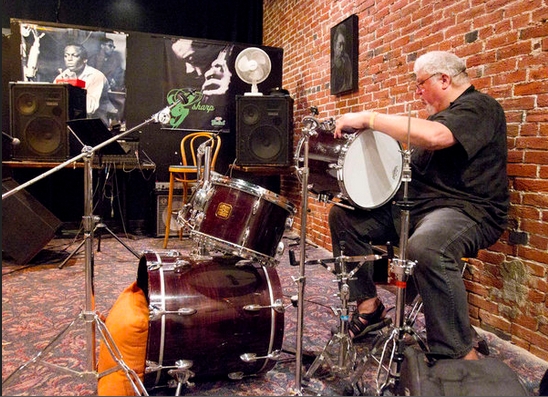
The 23rd Street Café has been featuring jam sessions since 1988. Mace Thompson, the owner, opens his establishment only on Tuesday evenings, 7:30pm to 11:30pm. There is no cover charge.
After 25 years and more than 1,300 Tuesday-night jazz jam sessions at Center City’s 23rd Street Cafe, the horns, drums, basses, guitars, violins, harmonicas, and singers will soon be silenced for good. The property at 223 N. 23d Street will be demolished this summer, likely to make way for condominiums.
But all is not lost. The jam sessions will resume on Tuesday, August 4th at the Manayunk Brewery.




 All That Philly Jazz