From 1965 to 1975, Broadcast Pioneers member Sid Mark hosted a widely acclaimed television show, first carried by Philadelphia’s Channel 17, WPHL-TV and then later aired by WHYY-TV, Channel 12. “The Mark of Jazz” was THE broadcast of that era for jazz.
In an interview with All About Jazz, Sid Mark talked about Nina Simone:
SM: And one of the people I was actually responsible for when it came to her success was Nina Simone.
AAJ: I know that Nina spent some time in Philadelphia.
SM: She started her career in Philadelphia. In her autobiography, she said the reason for her success was a white Jewish disc jockey, Sid Mark. She said, “If I knew him today, I don’t know if I’d kiss him or smack him in the mouth!” (laughter.) That’s a quote. We had a hell of a relationship! By the way, did the tribute concert by her daughter ever take place?
AAJ: It was performed at Town Hall last year. From what I understand, it was extremely successful.
SM: I love that picture of the two of them together.
AAJ: She’s been very active in promoting Nina’s legacy.
SM: Nina was something else. We had hours of discussions on the numerous radio and TV shows we did together. When I discovered her, she was just playing piano at a little joint in Philly at 22nd and Chestnut. It was a bar, and she wasn’t singing, just playing the piano.
The Elate Ballroom was located on the second floor of 711 S. Broad Street. The Elate Club Ballroom was on the ground floor.
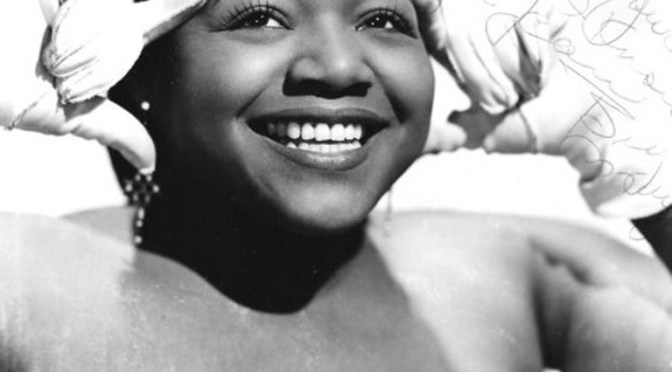
Joe Webb and his Decca Recording Orchestra featuring Big Maybelle played here at the “Shine on the Harvest Moon Dance” presented by legendary dance promoter Reese DuPree.
John Coltrane biographer Lewis Porter wrote:
Coltrane was hired when [Joe] Webb played for dancers in Philadelphia’s Elate Ballroom at 711 South Broad Street on Friday, September 13, 1946. Cal Massey (1928-72), a trumpeter from Pittsburgh, called “Folks” after his mother’s maiden name, happened to walk by when the band was playing and he ended up in the trumpet’s section. A lifelong friendship between Massey and Coltrane began as the two toured the country with the Webb band.
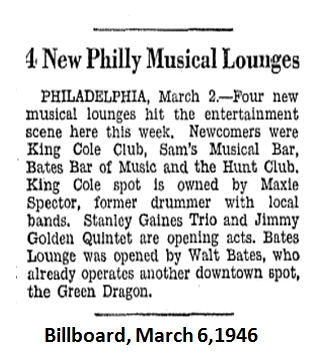
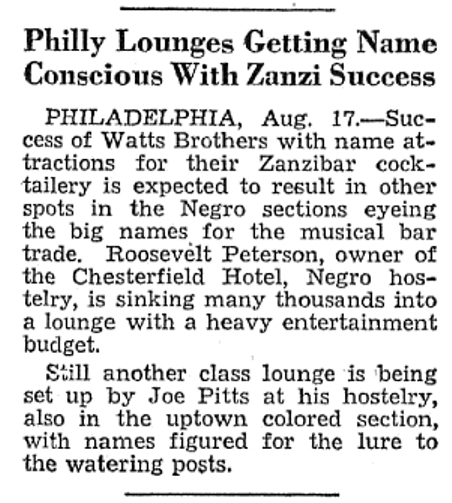
Joe Pitts’ Musical Bar was located in his “hostelry,” the Pitts Hotel. Joe Pitts’ and Watts’ Zanzibar were mentioned in the August 24, 1946 issue of Billboard.
From Jazz.com:
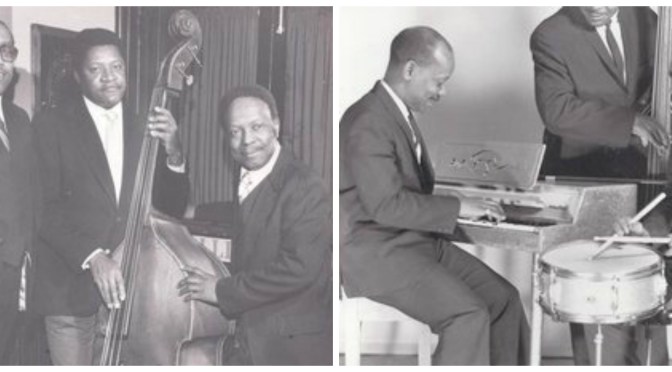
Ray Bryant and [Benny] Golson played regularly in late 1946 with bassist Gordon “Bass” Ashford. They performed one night a week at Joe Pitt’s Musical Bar, and weekends at the Caravan Republican Club, for as long as six months at a stretch.
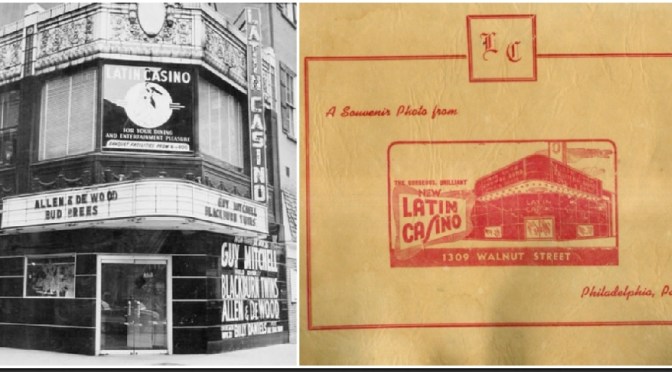
The Latin Casino opened in 1951. Its expansive lower level seated 500 people and hosted a constellation of stars, including Harry Belafonte, Sammy Davis Jr., Dean Martin, Richard Pryor, Jerry Lewis, Milton Berle, Lena Horne, Pearl Bailey, Louis Armstrong, Lionel Hampton, Johnny Mathis and Joey Bishop. At the time, it was Center City’s most sophisticated nightspot
In 1960, owners David Dushoff and Daniel “Dallas” Gerson moved the Latin Casino to Cherry Hill, New Jersey in response to customers’ complaints about parking and Philadelphia’s “blue” laws which banned the sale of alcohol after midnight Saturday.
Philadelphia Tribune columnist Alonzo Kittrels recalled:
Even if you never attended a show at the Latin Casino, I know its name brings to mind images of live entertainment. There were appearances by people such as Richard Pryor, the Temptations, Frank Sinatra and other members of the Rat Pack, Tom Jones, the Supremes and many other stars who made our evenings at this popular venue. The great R&B singer Jackie Wilson will always be associated with the Latin Casino because that was where he was stricken with a massive heart attack during a Dick Clark show. This happened while he was singing “Lonely Teardrops” and he never performed again.
Back in the day, Ridge Avenue was a vibrant commercial corridor. The heart and soul of North Philadelphia was also an entertainment district. The Blue Note was at 15th Street and Ridge Avenue.
The Bird Cage Lounge was one block up at Ridge and 16th Street. I don’t know whether it was named after him, but Charlie “Bird” Parker played there. The legendary Pearl Bailey began her singing and dancing career at the Pearl Theater, which was at Ridge and 21st Street.
Some of the jazz giants who roamed Ridge Avenue likely stayed at the Hotel LaSalle, which was close to the Pearl Theater. The hotel was listed in the The Negro Motorist Green Book. The Crossroads Bar at Ridge and Columbia Avenue (now Cecil B. Moore Avenue) was at the western tip of the storied “Golden Strip.”
Ridge began its steep decline in the aftermath of the 1964 Columbia Avenue race riots and construction of the Norman Blumberg Apartments public housing. Fast forward 50 years, Ridge is on the rise.
In 2014, the Philadelphia Housing Authority announced that transformation of the Blumberg/Sharswood neighborhood was its top priority. The Sharswood Blumberg Choice Neighborhoods Transformation Plan is a massive $500 million project that would, among other things, revitalize the Ridge Avenue corridor.
In an op-ed piece published in the Philadelphia Inquirer, PHA President and CEO Kelvin A. Jeremiah wrote:
The redevelopment of a community is about turning ideas into public policy and putting policy into action.
PHA’s revitalization efforts are a targeted, coordinated development model designed to maximize the economic benefits of neighborhood revitalization, not the piecemeal dispersed development model of the past. To transform communities into neighborhoods of choice, there must be good schools for every child, quality affordable housing for all families, and a vibrant small business commercial corridor. The challenge is turning the ideas and rhetoric into policy and practice.
In remarks before the National Trust for Historic Preservation’s recent conference, Marion Mollegen McFadden, Deputy Assistant Secretary for Grant Programs, U.S. Department of Housing and Urban Development, noted a community has both tangible and intangible assets:
I see preservation’s efforts to recognize and honor the cultural heritage of minority and ethnic groups as a valuable component of strong communities, in particular many of the communities that HUD serves. And I don’t just mean preservation of buildings and places, but also of diverse cultural ties and traditions, the intangible dimensions of heritage that together enrich us as a nation.
McFadden concluded with a quote from HUD Secretary Julián Castro:
History isn’t just a subject for books and documentaries. It’s alive and well in buildings, sites, and structures that shape our communities. They tell us who we are and where we come from – and it’s critical that we protect our past for present and future generations.
The Sharswood/Blumberg Choice Neighborhoods Transformation Plan raises the question: Does PHA value the area’s tangible and intangible assets that give the neighborhood its identity? If so, will a transformed Ridge Avenue preserve the neighborhood’s cultural heritage for current and future generations?
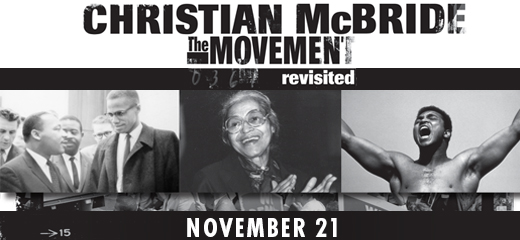
On Saturday at the Merriam Theater, bassist Christian McBride performed like it was 1969. McBride’s “The Movement, Revisited” is centered around the words of four Civil Rights icons, Rev. Martin Luther King Jr., Malcolm X, Rosa Parks and Muhammad Ali.
McBride and his 18-piece band were joined by the Philadelphia Heritage Chorale, and four narrators – Rev. Alyn Waller as Rev. Martin Luther King Jr., Dion Graham as Muhammad Ali, Samuel Stricklen as Malcolm X, and Sonia Sanchez as Rosa Parks.
McBride shared that he grew up reading Jet and Ebony which gave him a history lesson in the black experience. The four icons stood out for him. “The Movement, Revisited” stems from a commission by the Portland Arts Society to compose a piece for Black History Month:
The genesis for this project began in 1998 when McBride was commissioned by the Portland (ME) Arts Society to compose THE MOVEMENT, Revisited, a two-part composition for small instrumental group and gospel ensemble. This year, McBride envisioned a project of wider scope on the same theme and it has grown into a full-scale, 90-minute production.
The narrators brought to life the personality and passion of their character. I particularly enjoyed McBride’s exuberant “Rumble in the Jungle.” The choir evoked the spirit of the Freedom Singers with “I’m So Tired” and “Freedom, Struggle.”
I don’t want to predict anything, but the magnitude of the piece – why it was written, what it was about – I can’t imagine I’ll ever write something as monumental on this scale again. I do get overwhelmed playing it, and every time I do, it feels new. Sometimes, I play this piece and still go, “Wow, did I really write this?”
If the standing ovation is any indication, the audience was wowed by the piece.
McBride’s message music harkens back to earlier generations of jazz greats who were inspired by the struggle for racial justice. In 1929, Louis Armstrong asked, “(What Did I Do to Be So) Black and Blue.” Composed by Fats Waller, it is considered the first American popular song of racial protest.
Billie Holiday told the world about the horrors of lynching.
Both Armstrong and Holiday are featured in an exhibition at the Library of Congress, “The Civil Rights Act of 1964: A Long Struggle for Freedom.” The multimedia exhibition explores the events that shaped the Civil Rights Movement. It includes manuscripts like Dr. Billy Taylor’s “I Wish I Knew How It Would Feel to Be Free,” composed in 1954 and popularized by Nina Simone in the 1960s.
In 1959, bassist Charles Mingus composed “Fables of Faubus,” a satirical protest against Arkansas governor Orval Faubus who had deployed the Arkansas National Guard to Little Rock Central High School to prevent nine African American students from entering the segregated school.
Jazz has an element of freedom. It is that freedom that allowed jazz musicians to use their platform to sound a message of defiance and resistance. From John Coltrane’s “Alabama” to Max Roach’s “We Insist! Freedom Now Suite,” jazz was a soundtrack to the Civil Rights Movement.
I am an accidental preservationist. For this lifelong activist, the movement to save diverse places is about social justice. It’s about staking African Americans’ claim to the American story.
In his remarks before the National Trust for Historic Preservation’s annual conference, Bryan Stevenson, founding director of the Equal Justice Initiative, spoke eloquently about the ways in which the built environment reflects social inequalities:
Identity matters. You can tell the identity of a nation by looking at what they honor. . . . There is power in memorialization. You preserve the things that matter. . . . We do an injustice when we tell stories about history that are incomplete.
From the Civil War to Civil Rights, Philadelphia’s historic resources tell a more complete American story. But in Philly, only two percent of historic properties are protected. Incredibly in the 1950s, City Hall narrowly escaped the wrecking ball. Much to the chagrin of city leaders, including Edmund Bacon, then-head of the Planning Commission, rehabilitation cost less than demolition. In other words, it was “cheaper to keep her.”
Fast forward to today, gentrification lays bare Philadelphia’s culture of demolition. As I write this post, a developer is demolishing the church where Marian Anderson learned to sing and the congregation nurtured her talent. The world renowned contralto helped pave the way for the Civil Rights Movement.
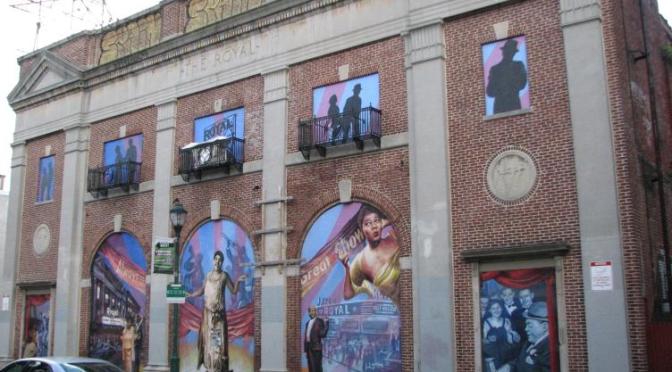
The Royal Theater was a center of the African American community from the 1920s to the 1950s. It was Philly’s first and largest movie theater to cater exclusively to African Americans. Although it’s listed in the National Register of Historic Places and the Philadelphia Register, the historic property is about to undergo a “facadectomy.”
These places are at the intersection of historic preservation and social justice. The buildings’ social history of resistance and triumph is connected to contemporary issues, including gentrification, displacement, income inequality and social inequity. Truth be told, developers are deciding which places are important.
In Los Angeles and Phoenix, adaptive reuse is a matter of public policy. Philadelphia’s culture of demolition has been exacerbated by the 10-year residential tax abatement which provides a perverse incentive for developers to tear down historic buildings.
To bring about policy changes, we must engage and empower accidental preservationists to become stewards of historic resources assets in their neighborhood.











 All That Philly Jazz