Category Archives: Advocacy

Philadelphia Pyramid Club

Founded in 1937 and formally opened three years later, the Philadelphia Pyramid Club was a small, exclusive club for black professionals. Its mission was to foster the “cultural, civic, and social advancement of Negroes in Philadelphia.” The membership fee was $120, and monthly dues were $2.40.

pyramid-club

The club hosted a wide range of social and cultural activities, including performances by Marian Anderson and Duke Ellington and, after 1941, annual art exhibitions for African American artists. It also hosted events with Dr. Martin Luther King Jr. and physicist J. Robert Oppenheimer, father of the atomic bomb. During the Pyramid Club’s heyday, its membership rolls were a Who’s Who of black Philadelphia.

The club was dissolved in 1963.

Pyramid Club Historical Marker

Philadelphia Jazz History Mosaic

NetworkArts was invited by The Free Library of Philadelphia to create after school arts programming in ten North Philadelphia library branches over a two-year period. Partnering with the Philadelphia Clef Club, NetworkArts offered programs in jazz history, lectures, demonstrations and poetry.

The collages of Romare Bearden were studied, and students created sculptures and plaques commemorating 75 important jazz artists who worked, lived, or were born in Philadelphia. During installation, Project HOME and over 200 neighborhood residents participated. The Philadelphia Clef Club Junior Ensemble performed during the community installation day.

Ridge Cotton Club

Opened in the 1930s and listed in the The Negro Motorist Green Book, the Ridge Cotton Club shows the influence of Harlem and the Cotton Club. And like the legendary Harlem nightspot, it was probably controlled by the mob.

Two of the original owners, Morris Brodsky and Harry Hirsch, died within days of each other in January 1949 following “injuries inflicted by an assailant.”

The Elmer Snowden Trio played here in April 1946.

From Bebop to Hip-hop

Hip-hop artists are influenced by that which came before. Like beboppers, they have created their own language and culture. Beboppers improvised. Hip-hop artists freestyle.

In an interview with West Philadelphia Music, a project of the University of Pennsylvania School of Arts and Science, jazz drummer Lucky Thompson said:

Uhh, yeah! Yeah, because it’s all improvisation. Like what they do, they call a rap, a rap is nothing new. Rappers, well, they was doing that back in the forties. That’s not, you know, that’s not new, that’s not new. That used to be a hip talk back then. You know, skeealeebop skeetaleebop babop la-deh-da, you know, that’s old. That’s not—that’s new to them, you know, but it’s not nothing new. It’s been out—it’s been here for a while, and they just called it scatting or talking jive—they would call it talking jive. So that’s, you know, and then cuz like, you can use it—they like now, you see, they using a lot of—they go to Europe, they take a lot of the traditional jazz music and put hip hop beats and everything right over the top of it. And they dance to it, you know, I was really—I was really shocked when I heard it when I went to Europe I was like, “Wow, they playing [Col]trane?” And they got them dancing you know, but it had like a hip hop—a hip hop beat, you know. But it was deep, it was deep, I swear it was deep.

Still, for some jazz purists, the only thing bebop and hip-hop have in common is “they rhyme.” While their heads are stuck in rarified air, Ahmir “Questlove” Thompson dropped some knowledge in the liner notes for “Droppin’ Science: Greatest Samples From The Blue Note Lab”:

The one that makes me the proudest, of course, is my hometown champ (and the greatest, funkiest, and most precise DJ ever!), DJ Jazzy Jeff, who lived up to his name in 1986 with a ditty called “A Touch of Jazz,” a compiled cram session of ’70s funk/jazz trivia looped and scratched to perfection. It was the “DJ cut” — remember those? — on his debut album, Rock the House (along with an MC I haven’t heard from in eons? Any locale for a Will Smith? Anyone? . . . lol).

[…]

Enter Idris Muhammad, a crucial general in the Blue Note army that was key to crossing the prestigious jazz label over to the soul side of thangs. That was how I got sucked into Bluebreaks. Same jazz outlook, just a lil’ funkier, to reach the corners of the ghetto that an otherwise (still worthy) Jackie McLean or a Horace Silver couldn’t penetrate. Idris’s drums had equal influence on me just as strong as if he were playing the role of John “Jabo” Starks or Clyde Stubblefield in the James Brown band.

In an interview with the Smithsonian Jazz Oral History project, NEA Jazz Master and Philly native Percy Heath said:

Anyhow, they [hip-hop artists] take little pieces of some things that were written in the bebop era, post-bebop era, and they make little licks out of it and they use it. That’s good that some people, they listen to hip-hop. So, hip-hop is like bebop was back then, revolutionary movement. This business of rapping, I used to do that in the schoolyard when I was twelve years old.

READ MORE

Happy Presidents’ Day

In 1964, Dizzy Gillespie threw his beret into the ring and ran for President of the United States.

dizzy-for-president-balloon

In a piece for Al Jazeera America, Tom Maxwell wrote:

It started as a joke, as so many serious things do. His booking agency had some “Dizzy Gillespie for president” buttons made around 1960, because, you see, it’s funny. Somebody even asked Gillespie why a black jazzman — a permanent member of the underclass if there ever was one — would even think of trying for the job. “Because we need one,” he said.

“Anybody coulda made a better President than the ones we had in those times, dillydallying about protecting blacks in the exercise of their civil and human rights and carrying on secret wars against people around the world,” Gillespie wrote in his autobiography “To Be, or Not … to Bop.” “I was the only choice for a thinking man.”

Vote Dizzy!

John Coltrane Duly Noted

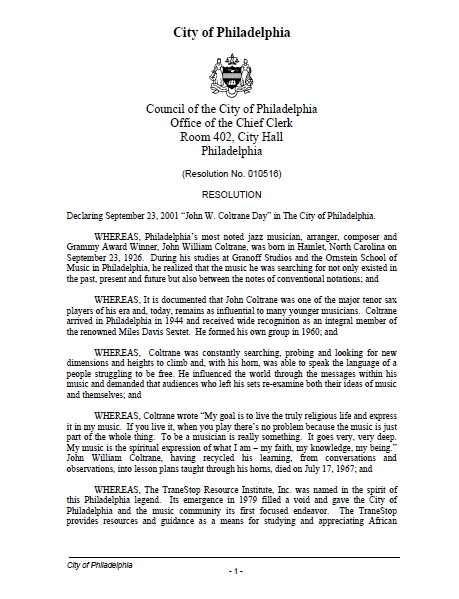
Music historian Ashley Kahn won the 2015 GRAMMY for Best Album Notes for Offering: Live from Temple University.

Ashley Kahn - 2.8.15

Yasuhiro Fujioka, founder of the John Coltrane House of Osaka, uncovered the long lost audiotape of John Coltrane’s last performance in Philadelphia. The Nov. 11, 1966 concert was aired live by WRTI, Temple University’s student-run radio station.

Notice of Coltrane's Concert at Mitten Hall

To purchase the album, go here.

The Hunting of Billie Holiday

In a new book, “Chasing the Scream: The First and Last Days of the War on Drugs,” Johann Hari writes how Billie Holiday was targeted by the Federal Bureau of Narcotics after she refused to be silent about racism:

One night, in 1939, Billie Holiday stood on stage in New York City and sang a song that was unlike anything anyone had heard before. ‘Strange Fruit’ was a musical lament against lynching. It imagined black bodies hanging from trees as a dark fruit native to the South. Here was a black woman, before a mixed audience, grieving for the racist murders in the United States. Immediately after, Billie Holiday received her first threat from the Federal Bureau of Narcotics.

Harry had heard whispers that she was using heroin, and—after she flatly refused to be silent about racism—he assigned an agent named Jimmy Fletcher to track her every move. Harry hated to hire black agents, but if he sent white guys into Harlem and Baltimore, they stood out straight away. Jimmy Fletcher was the answer. His job was to bust his own people, but Anslinger was insistent that no black man in his Bureau could ever become a white man’s boss. Jimmy was allowed through the door at the Bureau, but never up the stairs. He was and would remain an “archive man”—a street agent whose job was to figure out who was selling, who was supplying and who should be busted. He would carry large amounts of drugs with him, and he was allowed to deal drugs himself so he could gain the confidence of the people he was secretly plotting to arrest.

READ MORE

Nina Simone Netflix Documentary

Later this year, Netflix will debut an original documentary about Nina Simone, What Happened, Miss Simone? The film was screened at the Sundance Film Festival.

Rolling Stone reports:

Beginning with footage of the singer staring down an audience at the Montreux Jazz Festival in 1976, What Happened goes about answering its question by flipping back to Simone’s childhood, detailing her early musical ambitions to be the first black female classical pianist. Despite her talent and the financial support of well-to-do patrons, she was rejected by the prestigious Curtis Institute in Philadelphia; that “early jolt of racism,” as Simone referred to the incident, became the first of several events to fuel an inexhaustible supply of anger at society. A summer gig at an Atlantic City bar gave birth to the blues chanteuse she’d eventually become, with the film tracing her rise to hit recording artist, jazz sensation, long-suffering wife (her manager/husband Andrew Stroud does not come off well), a major player in the Civil Rights movement, industry pariah, American ex-pat, playing-for-chump-change café performer and, eventually, a rediscovered legend.

READ MORE