Category Archives: Advocacy

Waiting While Black at Starbucks

During the Jim Crow era, Louis Armstrong asked, “What did I do to be so black and blue?”

In 2018, men in blue uniforms arrested two African Americans whose only sin is in their skin. Their offense – waiting while black at Starbucks.

While implicit bias led to the 911 call, Police Commissioner Richard Ross is complicit in the criminalization of black men. In a video posted on Facebook, Ross said:

They did a service that they were called to do. And if you think about it logically, that if a business calls and they say that someone is here that I no longer wish to be in my business, [police officers] now have a legal obligation to carry out their duties.

There is nothing logical about implicit bias.

In an open letter, Starbucks CEO Kevin Johnson said the arrest was “reprehensible”:

By now, you may be aware of a disheartening situation in one of our Philadelphia-area stores this past Thursday, that led to a reprehensible outcome.

I’m writing this evening to convey three things:

First, to once again express our deepest apologies to the two men who were arrested with a goal of doing whatever we can to make things right. Second, to let you know of our plans to investigate the pertinent facts and make any necessary changes to our practices that would help prevent such an occurrence from ever happening again. And third, to reassure you that Starbucks stands firmly against discrimination or racial profiling.

In the coming days, I will be joining our regional vice president, Camille Hymes—who is on the ground in Philadelphia—to speak with partners, customers and community leaders as well as law enforcement. Most importantly, I hope to meet personally with the two men who were arrested to offer a face-to-face apology.

Meanwhile, Mayor Jim Kenney is “heartbroken”:

I am heartbroken to see Philadelphia in the headlines for an incident that — at least based on what we know at this point — appears to exemplify what racial discrimination looks like in 2018.

However, Kenney is not “heartbroken” enough to launch an independent investigation of the incident. Instead, the Philadelphia Police Department is investigating itself. A fact noted by the Washington Post:

Kenney said little about the response of his police force beyond mentioning an ongoing review from Police Commissioner Richard Ross.

In his Facebook monologue, Ross said the police department sends all new recruits to the National Museum of African American History and Culture and the United States Holocaust Memorial Museum because “we want them to know about the atrocities that were, in fact, committed by policing around the world.”

The Commissioner encouraged us to “make our own value judgment.” So here’s mine — Negro, please! Did you send new recruits to visit the African American Museum in Philadelphia’s exhibit, “Arresting Patterns: Perspectives on Race, Criminal Justice, Artistic Expression, and Community?” The museum is located one block from police headquarters.

Ross declared his “officers did absolutely nothing wrong” in arresting two black men whose only offense is the color of their skin. But he will not have the last word.

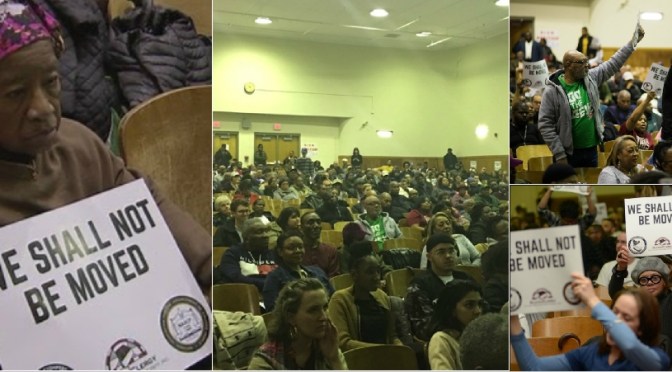
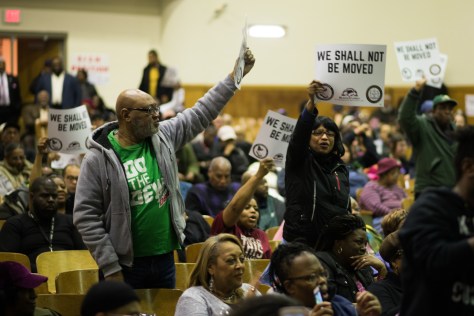
POWER, a coalition of clergy leaders representing more than 50 interfaith congregations in Southeastern and Central Pennsylvania, will hold a march and sit-in on Monday, April 16. Protesters will gather at 3:30pm at The Philadelphia Ethical Society, 1906 Rittenhouse Square. From there, they will march and occupy the Starbucks located at 1801 Spruce Street from 4-6pm.
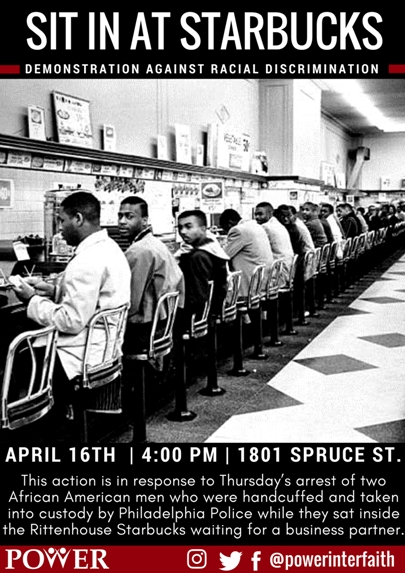
#Starbucks - POWER Sit-in2

Commissioner Ross, just so you know, they will not make any purchases. So get your paddy rollers ready.

Blue Note Salon

On December 8, 1956, the Miles Davis Quintet, featuring Miles Davis (trumpet), John Coltrane (tenor saxophone), Red Garland (piano), Paul Chambers (bass) and Philly Joe Jones (drums) performed at the Blue Note. The set was featured on the Mutual Network live remote radio broadcast, Bandstand, U.S.A.

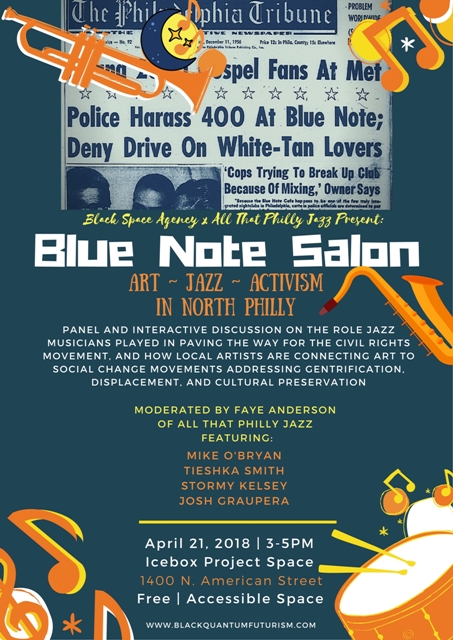
That same night, the police raided “the town’s swankiest jazz emporium.” The Blue Note was a “black and tan” club, an integrated nightspot where blacks and whites socialized on an equal basis. As such, it was the target of police harassment.

Philadelphia Tribune - Dec. 11, 1956

From the beginning, jazz was a tool for social change. Jazz musicians’ unbowed comportment created a cultural identity that was a steppingstone to the Civil Rights Movement. In remarks to the 1964 Berlin Jazz Festival, Dr. Martin Luther King Jr. said jazz is “triumphant music”:

Jazz speaks for life. The Blues tell the story of life’s difficulties, and if you think for a moment, you will realize that they take the hardest realities of life and put them into music, only to come out with some new hope or sense of triumph.

This is triumphant music.

Modern jazz has continued in this tradition, singing the songs of a more complicated urban existence. When life itself offers no order and meaning, the musician creates an order and meaning from the sounds of the earth which flow through his instrument.

It is no wonder that so much of the search for identity among American Negroes was championed by Jazz musicians. Long before the modern essayists and scholars wrote of racial identity as a problem for a multiracial world, musicians were returning to their roots to affirm that which was stirring within their souls.

Much of the power of our Freedom Movement in the United States has come from this music. It has strengthened us with its sweet rhythms when courage began to fail. It has calmed us with its rich harmonies when spirits were down.

On April 21, 2018, All That Philly Jazz and Black Quantum Futurism will present the “Blue Note Salon” which pays homage to jazz musicians’ legacy of resistance. The community discussion will feature creative change makers who work on social justice issues. Their work is at the intersection of art, community engagement and social change.

Blue Note Salon

The event is free and open to the public. To RSVP, go here.

Philly Celebrates Jazz 2018

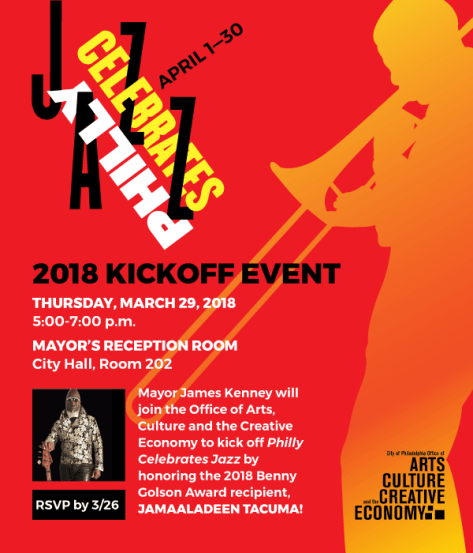
April is Jazz Appreciation Month. There is a lot of appreciation for jazz in the City of Brotherly Love and Sisterly Affection so Philly is getting the party started early. On March 29, Mayor James Kenney will join the Office of Arts, Culture and the Creative Economy to kick off Philly Celebrates Jazz by honoring the 2018 Benny Golson Award recipient, fashion-forward bassist Jamaaladeen Tacuma.

Jamaaladeen Tacuma

From the Office of Arts, Culture and the Creative Economy:

Jamaaladeen Tacuma is celebrated internationally for his creatively free and funky approach to the electric bass. His innovative style caught Ornette Coleman’s ear, and he became the first bassist in Coleman’s electric band, Prime Time, touring and recording with the group throughout the 1970’s and 80’s. Viewed as one of the most distinctive bassists of his generation, Tacuma is credited for redefining the potential of the instrument. Tacuma debuted as a bandleader, composer, and arranger in 1983 with the album Showstopper, going on to develop compositions that blend Prime Time’s elaborate harmonies with engaging melodies. His 1988 album Jukebox was nominated for a Grammy Award in 1989; in 2011 his ongoing achievements were recognized by the award of a Pew Fellowship in the Arts; he is the 2017 recipient of Philadelphia Clef Club of Jazz Best Bassist Award. Tacuma’s artistic and experimental approach to jazz music has been and continues to be a source of great pride for the Philadelphia jazz scene.

The March 29 event is free and open to the public

Philly Loves Jazz Kickoff Event - March 29

To RSVP go here.

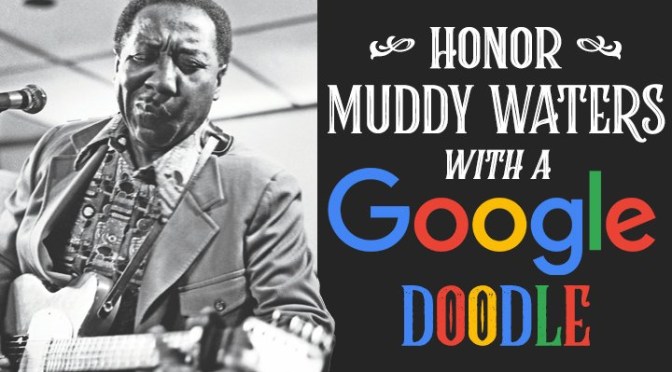
Help Get Muddy Waters a Google Doodle

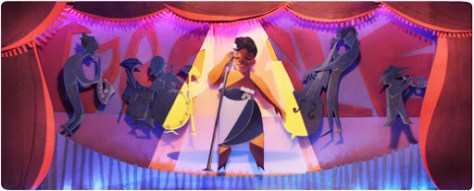
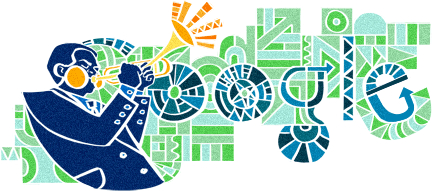
We all have seen Google Doodles. The drawings “celebrate holidays, anniversaries, and the lives of famous artists, pioneers, and scientists.”

Google Doodle - Ella Fitzgerald

Google Doodle - Dizzy Gillespie

Google accepts suggestions from the public. You can help one of the most celebrated bluesmen, Muddy Waters, get a Google Doodle.

Muddy Waters Google Doodle

American Blues Scene, a popular website, is petitioning Google to create a Muddy Waters doodle:

No figure has inspired an international music explosion quite like blues musician McKinley “Muddy Waters” Morganfield, who left a log cabin in a Mississippi cotton field to break much greater ground with his inimitable guitar and vocal style. After more than 100 years, Muddy Waters’ continuing impact has proven the blues singer to be one of the most significant figures in the history of American Music, inspiring generations of artists and cultural movements like Folk, Chicago Blues, and Rock n Roll.

You can sign the petition here. You can also email Google at proposals@google.com and tell them about the “Hoochie Coochie Man.”

The blues master is memorialized on a Chicago high-rise.

Muddy Waters Mural

With your help, Muddy Waters will be immortalized for all Google users.

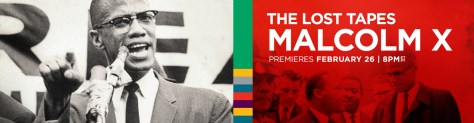
The Lost Tapes: Malcolm X

February 21 was the 53rd anniversary of the assassination of Malcolm X, El-Hajj Malik El-Shabazz.

Malcolm X

Two years ago, I nominated a former residence of Malcolm X for listing on the Philadelphia Register of Historic Places. In the statement of significance, I wrote:

Malcolm X, aka El-Hajj Malik El-Shabazz, is a world-renowned human rights activist and American icon whose charismatic leadership laid the foundation for the growth of orthodox Islam among African Americans in the City of Philadelphia, the Commonwealth of Pennsylvania and the nation. His life story is an American story. It is a “Horatio Alger” tale of a misspent youth, personal redemption and triumph in the struggle for racial equality.

During his “misspent youth,” Malcolm was known as “Detroit Red.” He was a fixture on the jazz scene in Harlem. His former residence, 2503 W. Oxford Street, was located a short walk from Philadelphia’s storied “Golden Strip.”

I also noted:

In the years since his assassination, Malcolm has become an American icon. He is the subject of countless books and academic studies, and documentaries, including PBS’ “Malcolm X: Make It Plain.” Spike Lee’s movie adaptation of The Autobiography of Malcolm X was released in 1992. “Malcolm X” featured an Oscar-nominated performance by Denzel Washington.

While the nomination was not successful, all was not lost. We raised awareness of Malcolm’s presence in Philadelphia. “The Lost Tapes: Malcolm X” will introduce a new generation to the human rights activist. The documentary premieres on the Smithsonian Channel on February 26 at 8pm EST.

The Lost Tapes

The documentary traces Malcolm’s life through rare archival footage from his speeches and media interviews. In comments following a recent screening Malcolm’s daughter, Ilyasah Al-Shabazz, said:

We finally have the opportunity to hear directly from our father’s mouth. … I was overwhelmed with emotion when I first saw it and I thought that it was a great piece of work.

For more information, visit the Smithsonian Channel.

Presidents’ Day 2018

I am a museum lover. Before the opening of the National Museum of African American History and Culture, the National Portrait Gallery was my favorite Smithsonian museum. It’s now my second museum. When Barack Obama won the 2008 election, I thought that he will be included in the pantheon of American Presidents.

President Obama’s portrait was unveiled last week.

Barack Obama - NPG

In an email, Obama wrote:

Today, Kehinde Wiley and Amy Sherald became the first black artists to create official, Smithsonian-commissioned portraits of a former President and First Lady.

And Michelle and I joined our distinguished predecessors and thousands of our fellow Americans on the walls of the Smithsonian National Portrait Gallery.

To call this experience humbling would be an understatement.

That’s because, as a former president, when you choose an artist to describe your likeness, you have the opportunity to shape, quite literally, how someone sees the office of the American presidency. And how they might see themselves in that presidency.

[…]

The arts have always been central to the American experience. They provoke thought, challenge our assumptions, and shape how we define our narrative as a country.

Thanks to Kehinde Wiley and Amy Sherald, generations of Americans — and young people from all around the world — will visit the National Portrait Gallery and see this country through a new lens. These works upend the notion that there are worlds where African Americans belong and worlds where we don’t. And that’s something Michelle and I hope we contributed to over the eight years we were so privileged to serve you from the White House.

Michelle Obama’s portrait will join the collection of First Ladies.

Michelle Obama - NPG

In case you missed it, check out “Obama Portrait Unveiling at the Smithsonian’s National Portrait Gallery.”

We Knew What We Had: The Greatest Story Never Told

Like Philadelphia, Pittsburgh once had a robust jazz scene with legendary venues, including the Granada Theater and the Crawford Grill.

Crawford Vintage

Crawford Grill - Pittsburgh - Historical Marker - 2001

Pittsburgh produced jazz greats such as Art Blakey, Billy Strayhorn, Mary Lou Williams, George Benson, Ahmad Jamal, Stanley Turrentine, Billy Eckstine and Kenny Clarke.

We Knew What We Had2

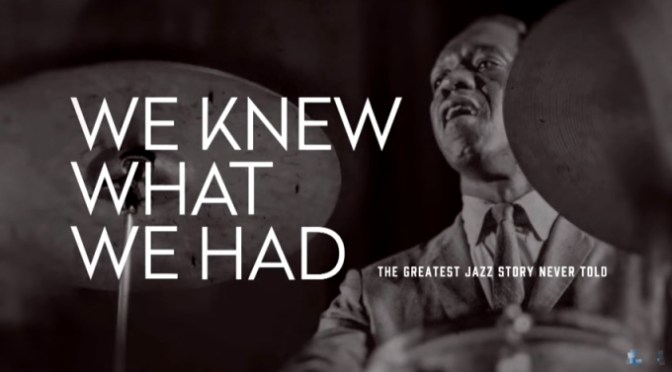
Thanks to a new documentary, “We Knew What We Had: The Greatest Story Never Told,” the world will know what Pittsburgh had.

The one-hour documentary includes live performance clips of the Jazz Masters, interviews and archival photographs. As important, the filmmakers contextualize Pittsburgh’s jazz culture by exploring social conditions and historical events.

“We Knew What We Had: The Greatest Story Never Told” will air in February. For more information and air dates, visit their website.

Lena Horne Forever

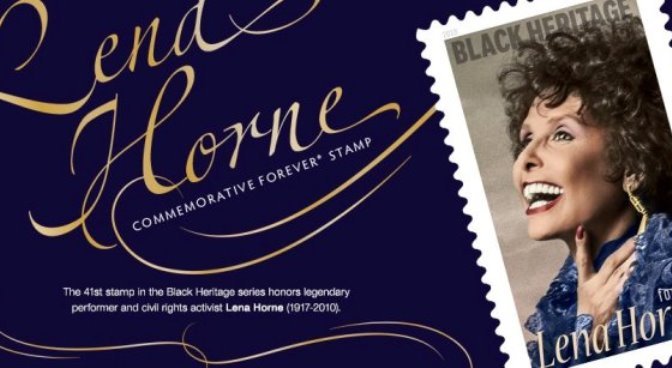
On Tuesday, the U.S. Postal Service will issue the Lena Horne Forever stamp. The 41st issuance in the Black Heritage series honors the legacy of Lena Horne:

Horne began her career as a dancer at Harlem’s Cotton Club and later became a featured vocalist with touring orchestras. The rampant racial discrimination she encountered from audiences, hotel and venue managers and others was so disconcerting that she stopped touring, and in 1941, she made her move to Hollywood. A year later, she signed a contract with MGM — one of the first long-term contracts with a major Hollywood studio — with the stipulation that she would never be asked to take stereotypical roles then available to black actors. Her most famous movie roles were in “Cabin in the Sky” and “Stormy Weather,” both released in 1943.

During World War II, Horne entertained at camps for black servicemen, and after the war worked on behalf of Japanese Americans who were facing discriminatory housing policies. She worked with Eleanor Roosevelt in pressing for anti-lynching legislation. In the 1960s, Horne continued her high-profile work for civil rights, performing at rallies in the South, supporting the work of the National Council for Negro Women, and participating in the 1963 March on Washington.

On Horne’s passing in 2010, President Barack Obama said:

Over the years, she warmed the hearts of countless Americans with her beautiful voice and dramatic performances on screen. From the time her grandmother signed her up for an NAACP membership as a child, she worked tirelessly to further the cause of justice and equality. In 1940, she became the first African American performer to tour with an all white band. And while entertaining soldiers during World War II, she refused to perform for segregated audiences – a principled struggle she continued well after the troops returned home.

From sultry Selina Rogers in “Stormy Weather” …

… to sweet Georgia Brown in “Cabin in the Sky” …

… and Glinda, the Good Witch in “The Wiz,” the legendary performer entertained millions.

Horne’s activism and willingness to speak truth to power inspired millions, including the writer.

Lena Horne Collage2

The trailblazer and civil rights activist will be in the public’s memory forever.

Lena Horne Forever

The First Day of Issue Stamp Dedication Ceremony will be was held at Symphony Space in New York City. The Lena Horne Forever stamp is on sale nationwide at post offices and online at The Postal Store.