All posts by Faye Anderson

I am director of All That Philly Jazz, a place-based public history project that is documenting and contextualizing Philadelphia’s golden age of jazz. The project is at the intersection of art, public policy, and cultural heritage preservation.

Bessie Smith

The first major blues and jazz singer on record and one of the most powerful of all time, Bessie Smith rightly earned the title of “The Empress of the Blues.” Even on her first records in 1923, her passionate voice overcame the primitive recording quality of the day and still communicates easily to today’s listeners (which is not true of any other singer from that early period). At a time when the blues were in and most vocalists (particularly vaudevillians) were being dubbed “blues singers,” Bessie Smith simply had no competition.

Back in 1912, Bessie Smith sang in the same show as Ma Rainey, who took her under her wing and coached her. Although Rainey would achieve a measure of fame throughout her career, she was soon surpassed by her protégée. She perfected her powerful delivery in the cabarets of Philadelphia and Atlantic City where she was a frequent attraction. In 1920, Smith had her own show in Atlantic City and, in 1923, she moved to New York. She was soon signed by Columbia and her first recording (Alberta Hunter’s “Downhearted Blues”) made her famous.

READ MORE

Bessie Smith - 1.15.15

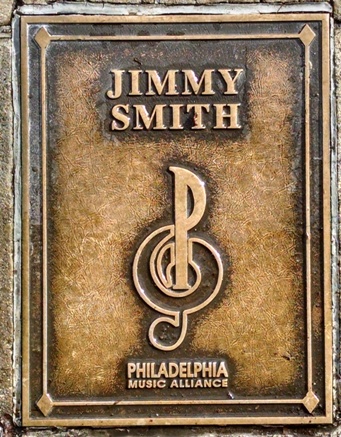
Jimmy Smith

Though he never received any exaggerated title, Jimmy Smith certainly ruled the Hammond organ in the ’50s and ’60s. He revolutionized the instrument, showing it could be creatively used in a jazz context and popularized in the process. His Blue Note sessions from 1956 to 1963 were extremely influential and are highly recommended. Smith turned the organ into almost an ensemble itself. He provided walking bass lines with his feet, left hand chordal accompaniment, solo lines in the right, and a booming, funky presence that punctuated every song, particularly the up-tempo cuts. Smith turned the fusion of R&B, blues, and gospel influences with bebop references and devices into a jubilant, attractive sound that many others immediately absorbed before following in his footsteps. Smith initially learned piano both from his parents and on his own.

Smith was born in Norristown, Pa., and attended the Hamilton School of Music in 1948, and Ornstein School of Music in 1949 and 1950 in Philadelphia. Smith began playing the Hammond in 1951, and soon earned a great reputation that followed him to New York, where he debuted at the Café Bohemia. A Birdland date and 1957 Newport Jazz Festival appearance launched Smith’s career. He toured extensively through the ’60s and ’70s. His Blue Note recordings included superb collaborations with Kenny Burrell, Lee Morgan, Lou Donaldson, Tina Brooks, Jackie McLean, Ike Quebec, and Stanley Turrentine, among others. He also did several trio recordings.

READ MORE

Jimmy Smith Plaque

McCoy Tyner

It is to McCoy Tyner’s great credit that his career after John Coltrane has been far from anti-climatic. Along with Bill Evans, Tyner has been the most influential pianist in jazz of the past 50 years, with his chord voicings being adopted and utilized by virtually every younger pianist. A powerful virtuoso and a true original (compare his playing in the early ’60s with anyone else from the time), Tyner (like Thelonious Monk) has not altered his style all that much from his early days but he has continued to grow and become even stronger.

McCoy Tyner grew up in Philadelphia where Bud Powell and Richie Powell were neighbors. As a teenager he gigged locally and met John Coltrane. He made his recording debut with the Art Farmer-Benny Golson Jazztet, but after six months left the group to join Coltrane in what (with bassist Jimmy Garrison and drummer Elvin Jones) would become the classic quartet. Few other pianists of the period had both the power and the complementary open-minded style to inspire Coltrane, but Tyner was never overshadowed by the innovative saxophonist. During the Coltrane years (1960-1965), the pianist also led his own record dates for Impulse.

READ MORE

McCoy Tyner Plaque

Charlie Ventura

A fine swing-oriented tenor saxophonist, Ventura is best-remembered for his attempt at popularizing bebop during the tail end of the music’s mid- to late-’40s heyday. Born Charles Venturo, one of thirteen children in a musical South Philadelphia family. His first instrument was C-melody sax. He switched to alto before eventually settling on tenor. Ventura left his day job at the Philadelphia Navy Yard in 1942 to join Gene Krupa’s band. He became a featured soloist with Krupa, playing with the drummer from 1942-1943 and 1944-1946 (working in the interim with guitarist/bandleader Teddy Powell). Ventura achieved considerable popularity while with Krupa, winning a Down Beat magazine award as best tenor saxophonist in 1945.

READ MORE

Charlie Ventura Plaque

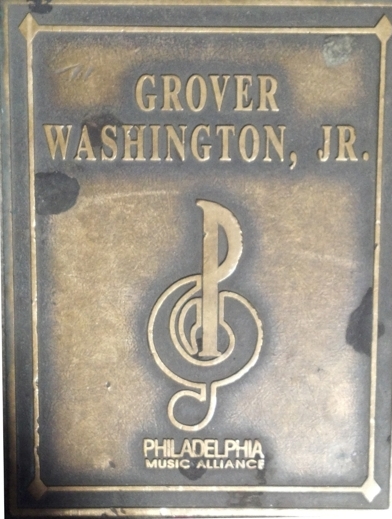
Grover Washington Jr.

One of the most popular saxophonists of all time (even his off records had impressive sales), Grover Washington, Jr. was long the pacesetter in his field. His roots were in R&B and soul-jazz organ combos, but he also fared very well on the infrequent occasions when he played straight-ahead jazz. A highly influential player, Washington was sometimes blamed for the faults of his followers; Kenny G. largely based his soprano sound on Grover’s tone. However, most of the time (except when relying on long hit medleys), Washington pushed himself with the spontaneity and chance taking of a masterful jazz musician.

Grover Washington, Jr., whose father also played saxophone, started playing music when he was ten and within two years was working in clubs. He picked up experience touring with the Four Clefs from 1959-1963 and freelancing during the next two years, before spending a couple years in the Army. He moved to Philadelphia in 1967, becoming closely identified with the city from then on, and worked with several organists, including Charles Earland and Johnny Hammond Smith, recording as a sideman for the Prestige label. His biggest break occurred in 1971, when Hank Crawford could not make it to a recording date; Washington was picked as his replacement, and the result was Inner City Blues, a big seller. From then on he became a major name, particularly after recording 1975’s Mister Magic and 1980’s Winelight; the latter included the Bill Withers hit “Just the Two of Us.”

READ MORE

Grover Washington Jr. Plaque

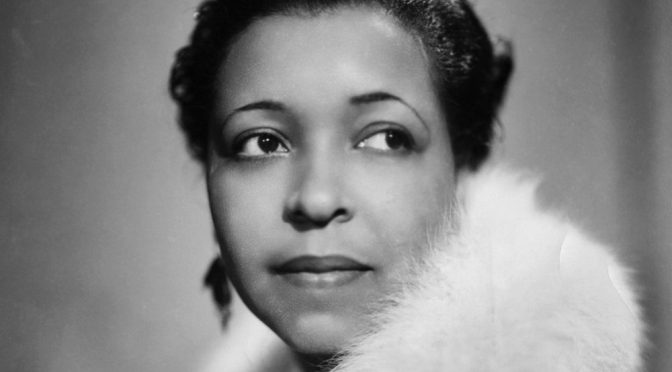
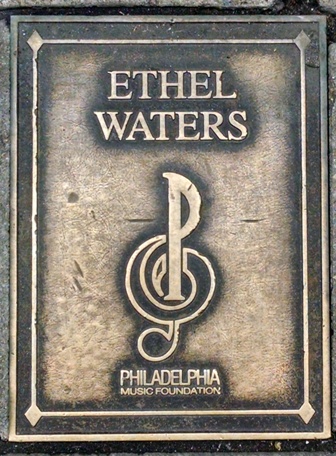
Ethel Waters

Ethel Waters had a long and varied career, and was one of the first true jazz singers to record. Defying racism with her talent and bravery, Waters became a stage and movie star in the 1930s and ’40s without leaving the U.S. She grew up near Philadelphia and, unlike many of her contemporaries, developed a clear and easily understandable diction. Originally classified as a blues singer (and she could sing the blues almost on the level of a Bessie Smith), Waters’ jazz-oriented recordings of 1921-1928 swung before that term was even coined.

A star early on at theaters and nightclubs, Waters introduced such songs as “Dinah,” “Am I Blue” (in a 1929 movie), and “Stormy Weather.” She made a smooth transition from jazz singer of the 1920s to a pop music star of the ’30s, and she was a strong influence on many vocalists including Mildred Bailey, Lee Wiley, and Connee Boswell. Waters spent the latter half of the 1930s touring with a group headed by her husband-trumpeter Eddie Mallory, and appeared on Broadway in 1939 in Mamba’s Daughter and in the 1943 film Cabin in the Sky; in the latter she introduced “Taking a Chance on Love,” “Good for Nothing Joe,” and the title cut.

In later years Waters was seen in nonmusical dramatic roles, and after 1960 she mostly confined her performances to religious work for the evangelist Billy Graham. The European Classics label has reissued all of Ethel Waters’ prime recordings and they still sound fresh and lively today.

Ethel Waters Plaque

Georgie Woods

Georgie Woods has improved, enhanced and inspired the lives of many throughout his multi-faceted career of entertainment and public service.

As “The Guy with the Goods,” Georgie Woods has entertained for five full decades on radio stations WHAT and WDAS. In 1960, Georgie became active in the civil rights movement as Vice President of the NAACP. Georgie became an outspoken advocate of equal opportunity and equal treatment for African Americans and joined the Reverend Doctor Martin Luther King, Jr. and Cecil B. Moore in an ongoing campaign that took Woods from Washington, D.C., to Selma, Alabama. His other humanitarian efforts included a 17-day tour of Vietnam, as the first African American to entertain the troops.

READ MORE

Georgie Woods Plaque

Bob & Barbara’s

Bob & Barbara’s Lounge has been serving cold beer, cocktails and live entertainment since 1969. Robert Porter, Owner, and Barbara Carter, Manager, were the original Bob and Barbara.

Bob & Barbara's Lounge - Original Owners - 1.25.15

In 1994, after Barbara Carter passed away and Robert Porter retired, the current owners took over the operation of the bar. For many years, Bob & Barbara’s was the clubhouse for the Philadelphia Cartoonist Society. Naturally, they drew cartoons of the house band, the Crowd Pleasers.

Bob and Barbara's House Band - the Crowd Pleasers

Sister Rosetta Tharpe

Sister Rosetta Tharpe was inducted into the Philadelphia Walk of Fame in 2017.

Alongside Willie Mae Ford Smith, Sister Rosetta Tharpe is widely acclaimed among the greatest Sanctified gospel singers of her generation; a flamboyant performer whose music often flirted with the blues and swing, she was also one of the most controversial talents of her day, shocking purists with her leap into the secular market — by playing nightclubs and theaters, she not only pushed spiritual music into the mainstream, but in the process also helped pioneer the rise of pop-gospel. Tharpe was born March 20, 1915 in Cotton Plant, AR; the daughter of Katie Bell Nubin, a traveling missionary and shouter in the classic gospel tradition known throughout the circuit as “Mother Bell,” she was a prodigy, mastering the guitar by the age of six. At the same time, she attended Holiness conventions alongside her mother, performing renditions of songs including “The Day Is Past and Gone” and “I Looked Down the Line.”

In time, the family relocated to Chicago, where Tharpe began honing her unique style; blessed with a resonant vibrato, both her vocal phrasing and guitar style drew heavy inspiration from the blues, and she further aligned herself with the secular world with a sense of showmanship and glamour unique among the gospel performers of her era. Signing to Decca in 1938, Tharpe became a virtual overnight sensation; her first records, among them Thomas A. Dorsey’s “Rock Me” and “This Train,” were smash hits, and quickly she was performing in the company of mainstream superstars including Cab Calloway and Benny Goodman. She led an almost schizophrenic existence, remaining in the good graces of her core audience by recording material like “Precious Lord,” “Beams of Heaven,” and “End of My Journey” while also appealing to her growing white audience by performing rearranged, uptempo spirituals including “Didn’t It Rain” and “Down by the Riverside.”

READ MORE

Sister Rosetta Tharpe Walk of Fame Plaque

Café Society Swing

In 1987, Congress passed House Concurrent Resolution 57 designating jazz “a rare and valuable national American treasure.” The resolution recognized jazz as a “unifying force, bridging cultural, religious, ethnic and age differences.” Indeed, jazz played an important role in paving the way for the Civil Rights Movement.

The Downbeat, located at 11th and Ludlow streets in Philadelphia, was the first racially integrated club in Center City. The building is still there.

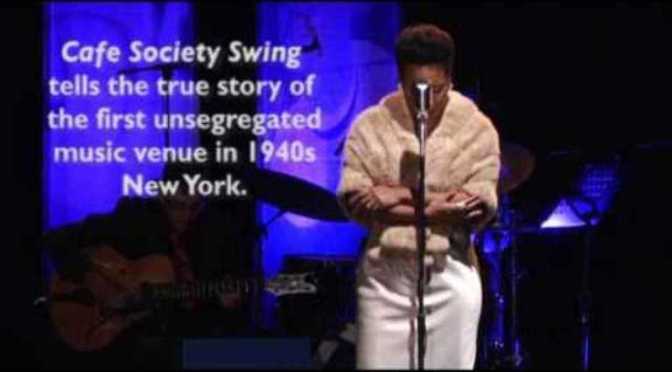
Café Society Swing, written by Alex Webb, tells the story of the legendary Café Society, the first integrated nightclub in New York City. The jazz spot played host to, among others, Fats Navarro, Dizzy Gillespie, Charlie Parker, Count Basie, Sarah Vaughn, Lena Horne, Sister Rosetta Tharpe, Ida Cox and Big Joe Turner. Philly Joe Jones was the house drummer.

The Café Society is where Billie Holiday first sang “Strange Fruit” in January 1939.

Philly’s Café Society was located on “The Golden Strip.”