Tag Archives: Cultural Heritage Preservation

Philadelphia Pyramid Club

Founded in 1937 and formally opened three years later, the Philadelphia Pyramid Club was a small, exclusive club for black professionals. Its mission was to foster the “cultural, civic, and social advancement of Negroes in Philadelphia.” The membership fee was $120, and monthly dues were $2.40.
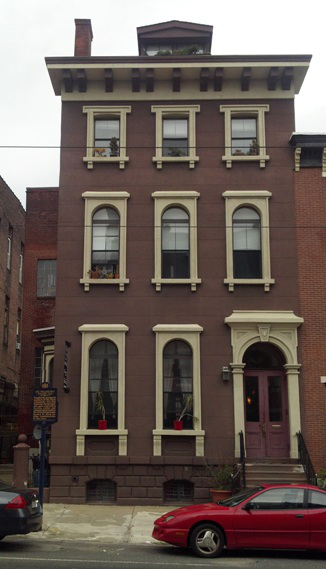
pyramid-club

The club hosted a wide range of social and cultural activities, including performances by Marian Anderson and Duke Ellington and, after 1941, annual art exhibitions for African American artists. It also hosted events with Dr. Martin Luther King Jr. and physicist J. Robert Oppenheimer, father of the atomic bomb. During the Pyramid Club’s heyday, its membership rolls were a Who’s Who of black Philadelphia.

The club was dissolved in 1963.

Pyramid Club Historical Marker

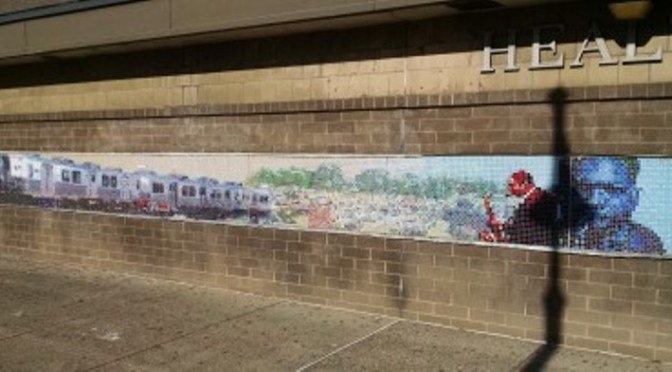
Health Care Center 6 Blue Train

The Health Centers of the Philadelphia Department of Public Health provide a full range of health services for Philadelphia’s underserved communities.

Every block tells a story about Philadelphia’s jazz heritage.

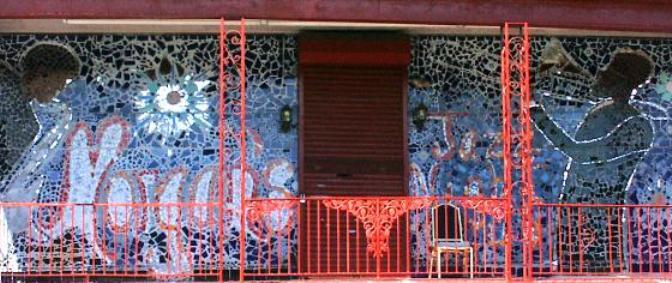
Giant Steps Mosaic

Giant Steps depicts seven key album covers, tracing John Coltrane’s career from his work with Miles Davis to his own compositions, and his great masterpiece A Love Supreme. Each mosaic was preceded by a multimedia educational program presented by the John Coltrane Cultural Society.

Ridge on the Rise Mural

This storytelling mural includes Cecil B. Moore, community members protesting at Girard College, and the Pearl Theatre where jazz greats like John Coltrane and Blanche Calloway performed.

In the mural, the art deco facade of the long gone theatre contrasts with the forbidding ten-foot stone wall that still encloses the grounds of Girard College, site of the landmark civil rights struggle.

Girard College Historical Marker

John Coltrane House

In 1952, at the age of twenty-six, with the benefit of a G.I. loan, John Coltrane bought for himself, his mother, his aunt and his first cousin the North 33rd Street property. Coltrane lived here from 1952 until 1958. It was a big, rowhouse, built for a well-to-do middle class at the turn of the 19th century and a huge step up from the cramped quarters in a deteriorating area of town where the family had been living. Coltrane owned and lived in this home longer than any other during his legendary career as a composer and saxophonist.

In 1999, the John Coltrane House was designated a National Historic Landmark, a recognition accorded to places that have “exceptional value or quality in illustrating or interpreting the heritage of the United States.”

John Coltrane Historical Marker

The recognition attests to the value of the house. The building is structurally sound but it needs some repairs. Money is needed to preserve the John Coltrane House for current and future generations.

For information on how you can help, contact the John Coltrane House.

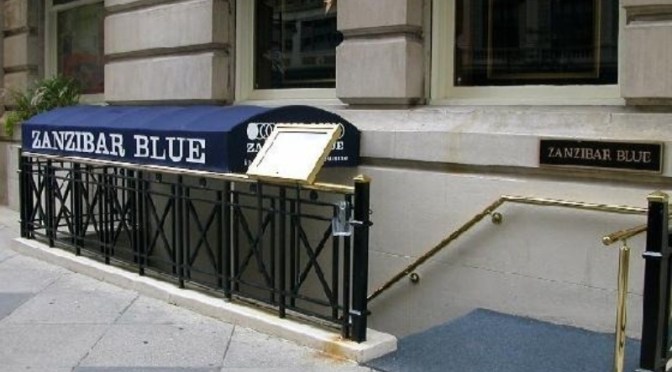
Zanzibar Blue

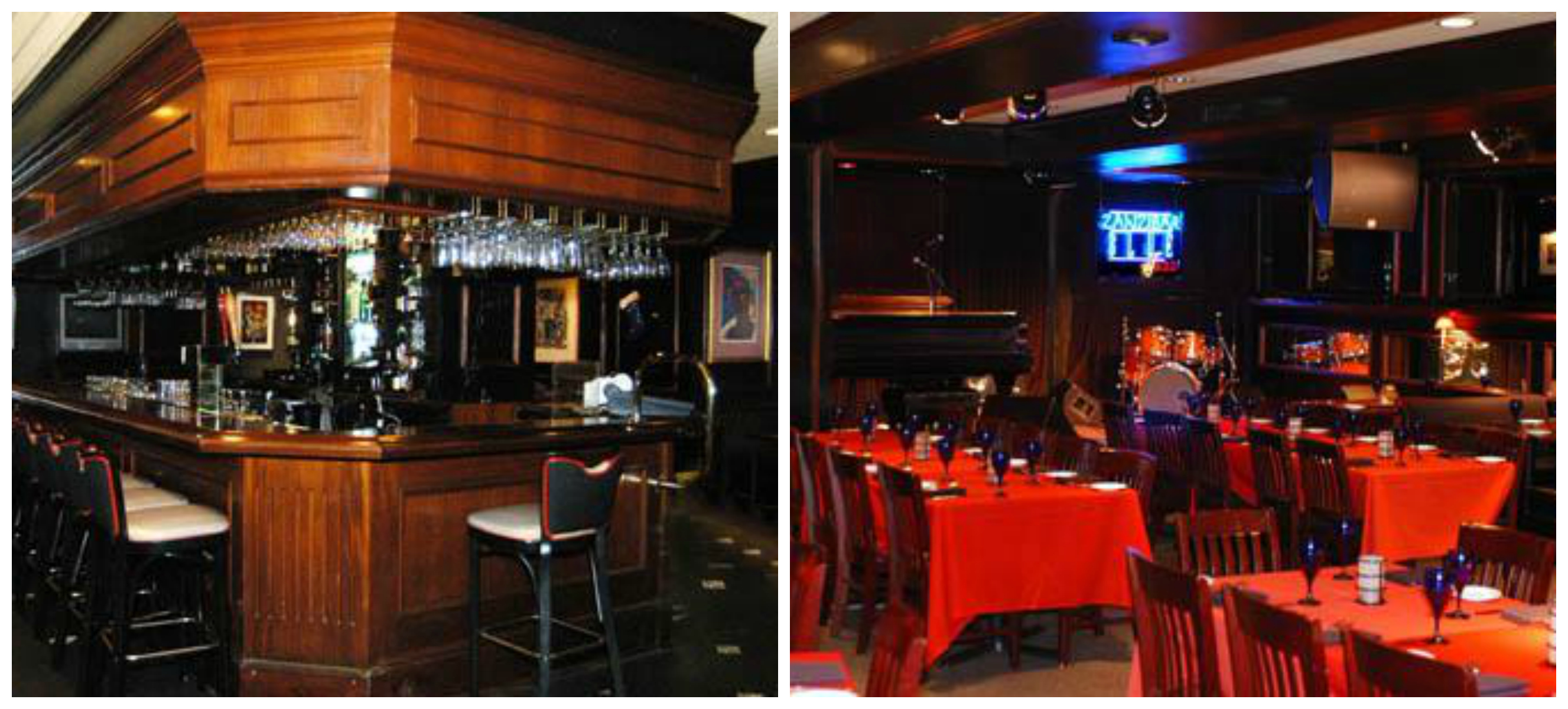
Owned by brothers, Robert and Benjamin Bynum, Zanzibar Blue first opened in 1990 on 11th Street in Washington Square West. In 1996, the club moved to the Bellevue on the Avenue of the Arts, where it played host to jazz and blues greats, including Nancy Wilson, Lou Rawls, Grover Washington, Jr., Jimmy Scott, Shirley Horn, Ahmad Jamal, Steve Tyrell, Chick Corea, Arturo Sandoval and Chuck Mangione.

Zanzibar Blue Collage - Broad Street

Smooth jazz radio station WJJZ broadcast Sunday brunches from Philadelphia’s premier jazz club. Zanzibar Blue closed on April 29, 2007.

Woodbine Club

The Woodbine Club was a private membership club that held regular weekend entertainment. The club was located on North 12th Street between Thompson and Master, less than 500 feet from John Coltrane’s apartment on North 12th Street.

John Coltrane's Apartment - 2.24.15

Regular bars were open from 9pm to 2am. Jazz musicians would hang out at the Woodbine Club from 3am to 7am. Musicians would have jam sessions where they would hone their craft and network to get gigs.

Saxophonist Odean Pope recalled:

I think the first time I heard Trane was around 1954. There was a place on 12th Street called the Woodbine Club. During that period people like Jimmy Oliver, Jimmy Heath, Red Garland, Shuggie Rose, Philly Joe Jones, those were the pioneer musicians during that period. And it was a place, an after hours place where they had entertainment, say from say twelve o’clock until around five in the morning. That was like Friday, Saturday, and Sunday. It was a sort of collaboration place where all of the musicians would come and exchange ideas and jobs. So this particular night it was Hassan Ibn Ali, Donald Bailey – some very fine percussion. They had sort of invited me along to go with them. And Trane, Jimmy Oliver, Jimmy Heath, Wilbur Cameron, Bill Barron, all of the musicians came there after they got off work and that was the most enlightened experience in my whole life, I think, of seeing so many wonderful musicians come together collectively and exchange ideas as well as perform.

Read more

Morgan’s

Organist Charles Earland and saxophonist Hank Crawford played here.

Blue Moon Jazz Club

Located in the historic Bourse Building, the Blue Moon Jazz Club played host to Johnny DeFrancesco, Norman Connors and his Starship band, guitarist Paul Jackson Jr., Nnenna Freelon, Kim Waters, Jean Carne, Frank Morgan, Dexter Wansel and Pieces of a Dream, among others.