Tag Archives: Civil Rights

Two Bit Club

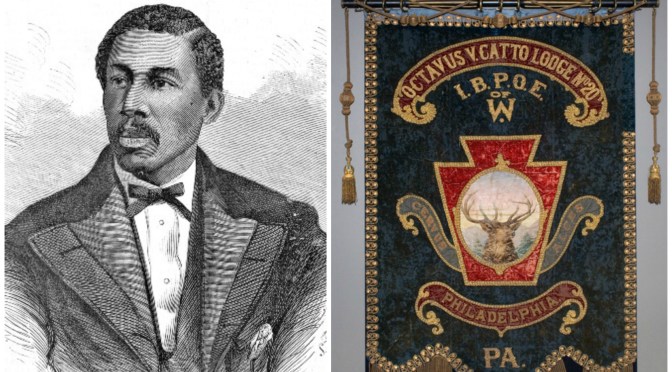
The Two Bit Club was located on the top floor of the O.V. Catto Elks Lodge, a cultural center for the African American community. The building was demolished in 1994.
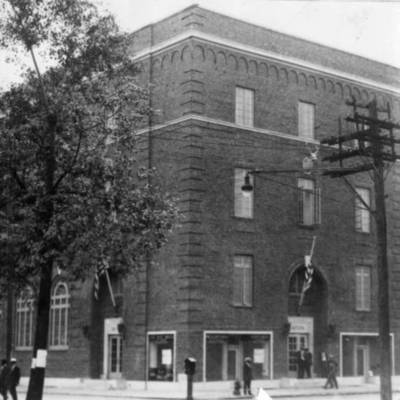
O.V. Catto Lodge - Special Collections Research Center, Temple University Libraries

From a 1994 Philadelphia Inquirer article lamenting the loss of this landmark:

Lois Fernandez, who lives a few blocks away, was one of the mourners who stopped by last week to see the wrecking ball at work.

“Damn, we’re losing a big part of our history and nobody cares,” said Fernandez, co-founder and director of Odunde, the annual African American festival on South Street.

Back in the 1950s, when Fernandez was a teenager, the “O.V.,” as she called it, was the late-night place to be.

After dinner at the former Postal Card, at 15th and South, and drinks and jazz at the former Pep’s, at Broad and South, young African Americans told each other, “Meet you at the Two Bit” after all the other clubs had closed at 2 a.m.

They were referring to the nightclub that once was located on the top floor of the old Elks Lodge.

On weekend nights until 5 a.m., couples danced the stroll, the strand and the Philly bop. The men wore their hair in the close-cropped “hustler” style and dressed in suits of silk and sharkskin. And their dates did their hair in pageboys or poodle cuts and wore long flared dresses over crinoline slips, accompanied by high heels and white gloves.

It was at the Two Bit Club that then-19-year-old Fernandez held her breath as she waited to get past the man at the door. Once inside, she ordered a Tom Collins or a Canadian Club and ginger ale, and let it sit all night until it turned to water.

“You felt so adult when you went to the Two Bit Club,” Fernandez said. ”You were always trying to act so sophisticated.”

It was at the Two Bit Club that Fernandez listened to jazz bands and saw tap dancers, her first shake dance and her first striptease.
READ MORE

Tuskegee Clubhouse

In an interview with All About Jazz, bassist Jymie Merritt talked about the “Forerunners” jazz workshops:

JM: So I started a workshop at the Tuskegee Clubhouse, and I got Kenny Lowe, the late, gifted pianist, the drummer Donald Bailey (we called him Duck), singer September Wrice and the saxophonist Odean Pope. And we kept it going for five years until I went with Max Roach.

AAJ: So the “Forerunners” was an ongoing workshop.

JM: Yes, and then we got to play on Sundays at Father Paul Washington’s church [Church of the Advocate], and I used that opportunity to go beyond the kind of bass playing I’d been exposed to, in order to develop new forms and build from that.

READ MORE

Church of the Advocate

The Church of the Advocate became a center of activism for the Civil Rights Movement embracing the cause of African American and women’s rights. It was the site of several nationally significant events, including the National Conference of Black Power (1968) and the Black Panther Convention (1970).

In the 1960s, Father Paul Washington invited musicians to come to the church for jam sessions which were held weekly on Tuesday. Tenor saxophonist Bootsie Barnes said the Church of the Advocate would be packed.

A collection of murals records the “stations” of the Civil Rights Movement.

Church of the Advocate Mural

These murals draw on Old Testament verses to dramatically illuminate parallels in African American history. Together, the medieval revival presentation of the building and the modern murals document the critical social role played by America’s inner city churches.

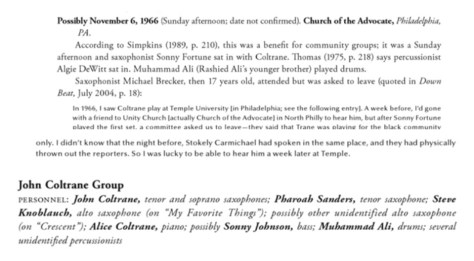
John Coltrane’s next-to-last performance in Philadelphia was held here on November 6, 1966. In an interview with DownBeat, Michael Brecker said he was asked to leave because the concert was for the black community.

Church of the Advocate - Michael Brecker Collage

For more information, visit Church of the Advocate.

Church of the Adocate Historical Marker

Earle Theater

The Earle Theater was a stop on the “Chitlin’ Circuit.” It was the most expensive theater ever built in Philadelphia. The Earle had an ornate interior and exterior and seating for 2,700. It was demolished in July 1953.

Earle Theater

In an interview with the Smithsonian Oral History Project, Philly native and NEA Jazz Master Benny Golson talked about how he was inspired to master the saxophone after seeing Lionel Hampton and Arnett Cobb at the Earle Theater:

I guess they usually went until 9 or 10 at night, which meant that they had about three or four shows a day. It was an ongoing thing. Week after week they’d have whatever band was popular. Benny Goodman, Woody Herman, anything. Charlie Spivak, Claude Thornhill, Tommy Dorsey. Any band that was popular, they would bring there. It was an ongoing thing. Count Basie, Duke Ellington. They all came there.

The reason I went is because I was in high school – Benjamin Franklin High School. The kids were coming back and says, “Oh man. You got to go to the Earle Theater and hear Lionel Hampton. You got to hear him play Flying Home.” Blah blah blah blah. So one day I didn’t go to school. I went there. That’s when I heard him. That’s when my life changed. That’s when I heard Arnett Cobb. Incidentally, years later – many years later – it must have been 50 years later – I happened to see him in Nice, France. I said, “You’re the reason that I play the saxophone.” He says, “I never knew that. Really?” I said, “Yes.” He had tears in his eyes, because he knew who I was. I said, “I hear you play, and that’s when my life changed.”

Read more

Ridge on the Rise Mural

This storytelling mural includes Cecil B. Moore, community members protesting at Girard College, and the Pearl Theatre where jazz greats like John Coltrane and Blanche Calloway performed.

In the mural, the art deco facade of the long gone theatre contrasts with the forbidding ten-foot stone wall that still encloses the grounds of Girard College, site of the landmark civil rights struggle.

Girard College Historical Marker

Jazz in Philadelphia!

Directed by Steven Berry, the documentary “Jazz in Philadelphia” came about as a result of conversations Berry had with WRTI Jazz Host Harrison “Yes Indeedy” Ridley, Jr.

A jazz educator and historian, Ridley had a lifelong dedication to what he called “the positive music.” He hosted a Sunday night show on WRTI for more than 30 years. Jazz in Philadelphia? Yes indeedy!

Blue Note

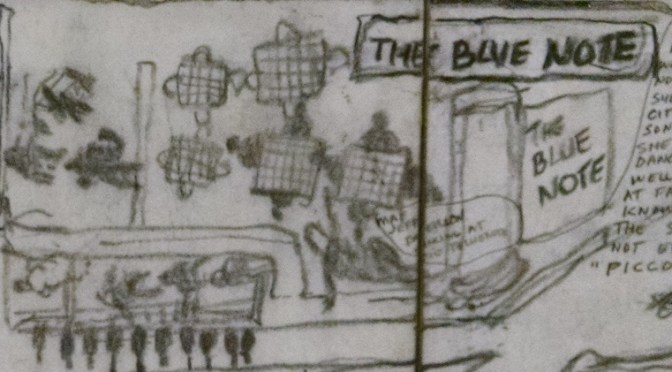
Open from 1949 to 1956, the Blue Note was located at 15th Street and Ridge Avenue. The house band, led by Ray Bryant, backed, among others, Miles Davis, John Coltrane, Lester Young, Dizzy Gillespie, Charlie Parker, Dave Brubeck, Clifford Brown, Mary Lou Williams, Buddy Rich, Chico Hamilton and Oscar Peterson.

Owner Jack Fields brought in Billie Holiday three or four times a year. Fields said, “She packed them in just to look at her.”

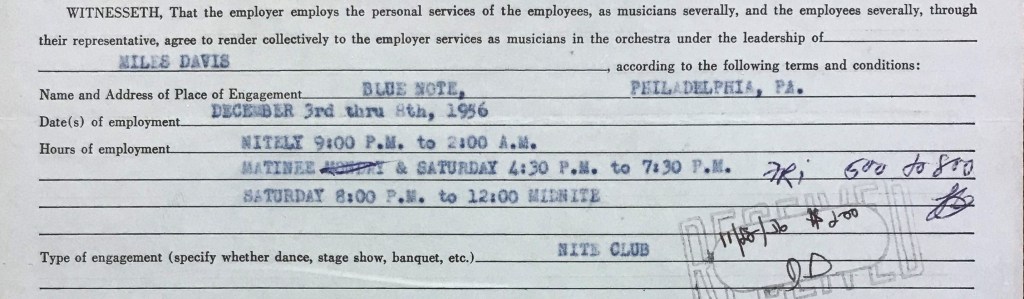
The Miles Davis Quintet, featuring John Coltrane (tenor saxophone), Red Garland (piano), Paul Chambers (bass) and Philly Joe Jones (drums), appeared at the Blue Note on December 3-8, 1956.

The performance was broadcast live on Mutual Network’s Bandstand USA. In his closing remarks, the announcer, Guy Wallace, said:

A great sound — the great sound by Miles Davis and his horn, from Lou Church’s Blue Note, 15th and Ridge Avenue down in Philadelphia. A truly fine place to go if you’re driving around down in that Philadelphia area and you want to hear some real cool jazz.

Miles Davis is the boy that can do it, because he’s one of the real great exponents of that cool sound in cool jazz. I don’t know, uh, as an observer (and more than just interested observer), I find it a pretty controversial thing to talk about cool jazz and other types of jazz, because those of you who are listening who like the clinical sound of cool jazz, really like it, and when we make any comment about it, we’re usually deluged with letters.

We hope you liked it, however, and we hope that you continue to listen to our Bandstand here on Saturday nights on Mutual as we present all types of jazz, from New Orleans to Chicago to Kansas City to the cool clinical sound of modern jazz. You’re listening to Bandstand USA on Mutual Network.

Read more

Happy Presidents’ Day

In 1964, Dizzy Gillespie threw his beret into the ring and ran for President of the United States.

dizzy-for-president-balloon

In a piece for Al Jazeera America, Tom Maxwell wrote:

It started as a joke, as so many serious things do. His booking agency had some “Dizzy Gillespie for president” buttons made around 1960, because, you see, it’s funny. Somebody even asked Gillespie why a black jazzman — a permanent member of the underclass if there ever was one — would even think of trying for the job. “Because we need one,” he said.

“Anybody coulda made a better President than the ones we had in those times, dillydallying about protecting blacks in the exercise of their civil and human rights and carrying on secret wars against people around the world,” Gillespie wrote in his autobiography “To Be, or Not … to Bop.” “I was the only choice for a thinking man.”

Vote Dizzy!

Philadelphia Clef Club Celebrates 20 Years on Avenue of the Arts

The Philadelphia Clef Club dates back to the golden age of Philly jazz. In 1966, it was formally organized as the social arm of Union Local 274, the black musicians union, whose members included Dizzy Gillespie, John Coltrane, Benny Golson, Bill Doggett, the Heath Brothers, Jimmy Smith and Nina Simone.

Over the years, the Clef Club has had five locations, including Broad and Carpenter Streets, and 13th Street and Washington Avenue. The Philadelphia Clef Club of Jazz and Performing Arts moved into its current location on the Avenue of the Arts in 1995. This construction fence told part of the story of the house that jazz built.

Construction Fence

For information about the 20th anniversary schedule of events, visit www.clefclubofjazz.org.

The Hunting of Billie Holiday

In a new book, “Chasing the Scream: The First and Last Days of the War on Drugs,” Johann Hari writes how Billie Holiday was targeted by the Federal Bureau of Narcotics after she refused to be silent about racism:

One night, in 1939, Billie Holiday stood on stage in New York City and sang a song that was unlike anything anyone had heard before. ‘Strange Fruit’ was a musical lament against lynching. It imagined black bodies hanging from trees as a dark fruit native to the South. Here was a black woman, before a mixed audience, grieving for the racist murders in the United States. Immediately after, Billie Holiday received her first threat from the Federal Bureau of Narcotics.

Harry had heard whispers that she was using heroin, and—after she flatly refused to be silent about racism—he assigned an agent named Jimmy Fletcher to track her every move. Harry hated to hire black agents, but if he sent white guys into Harlem and Baltimore, they stood out straight away. Jimmy Fletcher was the answer. His job was to bust his own people, but Anslinger was insistent that no black man in his Bureau could ever become a white man’s boss. Jimmy was allowed through the door at the Bureau, but never up the stairs. He was and would remain an “archive man”—a street agent whose job was to figure out who was selling, who was supplying and who should be busted. He would carry large amounts of drugs with him, and he was allowed to deal drugs himself so he could gain the confidence of the people he was secretly plotting to arrest.

READ MORE