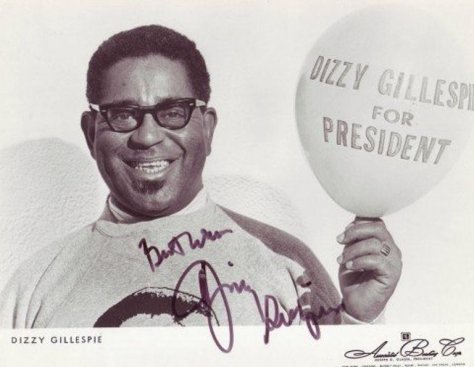
In 1964, Dizzy Gillespie threw his beret into the ring and ran for President of the United States.
In a piece for Al Jazeera America, Tom Maxwell wrote:
It started as a joke, as so many serious things do. His booking agency had some “Dizzy Gillespie for president” buttons made around 1960, because, you see, it’s funny. Somebody even asked Gillespie why a black jazzman — a permanent member of the underclass if there ever was one — would even think of trying for the job. “Because we need one,” he said.
“Anybody coulda made a better President than the ones we had in those times, dillydallying about protecting blacks in the exercise of their civil and human rights and carrying on secret wars against people around the world,” Gillespie wrote in his autobiography “To Be, or Not … to Bop.” “I was the only choice for a thinking man.”
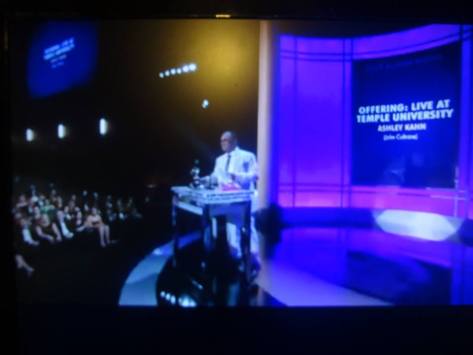
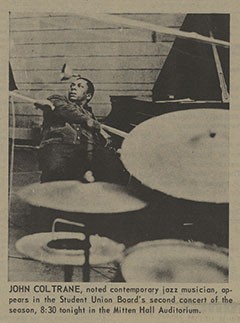
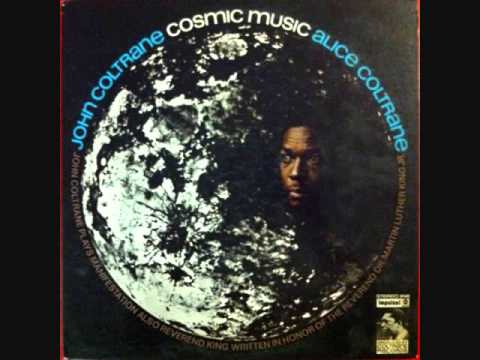
Yasuhiro Fujioka, founder of the John Coltrane House of Osaka, uncovered the long lost audiotape of John Coltrane’s last performance in Philadelphia. The Nov. 11, 1966 concert was aired live by WRTI, Temple University’s student-run radio station.
Marcus Shelby is a perennial Bay Area jazz favorite who’s compositions explore the African American experience. Shelby finds deeper meaning for his work sharing the music he loves and its history with young people in schools and juvenile halls. Learn more about Marcus Shelby.
In a new book, “Chasing the Scream: The First and Last Days of the War on Drugs,” Johann Hari writes how Billie Holiday was targeted by the Federal Bureau of Narcotics after she refused to be silent about racism:
One night, in 1939, Billie Holiday stood on stage in New York City and sang a song that was unlike anything anyone had heard before. ‘Strange Fruit’ was a musical lament against lynching. It imagined black bodies hanging from trees as a dark fruit native to the South. Here was a black woman, before a mixed audience, grieving for the racist murders in the United States. Immediately after, Billie Holiday received her first threat from the Federal Bureau of Narcotics.
Harry had heard whispers that she was using heroin, and—after she flatly refused to be silent about racism—he assigned an agent named Jimmy Fletcher to track her every move. Harry hated to hire black agents, but if he sent white guys into Harlem and Baltimore, they stood out straight away. Jimmy Fletcher was the answer. His job was to bust his own people, but Anslinger was insistent that no black man in his Bureau could ever become a white man’s boss. Jimmy was allowed through the door at the Bureau, but never up the stairs. He was and would remain an “archive man”—a street agent whose job was to figure out who was selling, who was supplying and who should be busted. He would carry large amounts of drugs with him, and he was allowed to deal drugs himself so he could gain the confidence of the people he was secretly plotting to arrest.
Later this year, Netflix will debut an original documentary about Nina Simone, What Happened, Miss Simone? The film was screened at the Sundance Film Festival.
Rolling Stone reports:
Beginning with footage of the singer staring down an audience at the Montreux Jazz Festival in 1976, What Happened goes about answering its question by flipping back to Simone’s childhood, detailing her early musical ambitions to be the first black female classical pianist. Despite her talent and the financial support of well-to-do patrons, she was rejected by the prestigious Curtis Institute in Philadelphia; that “early jolt of racism,” as Simone referred to the incident, became the first of several events to fuel an inexhaustible supply of anger at society. A summer gig at an Atlantic City bar gave birth to the blues chanteuse she’d eventually become, with the film tracing her rise to hit recording artist, jazz sensation, long-suffering wife (her manager/husband Andrew Stroud does not come off well), a major player in the Civil Rights movement, industry pariah, American ex-pat, playing-for-chump-change café performer and, eventually, a rediscovered legend.
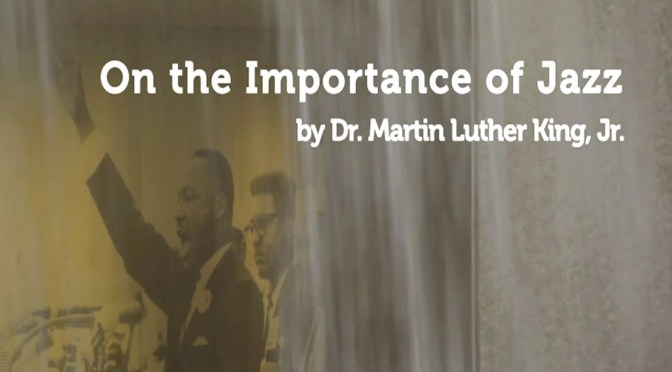
In remarks to the 1964 Berlin Jazz Festival, Rev. Martin Luther King Jr. spoke about the importance of jazz in paving the way for the Civil Rights Movement.
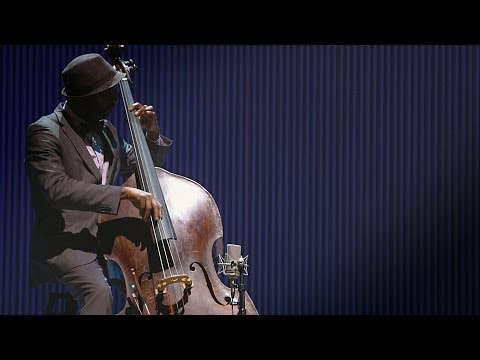
The Jazz Connect Conference, organized by JazzTimes and the Jazz Forward Coalition, was held January 8-9, 2015, in New York City and led into the annual Association of Performing Arts Presenters Conference, as well as Winter Jazzfest. The Jazz Connect Conference featured a series of workshops, panels discussions, and keynote address by Philly-native Christian McBride.
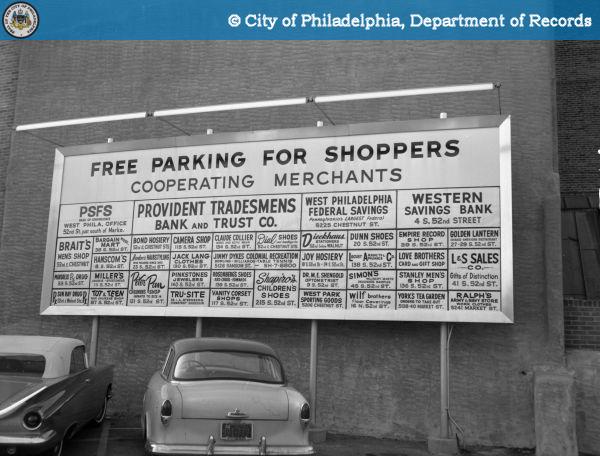
West Philly’s Main Street, 52nd Street, is a historic cultural and commercial corridor that stretches from Arch Street to the north and Baltimore Avenue to the south.
In a 2012 interview with Hidden City Philadelphia, Shirley Randleman, then-president of the 52nd Street Business Association, recounted:
Oh, it was wonderful. It was a thriving commercial corridor surrounded by a neighborhood that was financially stable. The 52nd Street corridor had five movie theaters, many high-end clothing stores, and eateries like Horn & Hardart, with the nickel automats. There were bakeries, doctor’s offices, and independent stores, like Buster Brown shoes. 52nd Street was the entertainment capital of West Philadelphia, AKA “the Strip,” and every top notch entertainer found his way there. It was more than just shops; it was the community meeting place. People were engaged in conversations in every shop and on the streets. We lived together.
In the 1960s and ‘70s, 52nd Street, aka “the Strip,” was the place to see and be seen. Celebrities including Muhammad Ali, Cab Calloway, Billy Eckstine, Joe Frazier, Teddy Pendergrass, Stevie Wonder, and members of the Philadelphia Eagles and Phillies hung out at Mr. Silk’s 3rd Base.
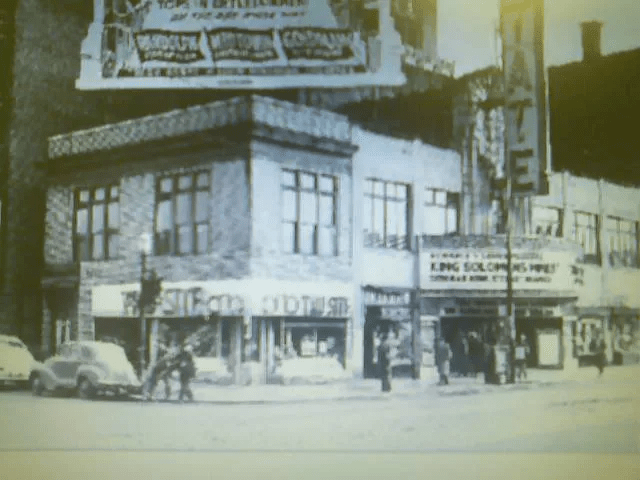
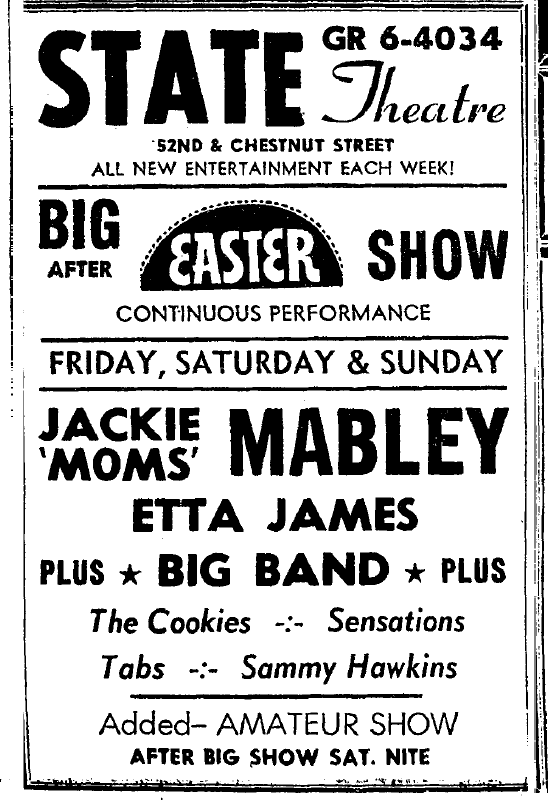
Everyone ordered mammer jammer sandwiches at Foo Foo’s Steak House. Top jazz musicians performed at the Aqua Lounge. Etta James and Jackie “Moms” Mabley graced the stage of the State Theatre in April 1963.
For more risqué entertainment, one could go to the Pony Tail and watch go-go girls bend over and “shake a tail feather.”
Lee Morgan’s historical marker was installed at 52nd and Chancellor streets in front of the former location of the Aqua Lounge (now African Cultural Art Forum) on International Jazz Day 2024.
Join All That Philly Jazz Director Faye Anderson for a stroll along 52nd Street. The walk and talk will start at Malcolm X Memorial Park and end at the Red Rooster.
The most recent 52nd Street Stroll was held on Saturday, October 5, 2024.
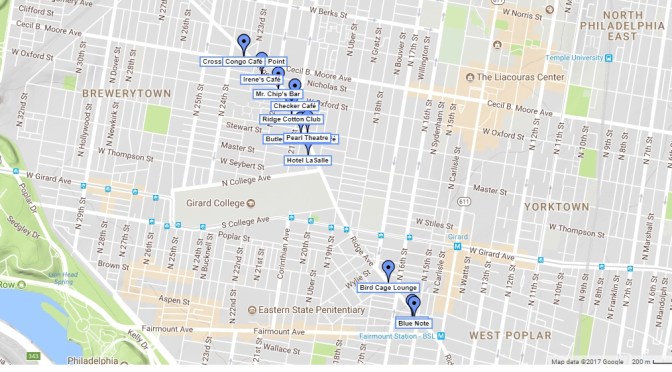
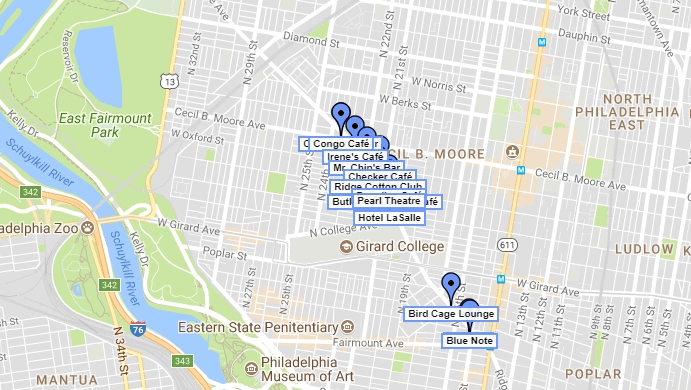
During Philadelphia’s golden age of jazz, there were jazz clubs in every neighborhood. There were so many clubs that folks in North Philly didn’t go to joints in South Philly and vice versa. There was a handful of clubs that reached legendary status and attracted patrons from all over the city. The Blue Note at 15th Street and Ridge Avenue was “the town’s swankiest jazz emporium.”
From 15th Street to Columbia Avenue (later renamed Cecil B. Moore Avenue), Ridge Avenue was a jazz corridor where legends-in-the-making roamed.









 All That Philly Jazz