All posts by Faye Anderson

I am director of All That Philly Jazz, a place-based public history project that is documenting and contextualizing Philadelphia’s golden age of jazz. The project is at the intersection of art, public policy, and cultural heritage preservation.

Blue Note

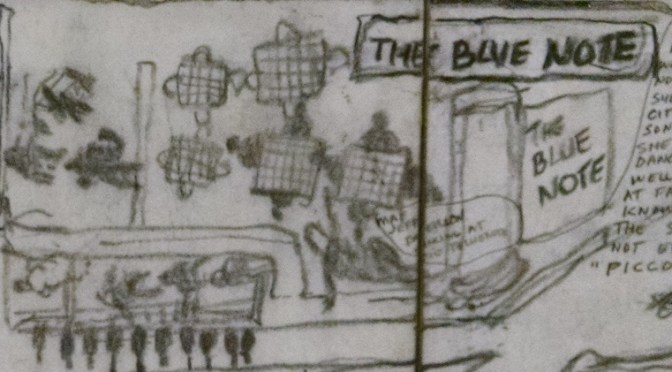
Open from 1949 to 1956, the Blue Note was located at 15th Street and Ridge Avenue. The house band, led by Ray Bryant, backed, among others, Miles Davis, John Coltrane, Lester Young, Dizzy Gillespie, Charlie Parker, Dave Brubeck, Clifford Brown, Mary Lou Williams, Buddy Rich, Chico Hamilton and Oscar Peterson.

Owner Jack Fields brought in Billie Holiday three or four times a year. Fields said, “She packed them in just to look at her.”

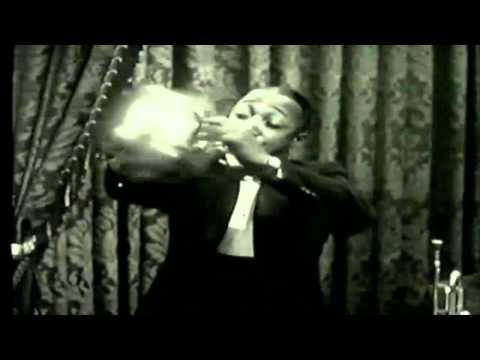
The Miles Davis Quintet, featuring John Coltrane (tenor saxophone), Red Garland (piano), Paul Chambers (bass) and Philly Joe Jones (drums), appeared at the Blue Note on December 3-8, 1956.
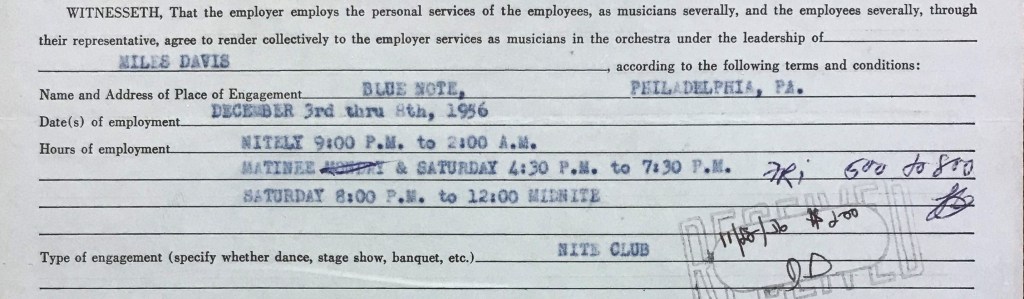
The performance was broadcast live on Mutual Network’s Bandstand USA. In his closing remarks, the announcer, Guy Wallace, said:

A great sound — the great sound by Miles Davis and his horn, from Lou Church’s Blue Note, 15th and Ridge Avenue down in Philadelphia. A truly fine place to go if you’re driving around down in that Philadelphia area and you want to hear some real cool jazz.

Miles Davis is the boy that can do it, because he’s one of the real great exponents of that cool sound in cool jazz. I don’t know, uh, as an observer (and more than just interested observer), I find it a pretty controversial thing to talk about cool jazz and other types of jazz, because those of you who are listening who like the clinical sound of cool jazz, really like it, and when we make any comment about it, we’re usually deluged with letters.

We hope you liked it, however, and we hope that you continue to listen to our Bandstand here on Saturday nights on Mutual as we present all types of jazz, from New Orleans to Chicago to Kansas City to the cool clinical sound of modern jazz. You’re listening to Bandstand USA on Mutual Network.
Read more

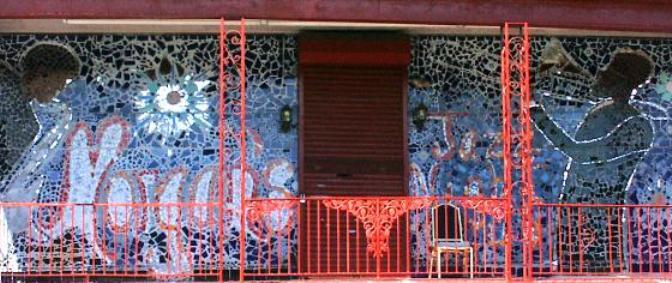
Morgan’s

Organist Charles Earland and saxophonist Hank Crawford played here.

Mama Rosa’s

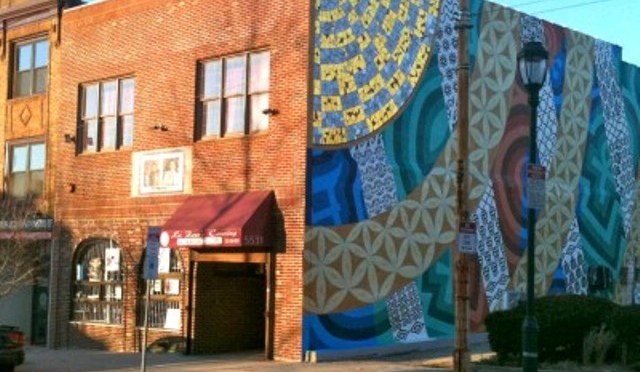
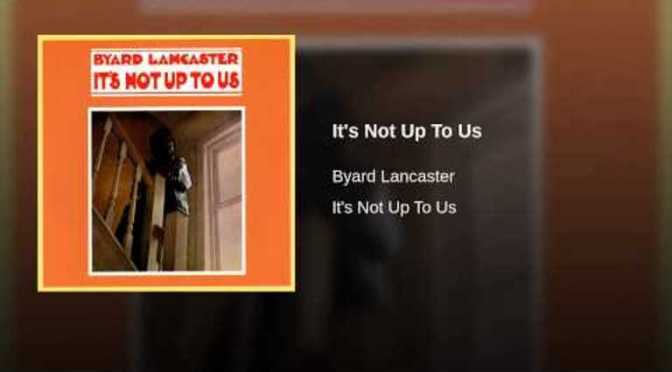
Located in the space now occupied by the LaRose Jazz Club, Mama Rosa was a popular neighborhood joint in the early 1970s. The weekly jam sessions were organized by multi-instrumentalist Byard Lancaster.

Foo Foo’s Steak House

After a night out on “the Strip,” folks would stop by Foo Foo’s Steak House to pick up a Mammer Jammer sandwich to eat on the way home.

In his autobiography, You Only Rock Once, Jerry Blavat, “the Geator with the Heater,” shared memories of Sammy Davis Jr.:

I remembered how he would call me every time he appeared at the Latin [Casino] and ask if I would go to Foo-Foo’s in West Philadelphia and get his “mammajamma” sandwiches.

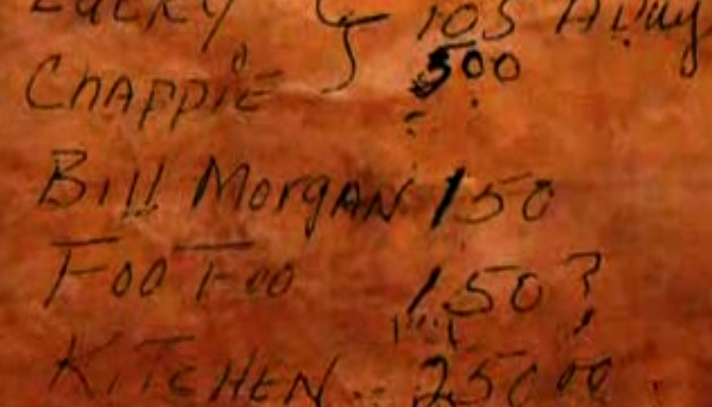
James “Foo Foo” Ragan, a numbers banker (illegal street lottery) and nightlife king, opened his eponymous restaurant in 1963. Foo Foo was featured on Gilbey’s Gin billboards in Philadelphia.

From Black Brothers Inc.: The Violent Rise and Fall of Philadelphia’s Black Mafia:

Notwithstanding Ragan’s criminal history, he soon found himself as an extension of the Black Mafia’s racket. “The older heads like [Gus] Lacy and Ragan were given a choice: come in out of the rain or stay out there in the cold,” said one informer. “They hadn’t salted any money away and they were too old to take on the opposition, so they fell into line. The old saying used to be, “You can’t fight City Hall.” Now the saying is, “You can’t buck the system, and this is the system.”

This page from the “Black Mafia notebook” confiscated by the Philadelphia Police Department Organized Crime Unit shows Foo Foo was being shaken down for a weekly “street tax.”

Foo Foo Ragan's Soliciation

Source: American Gangster – The Philly Black Mafia

LaRose Jazz Club

The LaRose Jazz Club presents a weekly Sunday Open Jam Session for seasoned performers and young lions. All instrumental musicians, vocalists, spoken word and jazz poets are welcome. The house band provided by Rob Henderson features a different bassist and pianist each week. Henderson supplies the drums, but musicians are encouraged to sit in throughout the night.

The Sessions run from 6-10 p.m. Admission is $5.00; food and drink are available.

There’s live jazz on Mondays, from 6-9 p.m. with legendary alto saxophonist Tony Williams. For more information, call (215) 844-5818.

2018 UPDATE:

Tony Williams and the Giants of Jazz now take the stage every Monday night and it is a communal affair. They never turn away a willing performer, whether a youngster from the community, a walk-in looking for fun or even someone with a now-questionable reputation in Bill Cosby.

Club LaRose, which is often referred to as LaRose Jazz Club, was in the news after Cosby’s performance there on January 19. But behind the protests, reporters and cameras that evening sat a loyal audience, one that proudly visits the club every week.

“You find people of every stripe, of every dot, every color, every age, every variance that you can think of is in this place and it’s just so warm and wonderful,” said Toni Rose, a Germantown resident who does not miss a Monday show.

Read more at Philadelphia Neighborhoods.

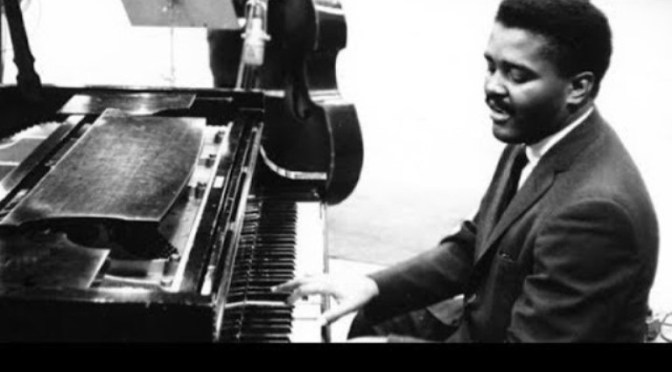
Located in Center City, Just Jazz hosted jazz and blues greats, including George Benson, McCoy Tyner, Morgana King, Bobbi Humphrey, Esther Phillips, Arthur Prysock, Les McCann, Lou Rawls, Jimmy Smith and Al Grey.

Miles Davis performed here on May 17, 1975.

Caravan Republican Club

From Jazz.com:

Ray Bryant and [Benny] Golson played regularly in late 1946 with bassist Gordon “Bass” Ashford. They performed one night a week at Joe Pitt’s Musical Bar, and weekends at the Caravan Republican Club, for as long as six months at a stretch.

READ MORE

Red Rooster Cafe

The Red Rooster Cafe opened circa 1952. The West Philly jazz club had a seating capacity of 350. Drummer Coatesville Harris led the house band. Coatesville’s 1953 recording, “Strange Things All The Rage,” features an uncredited solo by John Coltrane.

According to the radio documentary “Tell Me How Long Trane’s Been Gone,” in 1957 Coltrane kicked his heroin habit cold turkey by day and played at the Red Rooster at night.

McCoy Tyner met Coltrane at the Red Rooster when he was working a gig with the Cal Massey Band. It was here that Tyner played with Trane for the first time. From a 1997 news article:

It was at the Red Rooster, a now defunct jazz club on 52nd and Market streets in West Philadelphia, where Massey, a long-time Coltrane friend, introduced Tyner to the saxophonist. Later that afternoon, the club owner asked Coltrane if he would play the next week at the club. Coltrane didn’t have a rhythm section — in fact, he didn’t have a working band — so, with Massey’s blessing, he borrowed Massey’s band, which included Tyner and Garrison.

In an essay in “Lost Shrines of Jazz,” noted author and scholar James G. Spady wrote:

Saxophonist and Coltrane collaborator Archie Shepp, hailed in the ‘60s as one of the jazz purveyors of the so-called “new thing,” reflected on Philly’s importance to him:

I don’t want to leave out Clarence “C” Sharp, who was a tremendous influence and has helped me off and on. He was one of the main teachers in the Philadelphia school. . . . The first time I heard Trane, I was with Reggie Workman. We went to hear Coltrane at the Red Rooster out in West Philly. McCoy Tyner was playing with Trane that night. He [Coltrane] had a lot of problems with his teeth. (I didn’t know this until much later.) He didn’t play much. But what he played was so unusual. I was a bit frustrated by that. I had no idea at that time just how enormous this man’s capabilities were. One of my friends said, “That’s Philly Joe, the cat that went on to play with Miles.” He played drums that night.

The Red Rooster has long since closed its doors. The building is still there. It’s the last stop on the walking tour, 52nd Street Stroll.

Watts’ Zanzibar

Watts’ Zanzibar was located on the “Golden Strip.” In the 1940s, the house band was led by tenor saxophonist Jimmy Oliver who later played with Bootsie Barnes, the Heath Brothers and John Coltrane, and recorded with Dizzy Gillespie.

In an essay in “Lost Shrines of Jazz,” noted author and scholar James G. Spady wrote:

Perhaps no institution in the city was more responsible for Philly’s bop revolution than a North Philly club named Watts’ Zanzibar, located at 1833 W. Columbia Avenue (now named Cecil B. Moore Avenue, in honor of a black attorney and 1960s Civil Rights leader in Philadelphia). It was recognized as the bop spot, the home of modern African American culture. Sonically and sartorially hip, it both nurtured and reflected bop ethics and aesthetics. The very name reflected the old and the new: Africa and America, Watts’ Zanzibar. The proprietors were brothers Richard and Robert Watts.

Read more