Tag Archives: Lee Morgan

2016 NEA Jazz Master Archie Shepp

The 2016 NEA Jazz Masters were honored at a tribute concert at the John F. Kennedy Center for the Performing Arts.

This year’s class includes Archie Shepp who grew up in West Philadelphia. During an NEA interview, Shepp talked about jazz and Philadelphia:

The music that we call jazz has always been important in the African American community, especially in the poorer neighborhoods.

There was a lot of racism and prejudice, but a lot of music, a lot of blues and some good times. Music was all over Philadelphia. You could go down to North Philadelphia and hear young John Coltrane or Johnny Coles, Jimmy Oliver, Jimmy Heath. I suppose that’s what jazz is all about, suffering and good times, and somehow making the best of all of that.

At the tribute concert for Benny Carter, I got a chance to spend some time with Shepp during the break. He reminisced about the jam sessions at the Heath Brothers’ Family Home. He shared that he learned how to play chords from Coltrane and Lee Morgan.

Truth be told, Philadelphia’s contribution to jazz is mostly an untold story. We must capture stories about Philly’s jazz scene while those who know the history are still here.

Joe Pitts’ Musical Bar

Joe Pitts’ Musical Bar was located in his “hostelry,” the Pitts Hotel. Joe Pitts’ and Watts’ Zanzibar were mentioned in the August 24, 1946 issue of Billboard.

Joe Pitts' Musical Bar

From Jazz.com:

Ray Bryant and [Benny] Golson played regularly in late 1946 with bassist Gordon “Bass” Ashford. They performed one night a week at Joe Pitt’s Musical Bar, and weekends at the Caravan Republican Club, for as long as six months at a stretch.

Read more

2015 BlackStar Film Festival

The 4th annual BlackStar Film Festival gets underway on Thursday, July 30.

BlackStar Film Festival Logo

The four-day film fest is “a celebration of cinema focused on work by and about people of African descent in a global context. BlackStar highlights films that are often overlooked from emerging, established, and mid-career directors, writers and producers working in narrative, documentary, experimental and music video filmmaking.” The program also includes panel discussions and workshops.

I am particularly looking forward to “Virtuosity,” a collection of shorts, including University of Pennsylvania music professor Guthrie Ramsey’s documentary, “Amazing: The Tests and Triumph of Bud Powell.” The film is based on Ramsey’s 2013 book, The Amazing Bud Powell: Black Genius, Jazz History and the Challenge of Bebop.

Powell had frequent gigs in Philly in the 1940s and ‘50s. He performed in such legendary jazz spots as Watts’ Zanzibar, Downbeat and The Point. While in town, Powell shared his genius with young musicians, including Lee Morgan, at the Heritage House Jazz Workshop.

The festival runs from July 30 to Aug. 2. For the full schedule and ticket information, visit BlackStar Film Fest.

Music City

In 1947, drummer Ellis Tollin and his business partner William E. Welsh opened Music City, an instrument store located on the second floor of the Wurlitzer Building.

Tollin transformed the third floor into a 250-seat performance space, Music City Swing Club, where top jazz musicians, including Charlie Parker, Dizzy Gillespie, Miles Davis, Art Blakey and Buddy Rich held jam sessions and mentored young musicians like Bobby Timmons, Archie Shepp and Lee Morgan (circled).

Trumpeter Ted Curson recalled:

It was like the scene in Philadelphia for young cats and old cats. They would bring guys in from New York to play and they would have the young guys sit in with them. If you played pretty good you always ended up with some kind of gig.

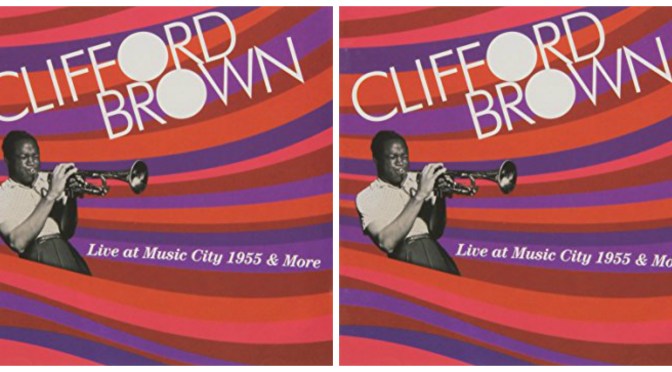
Jazz legend Clifford Brown gave his last performance at Music City. He left directly from here for a gig in Chicago. He never made it. He was killed in a car accident on the Pennsylvania Turnpike on June 26, 1956.

In a piece for Hidden City Philadelphia, archivist and Philadelphia music historian Jack McCarthy wrote:

On Tuesday evenings in the mid 1950s, young jazz enthusiasts from all over the city would gather inside the popular music store, Music City, at what is now 1033 Chestnut Street. Some came to jam, while others sat back and listened to intimate performances by major players of the era. It was an especially fertile period in Philly jazz when the city hummed with lively clubs and was home to many of the genre’s important instrumentalists. For aspiring teenage musicians who were too young to get into the clubs, Music City was a place to trade notes with fellow young players and even to play with their musical heroes if they were lucky. Many emerging Philly jazz performers of the 1950s cut their teeth there.

[…]

[Clifford] Brown had established himself as one of the top trumpeters in jazz by the mid1950s. He was living in Philadelphia during this period and was a frequent, featured guest at Music City. As the original story went, Brown performed at the store on the evening of June 26, 1956, accompanied by Ellis Tollin on drums and several other Philly musicians, and left directly from there to drive to a gig in Chicago. With him on the trip were the pianist Richie Powell and his wife, Nancy, who did the driving. On the Pennsylvania Turnpike between Harrisburg and Pittsburgh, the car ran off the road and crashed, killing all three.

Read more

Heritage House Jazz Workshop

From Jeffrey S. McMillan, “A Musical Education: Lee Morgan and the Philadelphia Jazz Scene of the 1950s”:

Early in 1954, a Camden, New Jersey, DJ named Tommy Roberts began holding jazz sessions at the Heritage House [Educational and Cultural Center], a north Philadelphia community center located on the second floor of what is now the Freedom Theater at 1346 N. Broad Street. These sessions became an important part of the Philadelphia jazz scene, especially for young musicians, and gave birth to a series of events known as the “Jazz Workshop.” Beginning in April 1954, the Workshop met every Friday afternoon from 4:00 to 6:00 and featured prominent jazz artists who were in town playing evening engagements in the clubs in Center City. The first hour of each session entailed a performance by the featured artists and was followed by an intermission where members of the audience were free to socialize with the musicians. The second hour was devoted to young musicians and composers who were encouraged to sit in with the artists or submit their work to be performed by the band. This unique, hands-on opportunity for youngsters to learn about jazz was augmented by the quality of artists that appeared at the Workshop.

In 1954 alone the artists included the Chet Baker Quintet (featuring James Moody), Johnny Hodges’s band (which, at the time, included John Coltrane), Buddy DeFranco, Art Blakey’s Jazz Messengers, Bud Powell, Ella Fitzgerald, George Shearing, Roy Eldridge, the Erroll Garner Trio, and Billy Taylor. Besides a 75¢ admission fee, there was only one restriction to being admitted to the Workshop: every attendee was required to be twenty years old or younger. Those of legal drinking age, twenty-one or older, had to take their business to the clubs to hear the artists.

Read More

Tuskegee Clubhouse

In an interview with All About Jazz, bassist Jymie Merritt talked about the “Forerunners” jazz workshops:

JM: So I started a workshop at the Tuskegee Clubhouse, and I got Kenny Lowe, the late, gifted pianist, the drummer Donald Bailey (we called him Duck), singer September Wrice and the saxophonist Odean Pope. And we kept it going for five years until I went with Max Roach.

AAJ: So the “Forerunners” was an ongoing workshop.

JM: Yes, and then we got to play on Sundays at Father Paul Washington’s church [Church of the Advocate], and I used that opportunity to go beyond the kind of bass playing I’d been exposed to, in order to develop new forms and build from that.

READ MORE

Earle Theater

The Earle Theater was a stop on the “Chitlin’ Circuit.” It was the most expensive theater ever built in Philadelphia. The Earle had an ornate interior and exterior and seating for 2,700. It was demolished in July 1953.

Earle Theater

In an interview with the Smithsonian Oral History Project, Philly native and NEA Jazz Master Benny Golson talked about how he was inspired to master the saxophone after seeing Lionel Hampton and Arnett Cobb at the Earle Theater:

I guess they usually went until 9 or 10 at night, which meant that they had about three or four shows a day. It was an ongoing thing. Week after week they’d have whatever band was popular. Benny Goodman, Woody Herman, anything. Charlie Spivak, Claude Thornhill, Tommy Dorsey. Any band that was popular, they would bring there. It was an ongoing thing. Count Basie, Duke Ellington. They all came there.

The reason I went is because I was in high school – Benjamin Franklin High School. The kids were coming back and says, “Oh man. You got to go to the Earle Theater and hear Lionel Hampton. You got to hear him play Flying Home.” Blah blah blah blah. So one day I didn’t go to school. I went there. That’s when I heard him. That’s when my life changed. That’s when I heard Arnett Cobb. Incidentally, years later – many years later – it must have been 50 years later – I happened to see him in Nice, France. I said, “You’re the reason that I play the saxophone.” He says, “I never knew that. Really?” I said, “Yes.” He had tears in his eyes, because he knew who I was. I said, “I hear you play, and that’s when my life changed.”

Read more

Blue Note

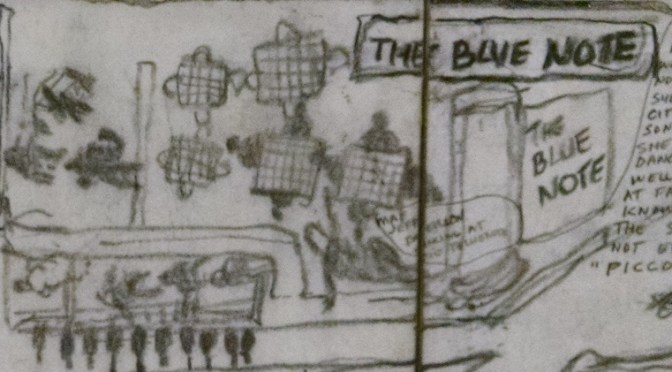
Open from 1949 to 1956, the Blue Note was located at 15th Street and Ridge Avenue. The house band, led by Ray Bryant, backed, among others, Miles Davis, John Coltrane, Lester Young, Dizzy Gillespie, Charlie Parker, Dave Brubeck, Clifford Brown, Mary Lou Williams, Buddy Rich, Chico Hamilton and Oscar Peterson.

Owner Jack Fields brought in Billie Holiday three or four times a year. Fields said, “She packed them in just to look at her.”

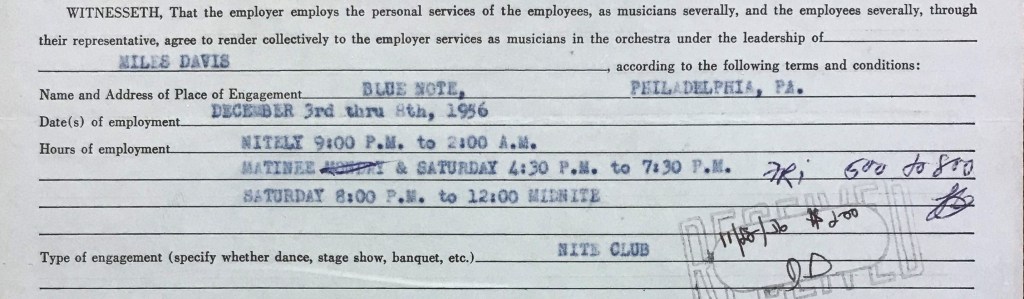
The Miles Davis Quintet, featuring John Coltrane (tenor saxophone), Red Garland (piano), Paul Chambers (bass) and Philly Joe Jones (drums), appeared at the Blue Note on December 3-8, 1956.

The performance was broadcast live on Mutual Network’s Bandstand USA. In his closing remarks, the announcer, Guy Wallace, said:

A great sound — the great sound by Miles Davis and his horn, from Lou Church’s Blue Note, 15th and Ridge Avenue down in Philadelphia. A truly fine place to go if you’re driving around down in that Philadelphia area and you want to hear some real cool jazz.

Miles Davis is the boy that can do it, because he’s one of the real great exponents of that cool sound in cool jazz. I don’t know, uh, as an observer (and more than just interested observer), I find it a pretty controversial thing to talk about cool jazz and other types of jazz, because those of you who are listening who like the clinical sound of cool jazz, really like it, and when we make any comment about it, we’re usually deluged with letters.

We hope you liked it, however, and we hope that you continue to listen to our Bandstand here on Saturday nights on Mutual as we present all types of jazz, from New Orleans to Chicago to Kansas City to the cool clinical sound of modern jazz. You’re listening to Bandstand USA on Mutual Network.

Read more

Lee Morgan ‘Walking the Bar’

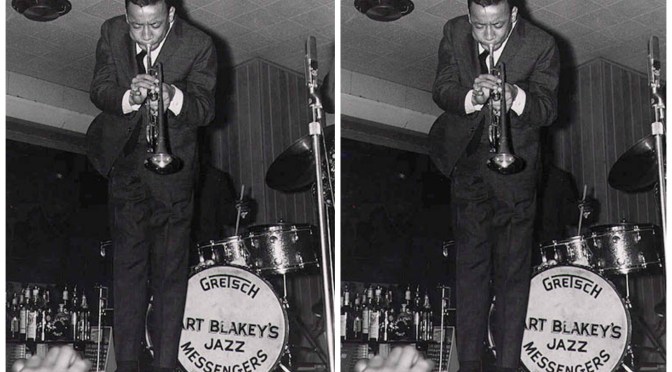
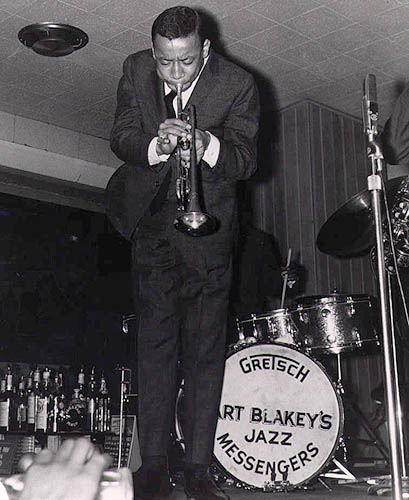
Back in the day, musicians used to “walk the bar.” Philly native Lee Morgan was among those “honking and stepping.”

Lee-Morgan-Walking-the-Bar

In an interview with the Smithsonian Jazz Oral History Project, NEA Jazz Master and Philly native Benny Golson said: “I caught my boy John Coltrane on the bar.” In a 2009 piece, jazz critic Marc Myers also shared the story:

In 1954, Coltrane’s expanding heroin and alcohol addiction cost him playing jobs, most notably a significant one with alto saxophonist Johnny Hodges. After moving back to Philadelphia, Coltrane was forced to play with local R&B bands to make ends meet. In some of these bands, he had to honk away on the tenor while walking along the bar. One night, he saw childhood friend and tenor saxophonist Benny Golson enter the club. Mortified, Coltrane climbed off the bar and walked out for good.

The Smithsonian interviewer asked Golson where the tradition was started:

I don’t know where it started. It didn’t start with the jazz artists, per se. It started with one of the entertainers. An entertainer’s plot is to do or to second-guess what the audience wants to hear. Yeah, I got involved in that. I did some crazy stuff when I was doing all that stuff. You do what you think is going to entertain them. It’s going to bring acclaim to what you’re doing. Yeah, what’s more ridiculous than getting up on the bar where the drinks are and start playing your low B-flats no matter what key you’re in, just honking. We call that honking and stepping. They’re applauding. Ain’t nothing happening. Stepping over those drinks.

Read More

The Golden Strip

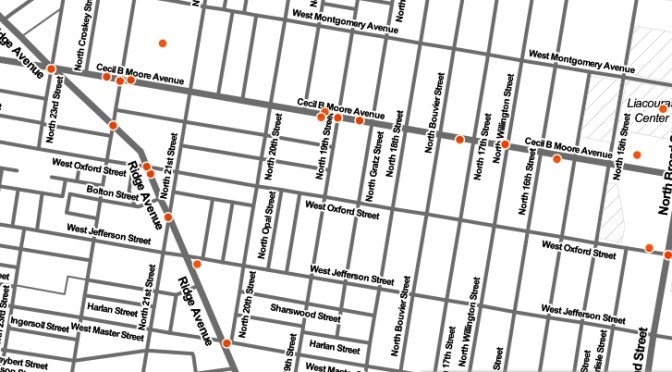
The “Golden Strip” spanned Columbia Avenue from 8th Street to 23rd Street. With neon signs aglow, it was also known as the “Great White Way.” Noted author and hip-hop scholar James G. Spady wrote:

The biggest concentration of bars and clubs frequented by blacks and offering Jazz was along Columbia Avenue (later renamed Cecil B. Moore Avenue). Among what as upwards of fifteen different venues were the Crystal Ball, 820 Club, Spider Kelly’s, Watts Zanzibar — one of the few black owned venues—and the North West Club. [Lee] Morgan played at many of these with groups made up of his peers. The trumpeter Cullen Knight remembered seeing Morgan at the North West, leading a band consisting of tenor saxophonist Odean Pope and a rhythm section of McCoy Tyner, Reggie Workman and Ronald Tucker.

Both the Zanzibar and North West were private clubs, and these were often keener to employ, under-age musicians than other venues; in addition, removed from some off the commercial concerns of the regular bars, they were thought of as sites for some degree of experiment among young musicians, as ‘hardcore’ bebop clubs where players could cultivate their jazz improvisation without needing to make concessions to dancers or casual listeners. Private venues would often pay the musicians a decent nightly fee, often around $10.

In Whisper Not: The Autobiography of Benny Golson, the NEA Jazz Master recalled his days on the Golden Strip with John Coltrane:

On jam days—Saturday afternoons between four and seven—John and I started at one end of Columbia Avenue, where most of the clubs were located, and proceeded toward the other end. We played at each club for an hour, then moved to the next. If we didn’t get to a particular club, we started there the following week. These clubs were small, on the ground floor of apartment houses or in storefront slots, long and narrow.

Published by Temple University Press, Golson’s autobiography is available for purchase here.