Tag Archives: #BlackCultureMatters

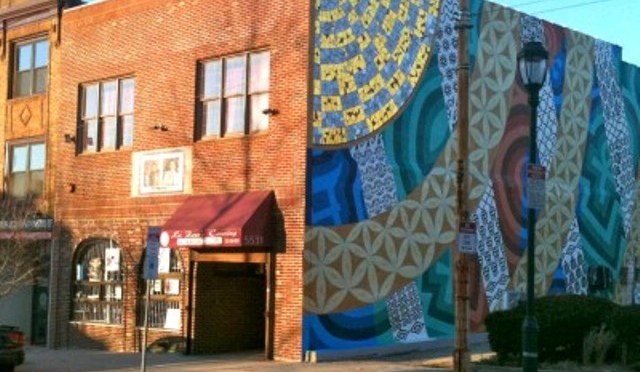
LaRose Jazz Club

The LaRose Jazz Club presents a weekly Sunday Open Jam Session for seasoned performers and young lions. All instrumental musicians, vocalists, spoken word and jazz poets are welcome. The house band provided by Rob Henderson features a different bassist and pianist each week. Henderson supplies the drums, but musicians are encouraged to sit in throughout the night.

The Sessions run from 6-10 p.m. Admission is $5.00; food and drink are available.

There’s live jazz on Mondays, from 6-9 p.m. with legendary alto saxophonist Tony Williams. For more information, call (215) 844-5818.

2018 UPDATE:

Tony Williams and the Giants of Jazz now take the stage every Monday night and it is a communal affair. They never turn away a willing performer, whether a youngster from the community, a walk-in looking for fun or even someone with a now-questionable reputation in Bill Cosby.

Club LaRose, which is often referred to as LaRose Jazz Club, was in the news after Cosby’s performance there on January 19. But behind the protests, reporters and cameras that evening sat a loyal audience, one that proudly visits the club every week.

“You find people of every stripe, of every dot, every color, every age, every variance that you can think of is in this place and it’s just so warm and wonderful,” said Toni Rose, a Germantown resident who does not miss a Monday show.

Read more at Philadelphia Neighborhoods.
Caravan Republican Club

From Jazz.com:

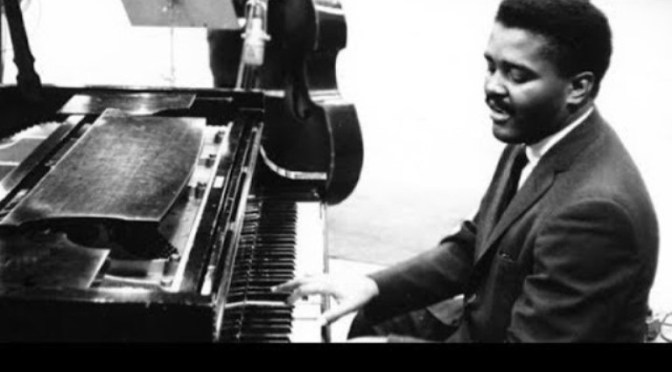
Ray Bryant and [Benny] Golson played regularly in late 1946 with bassist Gordon “Bass” Ashford. They performed one night a week at Joe Pitt’s Musical Bar, and weekends at the Caravan Republican Club, for as long as six months at a stretch.

READ MORE

Philly Groove Records

Located in West Philly on “the Strip,” Philly Groove Records was owned by Stan “The Man” Watson.

The record company put out discs by First Choice, the Delfonics and other lesser-known local acts. Thom Bell, who produced some of the Delfonics’ biggest hits at Sigma Sound Studios, met singer-songwriter Linda Creed while with Philly Groove. The Bell-Creed alliance hit it big in the ’70s with a string of hits they wrote and produced for the Spinners.

According to author Sean Patrick Griffin, the record company had ties to the fearsome Black Mafia:

John Stanley “Stan the Man” Watson owned Philly Groove Records, and employed the Black Mafia’s Bo Baynes from January 1968 until June 1971. Baynes’ stated position at Philly Groove was “road manager or promoter” and a PPD OCU [Philadelphia Police Department Organized Crime Unit] report states, “Reliable sources claim that Baynes did work for Watson. However, his position with Watson was that of an enforcer. Baynes’ primary mission was to intimidate disc jockeys to push certain records.

Black Brothers, Inc.: The Violent Rise and Fall of Philadelphia’s Black Mafia

The former location of Philly Groove Records is a stop on the 52nd Street Stroll. The next walking tour will be held on Saturday, October 5, 2024, 10am to 12pm. Tickets are $25 per person.

Buy Tickets

Jewel’s

From 1979 to 1989, Jewel Mann-Lassiter operated her eponymous jazz club, Jewel’s, on Broad Street in North Philly. Both local and national artists played here, including Trudy Pitts and Mr. C, Kevin Eubanks, Jimmy Scott, Bootsie Barnes, Evelyn Simms, Joey DeFrancesco and Pieces of a Dream.

In 1986, the Philadelphia Inquirer reported:

She brought in past and current greats Betty Carter, Gloria Lynne, Jimmy McGriff, Arthur Prysock, Dakota Staton, Herbie Mann. She tried out newcomers Nancy Kelly, Janice McClain. And the customers came, with Jewel’s attracting the city’s black movers and shakers as well as professional people, students from nearby Temple University and others seeking good music and good times.

Herbie Mann played there, tenor sax player Al Cohn and organist Jack McDuff. The “new Cotton Club,” Jewel likes to call her place.

READ MORE

Philadelphia Clef Club Celebrates 20 Years on Avenue of the Arts

The Philadelphia Clef Club dates back to the golden age of Philly jazz. In 1966, it was formally organized as the social arm of Union Local 274, the black musicians union, whose members included Dizzy Gillespie, John Coltrane, Benny Golson, Bill Doggett, the Heath Brothers, Jimmy Smith and Nina Simone.

Over the years, the Clef Club has had five locations, including Broad and Carpenter Streets, and 13th Street and Washington Avenue. The Philadelphia Clef Club of Jazz and Performing Arts moved into its current location on the Avenue of the Arts in 1995. This construction fence told part of the story of the house that jazz built.

Construction Fence

For information about the 20th anniversary schedule of events, visit www.clefclubofjazz.org.

First Nighter

First Nighter was owned by Sonny Driver, founder and publisher of SCOOP USA.

In a news column, Elmer Gibson recalled Herbie Hancock playing at the supper club:

Back in Philadelphia during the early seventies, Herbie’s sextet was appearing at a supper club called “Sonny Driver’s First Nighter.” As a member of Al Grey’s quartet who played the club weekly, I had backstage access and overheard the owner complain to Herbie after the first set that the audience wasn’t enjoying the esoteric style of music he was offering; he told him to play something recognizable like “Maiden Voyage.” Things became a little heated for a moment but while it was evident that Herbie was annoyed, he agreed to follow the man’s orders because, after all, the man was Sonny Driver. The next set started off with “Maiden Voyage” and continued through his major hits of the day, and while he satisfied the owner’s request, every song was re-arranged, in different keys and with chord substitutions. I was blown away because it took me a moment to recognize the songs myself, and there were five other musicians participating with him who probably had no better idea of what he was going to do than I did. Yet they created a seemingly flawless performance.

READ MORE

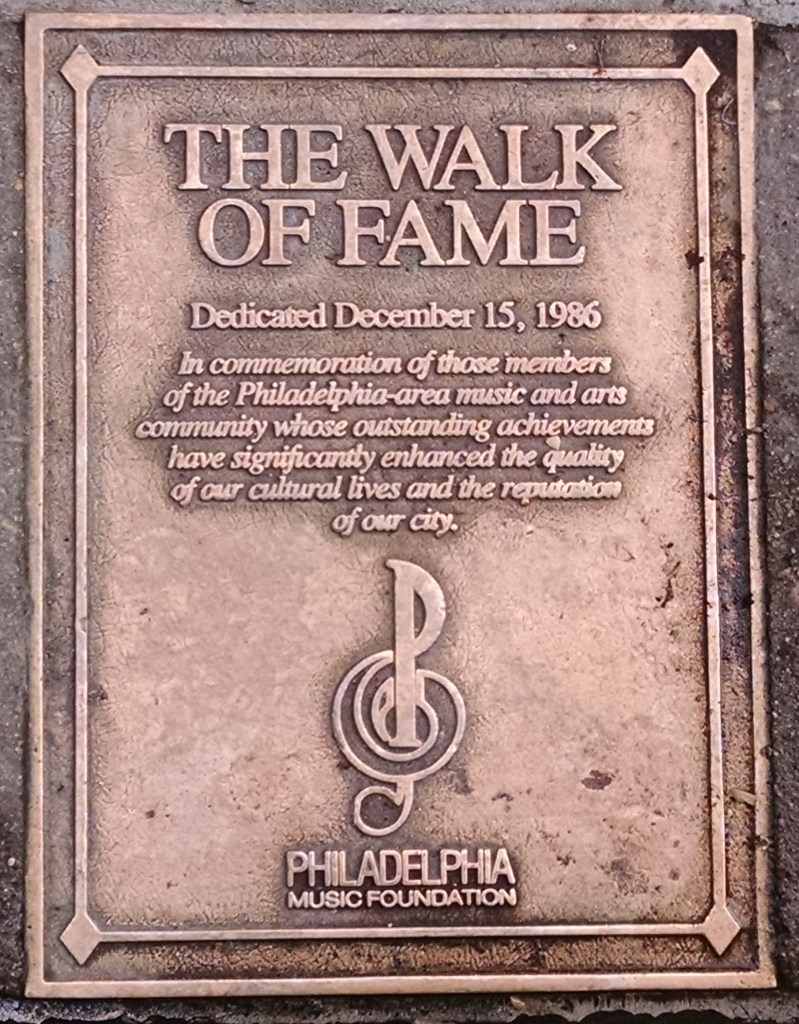
About the Walk of Fame

Established in 1986, the Walk of Fame is the creation of the Philadelphia Music Alliance, a nonprofit organization dedicated to the preservation and promotion of Philadelphia’s rich musical legacy, supporting the current music scene, and mentoring the next generation of music makers.

The Walk of Fame Plaque - 1986

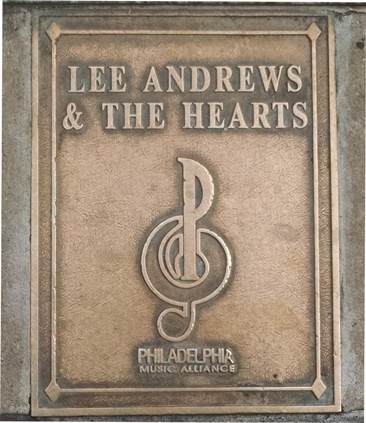
Lee Andrews & the Hearts

One of the finest R&B vocal groups of the ’50s, Lee Andrews & the Hearts specialized in smooth ballads and were influenced by similar vocal acts like the Moonglows, the Orioles, the Drifters, the 5 Royales, the Five Keys, the Midnighters, and the Ravens, while lead vocalist Lee Andrews’ influences were mostly solo artists like Bing Crosby, Frankie Laine, Frank Sinatra, and especially Nat King Cole. These two key influences — a harmonizing four-part vocal base with a strong but tender tenor voice leading the way — was the foundation of the Hearts’ hard-to-beat sound.

READ MORE

Lee Andrews Plaque

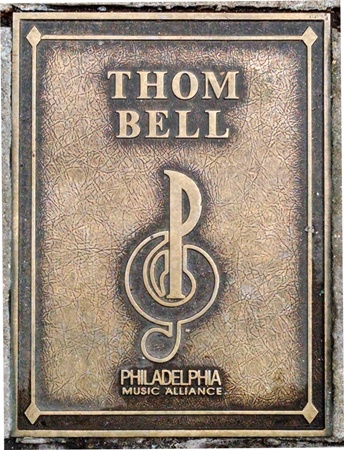
Thom Bell

In tandem with the visionary production team of Kenny Gamble and Leon Huff, arranger and producer Thom Bell was among the principal architects of the lush and seductive Philly soul sound, one of the most popular and influential musical developments of the 1970s. Born in Philadelphia in 1941, Bell studied classical piano as a youth; he joined Gamble’s harmony group the Romeos in 1959, and by the age of 19 was working as a conductor and arranger for hometown hero Chubby Checker. Within months he began writing original material for Checker as well, eventually joining the singer’s production company. When Checker’s organization folded, Bell signed on as a session pianist with Cameo Records, where he first worked with the local soul group the Delfonics. When their manager Stan Watson formed the Philly Groove label in 1968, Bell came aboard as a producer, helming Delfonics classics like 1968’s “La La Means I Love You” and 1970’s “Didn’t I Blow Your Mind This Time.”

READ MORE

Thom Bell - Resized