Category Archives: Lee Morgan

Aqua Lounge

Paul Myers opened the Aqua Lounge circa 1965. It was one of Philadelphia’s premier jazz clubs. The Aqua Lounge was the first jazz venue on “the Strip.”

Aqua Lounge headliners included Roy Ayers, George Benson, Art Blakey, Dave Burrell, Betty Carter, Ron Carter, Johnny Coles, Charles Earland, Dizzy Gillespie, Dexter Gordon, Herbie Hancock, Jimmy Heath, Joe Henderson, Freddie Hubbard, Rahsaan Roland Kirk, Gloria Lynne, Hugh Masekela, Thelonious Monk, Lee Morgan, Irene Reid, Max Roach, Pharoah Sanders, Shirley Scott, Gil Scott-Heron, Archie Shepp, Horace Silver, Jimmy Smith, Dakota Staton, McCoy Tyner, and Jimmy Witherspoon.

In an interview with the University of Pennsylvania School of Arts and Sciences’ West Philadelphia Music Project, jazz drummer Lucky Thompson shared his memories of the Aqua Lounge:

And right along 52nd street, there was a club called the Aqua Lounge, it used to bring a lot of famous musicians through there, like Miles, Max [unclear], and I mean they would come out and stand in one of the corners smoking a cigarette, and Philly Joe Jones, and umm, a lot of Shirley Scott, a lot of famous musicians. Called the Aqua Lounge. That was one of the clubs known for being on the Strip.

Gil Scott-Heron name-checks the Aqua Lounge in “Is That Jazz?”

Lee Morgan had a week-long engagement at the Aqua Lounge in October 1971. It was his last hometown appearance before his tragic death four months later.

The Aqua Lounge closed around 1975. It is now the home of the African Cultural Art Forum.

Lee Morgan’s historical marker was unveiled in front of the Aqua Lounge/African Cultural Art Forum on International Jazz Day 2024.

The Aqua Lounge is a stop on the walking tour, 52nd Street Stroll.

1st Quaker City Music Festival

The 1st Quaker City Music Festival, a three-day jazz festival produced by George Wein, was held at Connie Mack Stadium in August 1960.

1st Quaker City Festival - Connie Mack Stadium -1960

The lineup included Gloria Lynne, Dizzy Gillespie, Chico Hamilton, Herbert Mann, Nat Adderley, Ornette Coleman, Thelonius Monk, Art Blakey, and Lee Morgan.

Connie Mack Stadium was demolished on July 13, 1976.

Philadelphia Convention Hall

Philadelphia Convention Hall, also known as Municipal Auditorium, was located in West Philly near the campus of the University of Pennsylvania.

Convention Hall - 34th and Spruce

The venue played host to many events, including the 1940 and 1948 Republican National Conventions, and the 1959 Penn Relays Jazz Festival. Luminaries such as Pope John Paul II, Martin Luther King Jr. and Nelson Mandela spoke here.

On October 19, 1957, the Philadelphia Jazz Festival was held at Convention Hall. Jazz trumpeter and Philly native Lee Morgan was on the bill, along with, among others, trumpeter Miles Davis, pianist Horace Silver and organist Jimmy Smith.

Convention Hall was demolished in 2005.

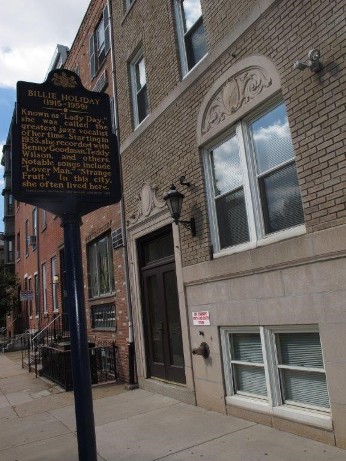
The legendary Showboat was located in the basement of the Douglass Hotel. Pianist Sam Dockery led the house band. The historical marker out front notes that Billie Holiday “often lived here.”

Douglass Hotel

The Showboat opened in the mid-1940s. Herb Keller bought the club and hotel in 1950. He sold both to Herb Spivak in 1964. Spivak renamed the jazz spot the “Showboat Jazz Theatr” (purposely leaving off the “e”).

All That Philly Jazz Director Faye Anderson interviewed Spivak on International Jazz Day 2019.

Herb Spivak - Faye M. Anderson

The Showboat was compact. Spivak more than tripled the seating capacity from 100 to 320. The small bandstand was behind the bar. The Showboat played host to jazz greats such as Miles Davis, Dizzy Gillespie, Lee Morgan, Art Blakey, Cannonball Adderley, Bootsie Barnes, Philly Joe Jones, Thelonious Monk, Aretha Franklin, Dinah Washington and Ramsey Lewis.

On June 17, 1963, John Coltrane Quartet recorded “Live at the Showboat” featuring Coltrane (sax) McCoy Tyner (piano), Jimmy Garrison (bass) and Roy Haynes (drums).

2016 NEA Jazz Master Archie Shepp

The 2016 NEA Jazz Masters were honored at a tribute concert at the John F. Kennedy Center for the Performing Arts.

This year’s class includes Archie Shepp who grew up in West Philadelphia. During an NEA interview, Shepp talked about jazz and Philadelphia:

The music that we call jazz has always been important in the African American community, especially in the poorer neighborhoods.

There was a lot of racism and prejudice, but a lot of music, a lot of blues and some good times. Music was all over Philadelphia. You could go down to North Philadelphia and hear young John Coltrane or Johnny Coles, Jimmy Oliver, Jimmy Heath. I suppose that’s what jazz is all about, suffering and good times, and somehow making the best of all of that.

At the tribute concert for Benny Carter, I got a chance to spend some time with Shepp during the break. He reminisced about the jam sessions at the Heath Brothers’ Family Home. He shared that he learned how to play chords from Coltrane and Lee Morgan.

Truth be told, Philadelphia’s contribution to jazz is mostly an untold story. We must capture stories about Philly’s jazz scene while those who know the history are still here.

2015 BlackStar Film Festival

The 4th annual BlackStar Film Festival gets underway on Thursday, July 30.

BlackStar Film Festival Logo

The four-day film fest is “a celebration of cinema focused on work by and about people of African descent in a global context. BlackStar highlights films that are often overlooked from emerging, established, and mid-career directors, writers and producers working in narrative, documentary, experimental and music video filmmaking.” The program also includes panel discussions and workshops.

I am particularly looking forward to “Virtuosity,” a collection of shorts, including University of Pennsylvania music professor Guthrie Ramsey’s documentary, “Amazing: The Tests and Triumph of Bud Powell.” The film is based on Ramsey’s 2013 book, The Amazing Bud Powell: Black Genius, Jazz History and the Challenge of Bebop.

Powell had frequent gigs in Philly in the 1940s and ‘50s. He performed in such legendary jazz spots as Watts’ Zanzibar, Downbeat and The Point. While in town, Powell shared his genius with young musicians, including Lee Morgan, at the Heritage House Jazz Workshop.

The festival runs from July 30 to Aug. 2. For the full schedule and ticket information, visit BlackStar Film Fest.

Music City

In 1947, drummer Ellis Tollin and his business partner William E. Welsh opened Music City, an instrument store located on the second floor of the Wurlitzer Building.

Tollin transformed the third floor into a 250-seat performance space, Music City Swing Club, where top jazz musicians, including Charlie Parker, Dizzy Gillespie, Miles Davis, Art Blakey and Buddy Rich held jam sessions and mentored young musicians like Bobby Timmons, Archie Shepp and Lee Morgan (circled).

Trumpeter Ted Curson recalled:

It was like the scene in Philadelphia for young cats and old cats. They would bring guys in from New York to play and they would have the young guys sit in with them. If you played pretty good you always ended up with some kind of gig.

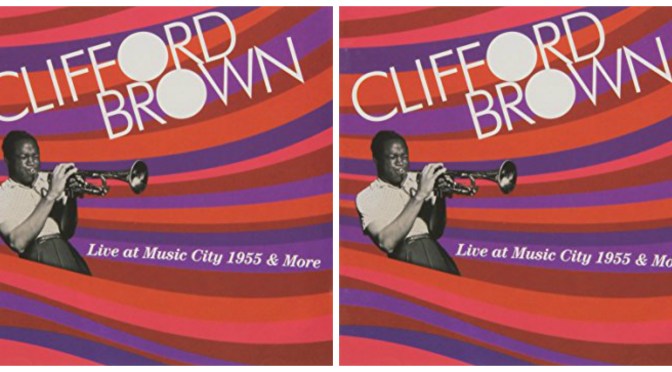
Jazz legend Clifford Brown gave his last performance at Music City. He left directly from here for a gig in Chicago. He never made it. He was killed in a car accident on the Pennsylvania Turnpike on June 26, 1956.

In a piece for Hidden City Philadelphia, archivist and Philadelphia music historian Jack McCarthy wrote:

On Tuesday evenings in the mid 1950s, young jazz enthusiasts from all over the city would gather inside the popular music store, Music City, at what is now 1033 Chestnut Street. Some came to jam, while others sat back and listened to intimate performances by major players of the era. It was an especially fertile period in Philly jazz when the city hummed with lively clubs and was home to many of the genre’s important instrumentalists. For aspiring teenage musicians who were too young to get into the clubs, Music City was a place to trade notes with fellow young players and even to play with their musical heroes if they were lucky. Many emerging Philly jazz performers of the 1950s cut their teeth there.

[…]

[Clifford] Brown had established himself as one of the top trumpeters in jazz by the mid1950s. He was living in Philadelphia during this period and was a frequent, featured guest at Music City. As the original story went, Brown performed at the store on the evening of June 26, 1956, accompanied by Ellis Tollin on drums and several other Philly musicians, and left directly from there to drive to a gig in Chicago. With him on the trip were the pianist Richie Powell and his wife, Nancy, who did the driving. On the Pennsylvania Turnpike between Harrisburg and Pittsburgh, the car ran off the road and crashed, killing all three.

Read more

Heritage House Jazz Workshop

From Jeffrey S. McMillan, “A Musical Education: Lee Morgan and the Philadelphia Jazz Scene of the 1950s”:

Early in 1954, a Camden, New Jersey, DJ named Tommy Roberts began holding jazz sessions at the Heritage House [Educational and Cultural Center], a north Philadelphia community center located on the second floor of what is now the Freedom Theater at 1346 N. Broad Street. These sessions became an important part of the Philadelphia jazz scene, especially for young musicians, and gave birth to a series of events known as the “Jazz Workshop.” Beginning in April 1954, the Workshop met every Friday afternoon from 4:00 to 6:00 and featured prominent jazz artists who were in town playing evening engagements in the clubs in Center City. The first hour of each session entailed a performance by the featured artists and was followed by an intermission where members of the audience were free to socialize with the musicians. The second hour was devoted to young musicians and composers who were encouraged to sit in with the artists or submit their work to be performed by the band. This unique, hands-on opportunity for youngsters to learn about jazz was augmented by the quality of artists that appeared at the Workshop.

In 1954 alone the artists included the Chet Baker Quintet (featuring James Moody), Johnny Hodges’s band (which, at the time, included John Coltrane), Buddy DeFranco, Art Blakey’s Jazz Messengers, Bud Powell, Ella Fitzgerald, George Shearing, Roy Eldridge, the Erroll Garner Trio, and Billy Taylor. Besides a 75¢ admission fee, there was only one restriction to being admitted to the Workshop: every attendee was required to be twenty years old or younger. Those of legal drinking age, twenty-one or older, had to take their business to the clubs to hear the artists.

Read More

Earle Theater

The Earle Theater was a stop on the “Chitlin’ Circuit.” It was the most expensive theater ever built in Philadelphia. The Earle had an ornate interior and exterior and seating for 2,700. It was demolished in July 1953.

Earle Theater

In an interview with the Smithsonian Oral History Project, Philly native and NEA Jazz Master Benny Golson talked about how he was inspired to master the saxophone after seeing Lionel Hampton and Arnett Cobb at the Earle Theater:

I guess they usually went until 9 or 10 at night, which meant that they had about three or four shows a day. It was an ongoing thing. Week after week they’d have whatever band was popular. Benny Goodman, Woody Herman, anything. Charlie Spivak, Claude Thornhill, Tommy Dorsey. Any band that was popular, they would bring there. It was an ongoing thing. Count Basie, Duke Ellington. They all came there.

The reason I went is because I was in high school – Benjamin Franklin High School. The kids were coming back and says, “Oh man. You got to go to the Earle Theater and hear Lionel Hampton. You got to hear him play Flying Home.” Blah blah blah blah. So one day I didn’t go to school. I went there. That’s when I heard him. That’s when my life changed. That’s when I heard Arnett Cobb. Incidentally, years later – many years later – it must have been 50 years later – I happened to see him in Nice, France. I said, “You’re the reason that I play the saxophone.” He says, “I never knew that. Really?” I said, “Yes.” He had tears in his eyes, because he knew who I was. I said, “I hear you play, and that’s when my life changed.”

Read more

Academy of Music

Opened in 1857, the Academy of Music is the country’s oldest concert hall and opera house. The “Grand Old Lady of Broad Street” has welcomed jazz, blues and R&B legends, including Duke Ellington, Billie Holiday, Lee Morgan, Count Basie, Louis Armstrong, Miles Davis, Shirley Horn, Ray Charles, Aretha Franklin and James Brown.

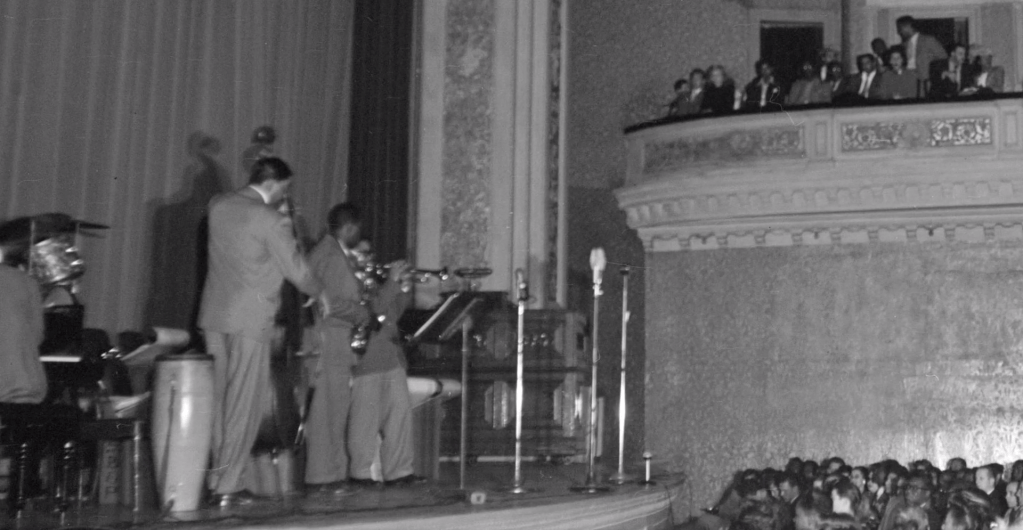
On June 5, 1945, the Dizzy Gillespie Quartet, featuring Charlie Parker, was in the house. Seated in the next-to-last row were Benny Golson and John Coltrane.

In an interview with the Smithsonian Jazz Oral History Project, NEA Jazz Master Benny Golson recalled:

When we heard – John and I, when we first heard Charlie Parker and Dizzy Gillespie] – I told you he was sounding like Johnny Hodges – our lives changed that night. We had never heard any music like that. Never. We were screaming like these Beatles groupies, when they used to hear the Beatles. They played this Latin tune. We never heard any Latin tune like that in our lives. The Latin tunes that we played were like Lady of Spain, the stock arrangements, My Shawl. But this Latin thing, we had never heard it. Then they played an interlude, and they made a break, and Charlie Parker made a pickup by himself. Usually it was two bars, but he did it four bars, double-time. We were going crazy. We almost – of course we were up there with the cheap seats – we almost fell over the balcony. It was A Night in Tunisia. We never heard that before. Oh my goodness.

Golson expounded on that fateful night in his autobiography, Whisper Not: The Autobiography of Benny Golson:

The concert was staged at the Academy of Music, home of the Philadelphia Orchestra. We took our places, greatly excited, in the cheap seats in the uppermost level. Diz’s band kicked off with the strangest Latin-sounding tune we had ever heard. John thought it sounded “like snake charmer’s music”: Dizzy’s “A Night in Tunisia” was weirder than anything we had heard before, but intriguing. The band moved through the melody, dove into an interlude, then opened into a bravura set of riffs, or glissandi, a sustained high-octane break by the alto player, Charlie Parker. To us, the sound was way out there. Parker was dressed in a double-breasted suit with all of the buttons closed. He looked like an adult stuffed into his grade school graduation suit. …

We both nearly fell over the balcony rail, all the cells and nerves in our bodies wild with abandon. Their music was crazy and we went into an exuberant delirium, doubtless a form of higher awareness and pure joy. John tried to crawl up my gyrating body while I was grabbing onto him with barely contained amazement. We were both screaming like schoolgirls. We had heard strong performances in our young lives, but nothing like this. This was beyond “good.” It was completely new, innovative, and profound. We were drunk with happiness and bewilderment. I felt like crying. We didn’t know then, but our musical world changed that night.

Published by Temple University Press, Golson’s autobiography is available for purchase here.