The Checker Café was a place to see and be seen. On May 23, 1935, Philadelphia Tribune columnist, “the Negro Councilman,” wrote:
When the show has nearly ended you will then see no other than our own sepia Gloria Swanson, who is direct from the Grand Terrace in Chicago and then you can tell the world that you have seen a real show.
As with many jazz venues, the Checker Café was about “intersectionality” before it became a thing. The “sepia Gloria Swanson” was a female impersonator.
In the 1980s under new ownership, the nightspot was renamed the Checker Club.
Trumpeter Cullen Knight is the recipient of the 2015 Philadelphia Clef Club of Jazz and Performing Arts “Living Legend” Award. Knight shared some memories with Philadelphia Inquirer architecture critic Inga Saffron:
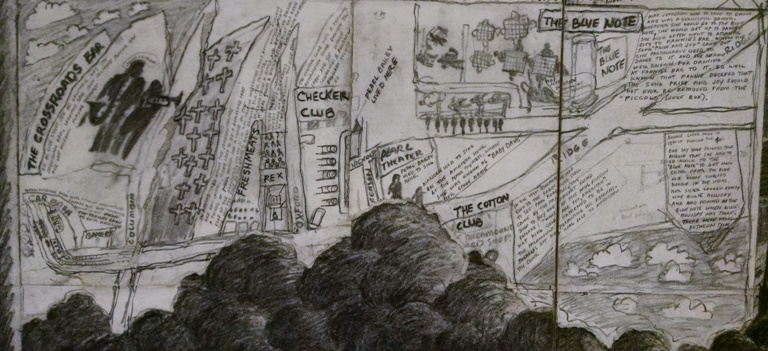
It’s a bit ironic that the Checker is the only one of those Ridge Avenue joints to survive. It wasn’t the biggest or best known of the venues that lined the avenue during North Philadelphia’s jazz heyday in the mid-20th century. That distinction was probably held by the Pearl Theater on the next block, where Bailey and her sister Jura worked as ushers, and brother Bill tended the candy counter.
Trumpeter Cullen Knight, who grew up a block away, says the Checker was where musicians hung out before and after the shows, partly because the food and the house trio were equally reliable. Its motto was “Good Food. Good Cooks. Good Service.” Among those providing service was Pearl Bailey, who did a stint as a singing waitress and is now immortalized by a mural on the building’s south side. In the ’30s, a gay singer known as the “Sepia Gloria Swanson” was also a regular.
While some clubs, like Ridge Cotton Club and Blue Note, took their inspiration from famous Harlem venues, the Checker got its name from the black-and-white pattern painted on the ground floor. Its horseshoe-shaped bar had just enough space in its curve for a small band. Tables occupied the rest of the room.
Paul Myers opened the Aqua Lounge circa 1965. It was one of Philadelphia’s premier jazz clubs. The Aqua Lounge was the first jazz venue on “the Strip.”
Aqua Lounge headliners included Roy Ayers, George Benson, Art Blakey, Dave Burrell, Betty Carter, Ron Carter, Johnny Coles, Charles Earland, Dizzy Gillespie, Dexter Gordon, Herbie Hancock, Jimmy Heath, Joe Henderson, Freddie Hubbard, Rahsaan Roland Kirk, Gloria Lynne, Hugh Masekela, Thelonious Monk, Lee Morgan, Irene Reid, Max Roach, Pharoah Sanders, Shirley Scott, Gil Scott-Heron, Archie Shepp, Horace Silver, Jimmy Smith, Dakota Staton, McCoy Tyner, and Jimmy Witherspoon.
In an interview with the University of Pennsylvania School of Arts and Sciences’ West Philadelphia Music Project, jazz drummer Lucky Thompson shared his memories of the Aqua Lounge:
And right along 52nd street, there was a club called the Aqua Lounge, it used to bring a lot of famous musicians through there, like Miles, Max [unclear], and I mean they would come out and stand in one of the corners smoking a cigarette, and Philly Joe Jones, and umm, a lot of Shirley Scott, a lot of famous musicians. Called the Aqua Lounge. That was one of the clubs known for being on the Strip.
Gil Scott-Heron name-checks the Aqua Lounge in “Is That Jazz?”
Lee Morgan had a week-long engagement at the Aqua Lounge in October 1971. It was his last hometown appearance before his tragic death four months later.
The influence of Harlem and the legendary Cotton Club with its extravagant floor shows of light-skinned chorus girls are noted in the previous descriptions, as well as the naming of the Ridge Cotton Club along the Ridge Avenue entertainment district. In addition, the ubiquitous title of café such as Art’s Café, Pocahontas Café, Hy De Ho Café and The Roseland Café implied inspiration from Europe and the desire to accentuate superior social mingling.
In a 1996 interview with the Philadelphia Inquirer jazzman Jimmy Oliver recounted that he used to play at Irene’s Café whose regulars included Pearl Bailey.
Jimmy Oliver is one of Philly’s many unsung jazz greats. From Wikipedia:
James Henry Oliver was a tenor saxophonist and bandleader based in Philadelphia. Active from the mid-1940s, his bands, including the house band at local venues, featured, among other musicians, Philly Joe Jones, Steve Davis, Red Garland, Johnny Coles, Charlie Rice, Sam Reed and Mickey Roker. He has been cited as one of several sax players who influenced John Coltrane.
Turning down the temptation to work in New York, he preferred to play locally in Philadelphia, alongside local jazz stars such as Bootsie Barnes, the Heath Brothers and Philly Joe Jones as well as visiting stars Charlie Parker, Pearl Bailey and Max Roach, and, especially around 1946-47, while in residence at the Zanzibar Café, he was noted for playing “against” visitors Lester Young, Coleman Hawkins, Ben Webster, Dexter Gordon, Illinois Jacquet, Arnett Cobb, George Auld and Charlie Ventura.
On one of his very few known recordings, on September 16, 1950, Oliver sat in for John Coltrane, who was ill, and recorded with the Dizzy Gillespie sextet for Prestige. The album, Prestige 1st Sessions, Vol. 3, released in 1994, features a solo by Oliver on the track “She’s Gone Again.”
Located in Center City, Morton Casway’s Celebrity Room was popular in the 1940s. It played host to a number of jazz and blues greats, including Fats Waller, Mary Lou Williams and Art Tatum.
In the September 11, 1948 issue of Billboard magazine, it was reported that Casway and other Philadelphia club operators were “singing the blues.”
The nightspot’s booker, Nat Segall, “is the only prospect shopping around the center of town for a new spot. Segall, the former owner of the Downbeat, found his sweet spot. He moved on and became the booking agent for the legendary Showboat.
The influence of Harlem and the legendary Cotton Club with its extravagant floor shows of light-skinned chorus girls are noted in the previous descriptions, as well as the naming of the Ridge Cotton Club along the Ridge Avenue entertainment district. In addition, the ubiquitous title of café such as Art’s Café, Pocahontas Café, Hy De Ho Café and The Roseland Café implied inspiration from Europe and the desire to accentuate superior social mingling.
Saxophonist Jimmy Woods was a regular at this nightspot.
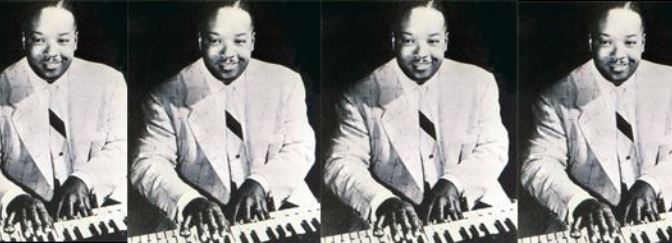
At some point Butler’s Paradise Café closed. After refurbishing, in December 1952 it reopened as Butler’s Café. Billboard reported that the headliner was “Bill Doggett and his organ and trio.” Doggett co-wrote the smash R&B hit, “Honky Tonk,” which sold four million copies.
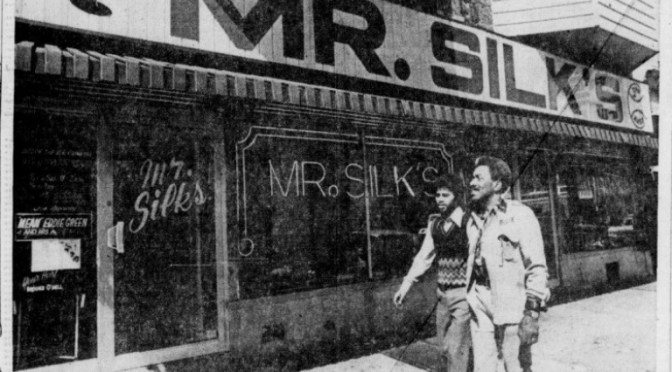
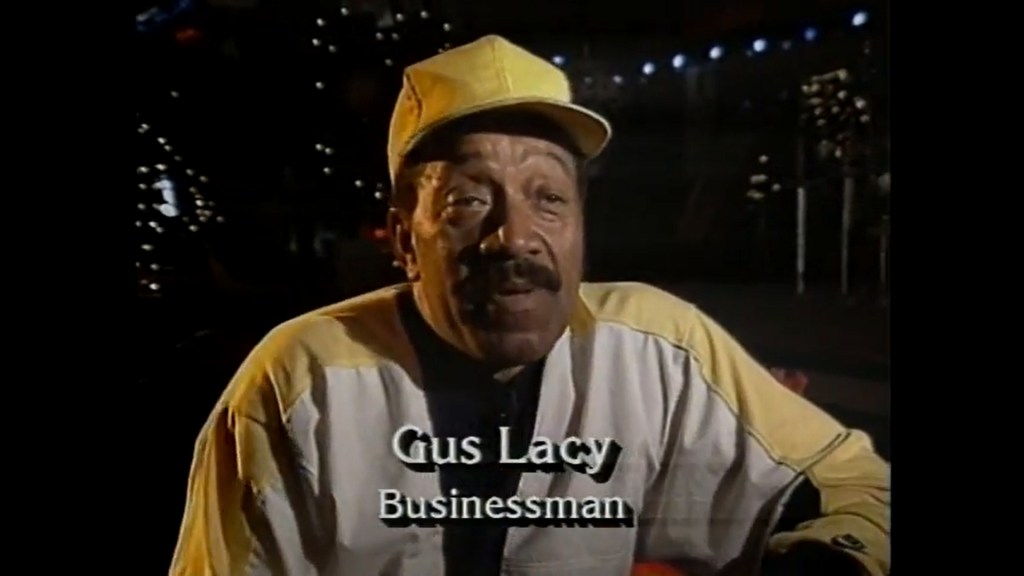
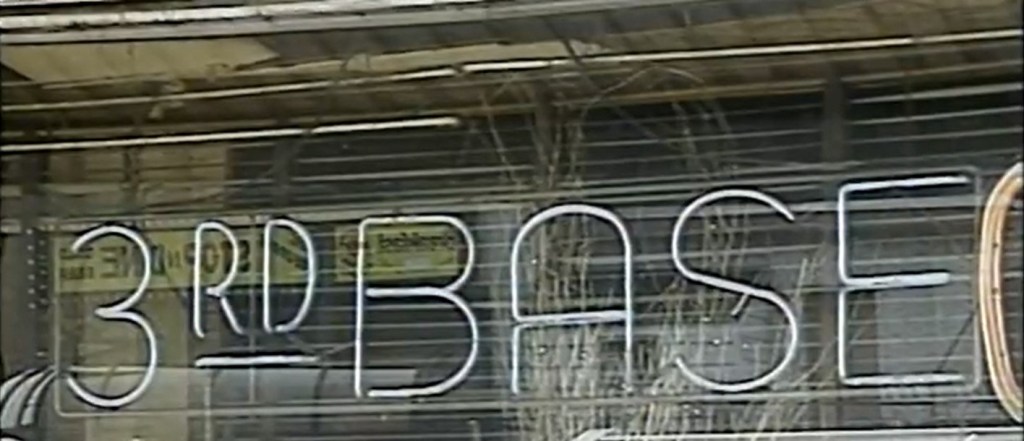
Gus “Mr. Silk” Lacy, was the unofficial mayor of S 52nd Street, aka “the Strip.” He and his wife, Virginia, owned Mr. Silk’s 3rd Base.
Heavyweight champions Muhammad Ali and Joe Frazier, and music legends Cab Calloway, Billy Eckstine, Teddy Pendergrass and Stevie Wonder were among the celebrities who frequented Mr. Silk’s.
Jazz vocalist Jimmy Scott performed here. In his biography, Faith in Time: The Life of Jimmy Scott, he recounted the neon sign outside read: “Always Touch Third Base Before You Go Home.”
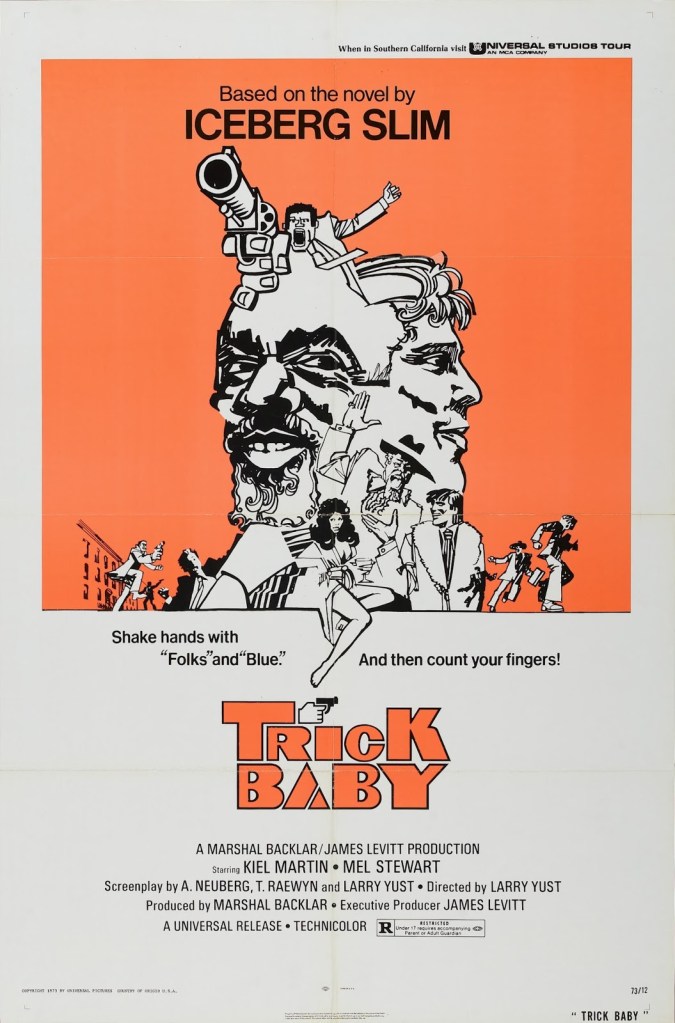
Mr. Silk’s 3rd Base was featured in the 1972 Blaxploitation film Trick Baby.
Between “White Folks” and Blue, we see both sides of the city: from a posh dinner party where “White Folks” meets well-heeled businessmen whose greed makes them potential marks as well as the raucous scene at “Mr. Silk’s Third Base” a West Philly nightclub that functions as Blue’s unofficial office. We see a lot of the warm glowing interior of Mr. Silk’s. The club was a real place, a center of African American nightlife (their slogan was “You have to touch 3rd Base before you go home”).
Owner Gus Lacy was “Mr. Silk,” by all accounts a bon vivant who received his smooth moniker by selling ladies’ undergarments along his postal route. He was also known as “The Mayor of 52nd Street” and before it closed in 1985 politicians, pimps and regular folks rubbed shoulders with stars like Stevie Wonder, Muhammad Ali and James Earl Jones. It’s a blessing that this little corner of the world was captured on film.
Mr. Silk’s closed in 1984. The former location of Mr. Silk’s 3rd Base is a stop on the 52nd Street Stroll. The most recent walking tour was held on Saturday, October 5, 2024.
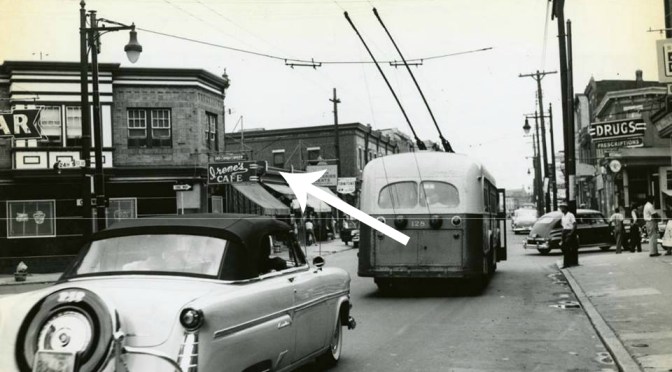
The Ridge Point Café, aka the Crossroads Bar, was located at the crossroads of Ridge Avenue, 23rd Street and Columbia Avenue. In Whisper Not: The Autobiography of Benny Golson, the NEA Jazz Master shared a story about John Coltrane’s gig at this North Philly club:
Philadelphia boasted many jazz clubs at that time, and John and I continued to gig often. John, however, soon got a very strange gig. Word came to me that John was working at a club called The Ridge Point. We called it The Point because of the street configuration there, where instead of bisecting each other, three streets crossed—Columbia Avenue, 23rd Street, and Ridge Avenue—such that the shape of the building at that intersection resembled a large slice of pie—much like the famous Flatiron Building in Manhattan. The bar’s shape mimicked the building. The bandstand was at the wide end of the pie. The tip, or the point, was the main entrance. All that was interesting, but The Point was not a bona fide jazz club. Eddie Woodland, a tenor player, usually held forth. Woodland was a “boot ‘em up” tenor player with a circus aura, who held audiences in the palm of his hand by walking the bar, with bravado. Crowds loved him, but for some reason, he took a leave of absence. Maybe he was sick. Then word went around that my pal John was playing at The Point, and I knew John wasn’t that kind of saxophone player. The Point was definitely not a hip jazz club, and regulars expected every artist to walk the bar.
Woodland’s “boot ’em up” saxophone can be heard on “Stranger in Town.”
More from Golson:
I could not believe what I saw. This wasn’t Eddie at all, but John! John Coltrane was up on the bar at the small end, at the tip of the mud pie, honking, grooving, preparing to go down to the far end and back to the bandstand again. He was cranked up, playing low B-flats, nimbly stepping over drinks like a mountain goat on slippery terrain. He didn’t see me right away. But when he came up from one of his low horn-swooping movements, he looked in my direction. His eyes got wide and he stopped right in the middle of a group of low B-flats. He took the horn out of his mouth, stood straight up, and said, “Oh, no!” I fell against the wall, dying with laughter. I’d busted him. He was humiliated, but he finished his slumming bar performance.
Published by Temple University Press, Golson’s autobiography is available for purchase here.
In Whisper Not: The Autobiography of Benny Golson, the NEA Jazz Master recounted:
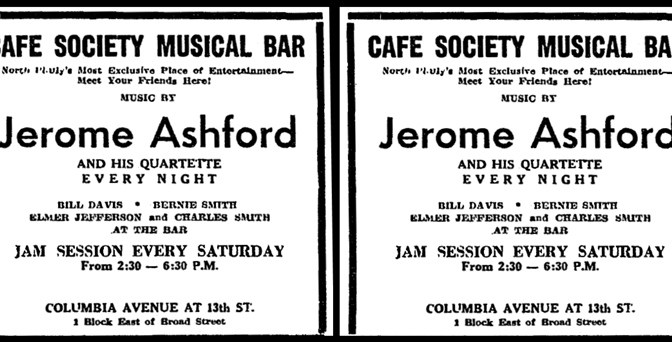
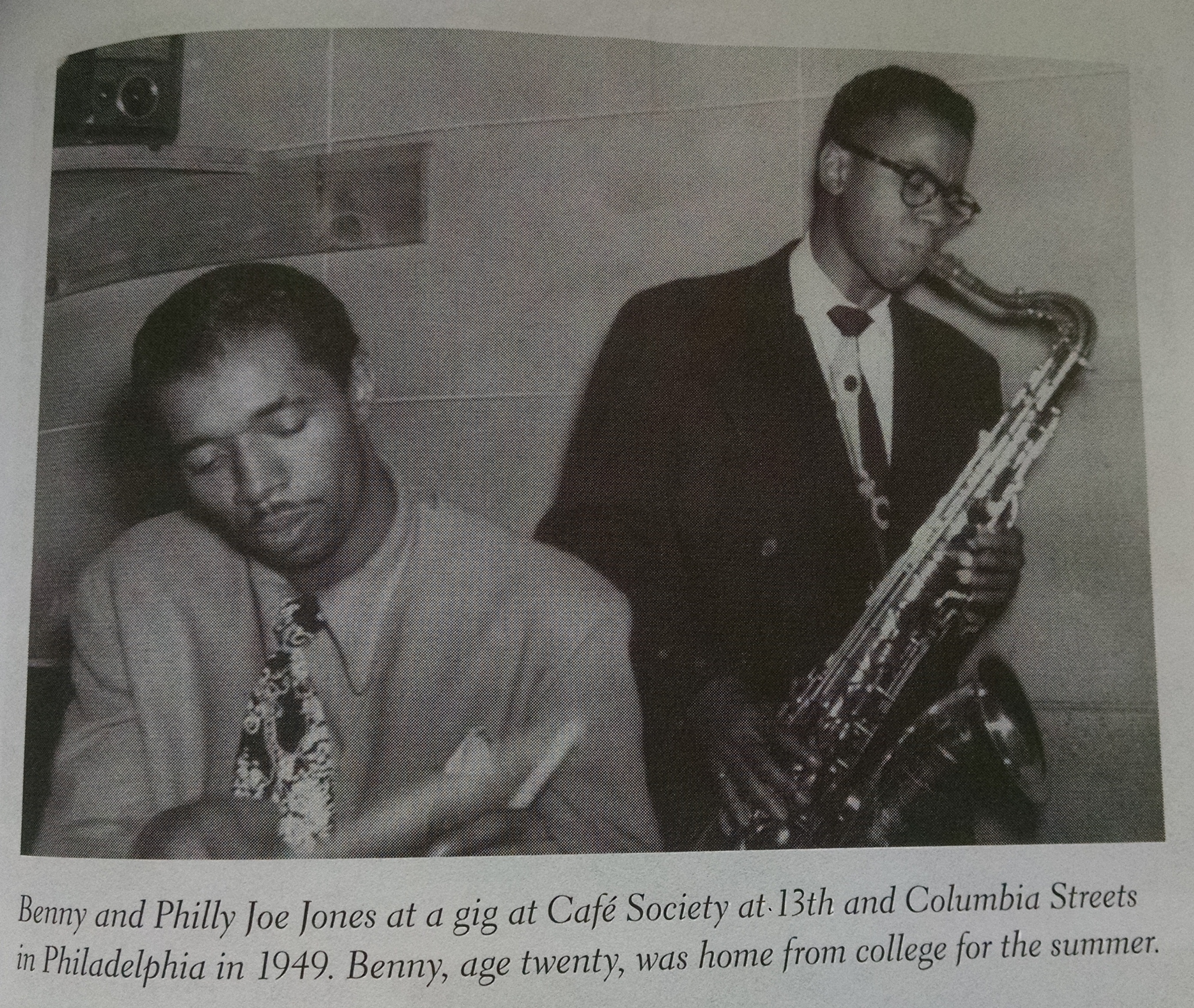
I used to dream of playing with Philly Joe. He played with all my recorded heroes when they came to town: Coleman Hawkins, Ben Webster, Roy Eldridge, Charlie Parker, Dizzy Gillespie, and Eddie Heywood. I came home from my first year in college, in 1948, and “Bass” Ashford, a mainstay on the local scene, asked me to join his quartet for the entire summer season at Café Society, at 13th Street and Columbia Avenue. Café Society was a very popular jazz spot in North Philly, not far from where I lived and only three blocks from John Coltrane’s house. John often popped in while the group played there. I showed up for the first rehearsal to find that Philly Joe would be our percussionist! I almost fainted. I acted as if nothing were unusual, but I was flying.
Published by Temple University Press, Golson’s autobiography is available for purchase here.








 All That Philly Jazz