Organist Austin Mitchell, Jr., was a featured attraction at The Postal Card.
WRTI Jazz Host Bob Perkins shared that “Michel [sic] and his Hammond organ was his calling card.”
Trumpeter Lee Morgan had a week-long engagement at The Postal Card the last week in December 1961. According to a story published in the Philadelphia Tribune on January 6, 1962, Morgan didn’t finish his gig:
Here’s why Lee Morgan, the jazz trumpeter, cancelled out his week’s engagement at that South Philly club before it was over. He’s Army bound.
The Tribune later reported that Morgan was not drafted. Truth be told, it was wishful thinking. The talented trumpeter was in the throes of a heroin addiction.
The Postal Card is a stop on the Green Book walking tour which will be held on Saturday, November 9, 2024, from 10am to 12pm. Tickets are $25 per person.
From the moment the first enslaved Africans were brought to British colonial America in 1619, Black mobility has been policed. Frederick Douglass had to carry a pass as he traveled across the country to recruit Black troops for the Civil War.
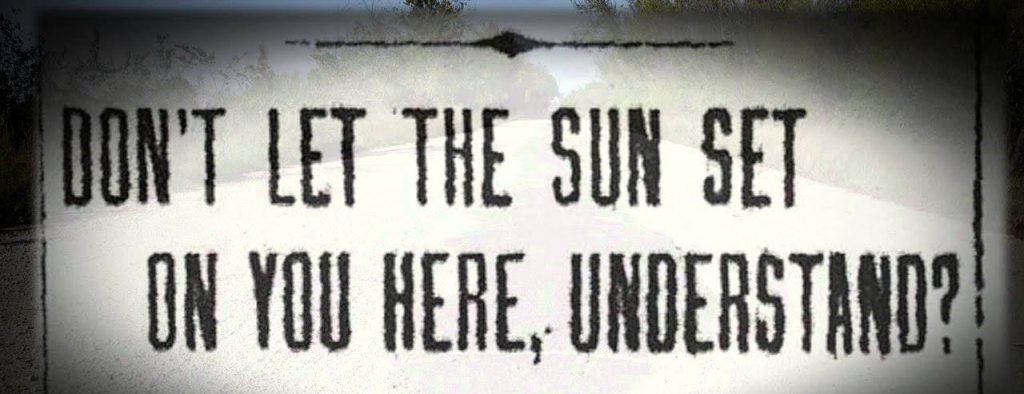
While white Americans were told to get their kicks on Route 66, African Americans had to put the pedal to the metal lest the sun go down on them in one of the sundown towns along the storied highway.
A two-hour documentary, “Driving While Black: Race, Space and Mobility in America,” aired on PBS on October 13, 2020.
Gretchen Sorin, director of the Cooperstown Graduate Program of the State University of New York, spent 20 years researching Black mobility. The documentary is based on her book, “Driving While Black: African-American Travel and the Road to Civil Rights.” Sorin, director Ric Burns, producer and editor Emir Lewis, and Spencer Crew, acting director of the National Museum of African American History and Culture, recently participated in a forum at the John F. Kennedy Presidential Library and Museum.
A travel guide, The Negro Motorist Green Book helped Black travelers navigate racialized public spaces. For information about the Green Book in Philadelphia, go here.
John Coltrane’s eighth studio album, Africa/Brass, was released in 1961. The tracks include “Song of the Underground Railroad.”
To celebrate Coltrane’s birthday (September 23, 1926), All That Philly Jazz Director Faye Anderson will lead the Philadelphia Jazz Heritage Walking Tour: Green Book Edition. A travel guide, Green Book listings were effectively an Underground Railroad 2.0, a network of safe spaces where African Americans could avoid the indignities and humiliations of racial segregation.
Green Book Philadelphia walking tour stops include:
National historic landmark where Coltrane first heard Charlie Parker and Dizzy Gillespie;
Supper club that was a hangout for the producers and musicians who created “The Sound of Philadelphia”;
Hotel that welcomed jazz luminaries to its stage from the 1940s to the 1980s, and where Coltrane recorded a live album;
Pep’s Musical Bar where Coltrane and other jazz and blues greats performed;
Jazz club that paid homage to postal workers and U.S. Postal Service;
Dive bar that was the setting for the Broadway play “Lady Day at Emerson’s Bar and Grill”; and
Fraternal lodge where Bessie Smith’s funeral was held and an after-hours club was located on the top floor.
All That Philly Jazz Walking Tour: Green Book Edition will be held on September 21 and 22. Join us as we talk and walk in the footsteps of a jazz giant.
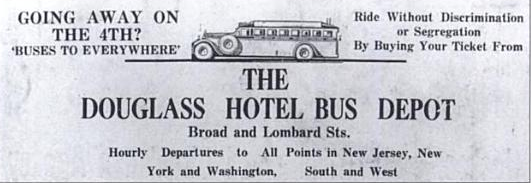
In September, I will lead a walking tour of Green Book sites in Philadelphia. The stops include the Douglass Hotel which offered transportation to Atlantic City, or more accurately, to Chicken Bone Beach.
After complaints from white bathers, African Americans were restricted to a stretch of the Atlantic City beach near Convention Hall. The segregated area became known as Chicken Bone Beach.
This two-part audio doc provides an overview of Chicken Bone Beach and the entertainment district that became a magnet for black vacationers, day-trippers and luminaries such as Martin Luther King Jr., Louis Armstrong, Nina Simone, Duke Ellington, Count Basie and Sammy Davis Jr.
The Checker Café was a place to see and be seen. On May 23, 1935, Philadelphia Tribune columnist, “the Negro Councilman,” wrote:
When the show has nearly ended you will then see no other than our own sepia Gloria Swanson, who is direct from the Grand Terrace in Chicago and then you can tell the world that you have seen a real show.
As with many jazz venues, the Checker Café was about “intersectionality” before it became a thing. The “sepia Gloria Swanson” was a female impersonator.
In the 1980s under new ownership, the nightspot was renamed the Checker Club.
Trumpeter Cullen Knight is the recipient of the 2015 Philadelphia Clef Club of Jazz and Performing Arts “Living Legend” Award. Knight shared some memories with Philadelphia Inquirer architecture critic Inga Saffron:
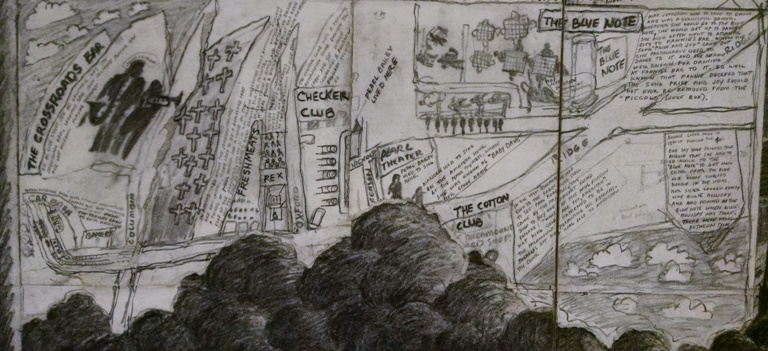
It’s a bit ironic that the Checker is the only one of those Ridge Avenue joints to survive. It wasn’t the biggest or best known of the venues that lined the avenue during North Philadelphia’s jazz heyday in the mid-20th century. That distinction was probably held by the Pearl Theater on the next block, where Bailey and her sister Jura worked as ushers, and brother Bill tended the candy counter.
Trumpeter Cullen Knight, who grew up a block away, says the Checker was where musicians hung out before and after the shows, partly because the food and the house trio were equally reliable. Its motto was “Good Food. Good Cooks. Good Service.” Among those providing service was Pearl Bailey, who did a stint as a singing waitress and is now immortalized by a mural on the building’s south side. In the ’30s, a gay singer known as the “Sepia Gloria Swanson” was also a regular.
While some clubs, like Ridge Cotton Club and Blue Note, took their inspiration from famous Harlem venues, the Checker got its name from the black-and-white pattern painted on the ground floor. Its horseshoe-shaped bar had just enough space in its curve for a small band. Tables occupied the rest of the room.








 All That Philly Jazz