Tag Archives: #BlackCultureMatters

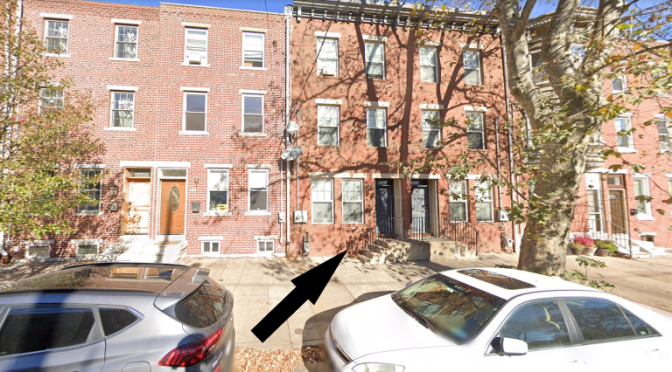
Sun Ra Arkestra House

The three-story rowhouse in Germantown has been home to the Arkestra since 1969. Sun Ra Arkestra Director Marshall Allen still lives and plays here.
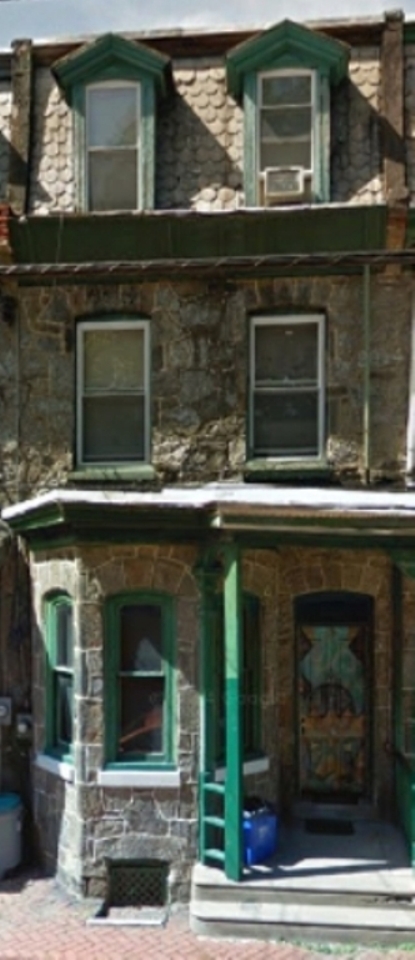
Sun Ra Arkestra House

Today the house is a living museum, full of paintings, sheet music and concert posters, dedicated to keeping the spirit of Sun Ra alive.
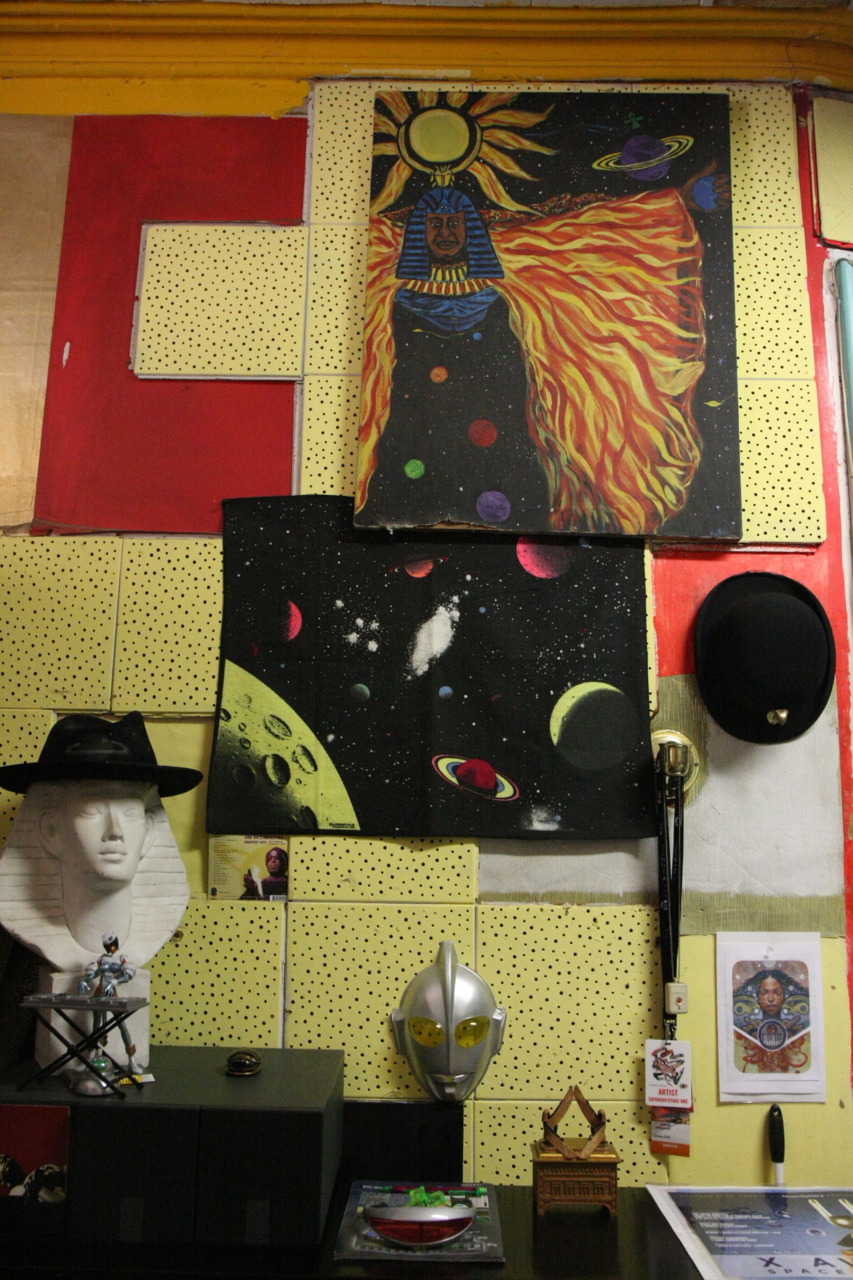
Sun Ra House Interior

Memories from jazz educator and musician Paul Combs:

One thing about having Sun Ra as a neighbor was the possibility of running into him in everyday situations, like shopping at the supermarket. One day a friend of mine and I did just this. Sun Ra and John Gilmore, the great tenor saxophonist and Ra’s right-hand man, were taking care of the shopping for their household (many of the Arkestra members lived in a big house together with their leader). I have always had the impression that life was one big cosmic game for these folks, one that involved serious dedication and a deep sense of humor.

Both musicians were wearing robes, although less elaborate ones than they would wear on stage. Gilmore had a small, brimless North African cap on, and Ra a small turban. Gilmore pushed the cart, and Ra followed behind directing him to the various things they needed. My friend and I followed them at a respectful distance. Finally they got to the meat counter. This was a small neighborhood supermarket and it was customary to have a butcher on duty behind the counter in those days. As they parked themselves in front of the counter Sun Ra said, “John, tell the butcher that Sun Ra would like five pounds of hamburger,” and, although the butcher could hear Ra at least as well as we could, Gilmore relayed the request. The butcher served up the meat with a straight face, as if he were either in on the play or it was a normal scene to him.

I may be wrong, but I have always had the feeling that once the two of them got home they sat down and had a good laugh. My friend and I sure did, and we wished we had thought of this little piece of theater ourselves.

Read more

La Gayla

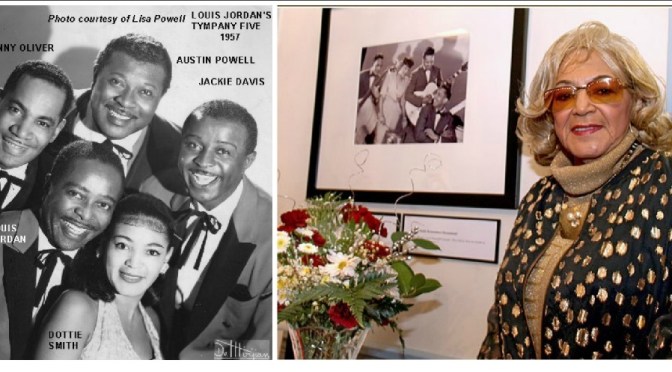
Dottie Smith was a jazz vocalist who recorded and toured with bandleader Louis Jordan. Jordan saw her perform at Spider Kelly’s and offered her a job on the spot.

Jazz Historian and WRTI Jazz Host Bob Perkins wrote:

Dottie Smith opened her own place on Columbia Avenue, called La Gayla, a handle based on her married name, Gayle. She booked local icons Bootsie Barnes, Jimmy Oliver, Philly Joe Jones and host of others.

READ MORE

Bessie Smith House

Bessie Smith moved to Philadelphia circa 1922. After her marriage to Jack Gee on June 7, 1923, she lived on Christian Street in South Philly.

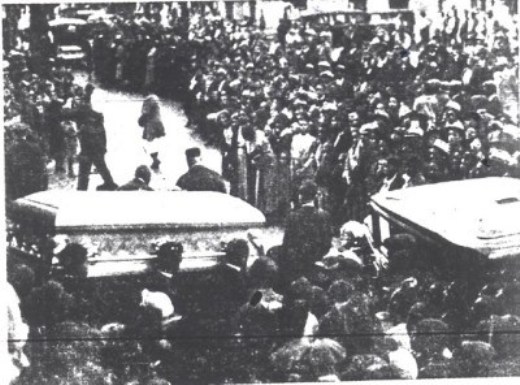
The “Empress of the Blues” died in an auto accident in Mississippi on September 26, 1937. Her funeral was held in Philadelphia on October 4, 1937.

Bessie Smith2

The funeral was moved from Upshur’s Funeral Home to O.V. Catto Elks Lodge to accommodate the 30,000 mourners who filed pass her casket.

bessie-smith-funeral-procession-e1426130630576

Bessie’s casket was taken on a slow tour of her South Philly neighborhood, briefly stopping at the Standard Theater where she regularly performed.

Women of Jazz Mural

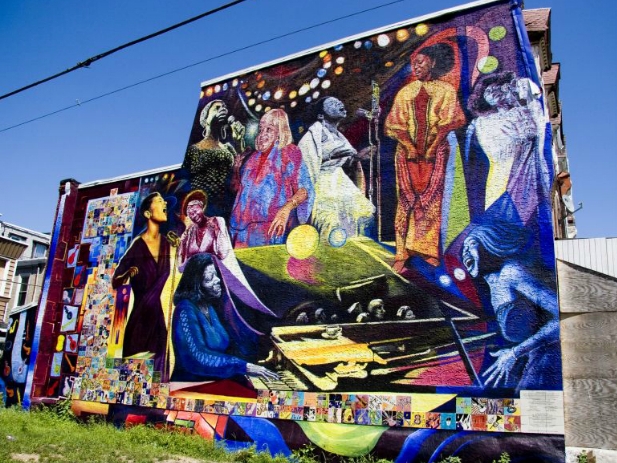
The Women of Jazz mural features many of the most iconic female jazz performers in the world, including Nina Simone, Billie Holiday, Dinah Washington, Betty Carter, Shirley Scott, Dottie Smith, Ella Fitzgerald, Sarah Vaughan and Mary Lou Williams. The tiles below and to the left of the mural were designed by students at several of the city’s public schools.

Women of Jazz Mural

Smith, affectionately called Miss Dot, is the blonde next to Nina Simone. She was a longtime resident of Strawberry Mansion and a former manager of the legendary Gert’s Lounge. Miss Dot died in December 2014.

Women of Jazz is included in the Mural Arts Program’s African American Iconic Images Collection.

UPDATE: In 2016, the Philadelphia Housing Authority demolished the mural.

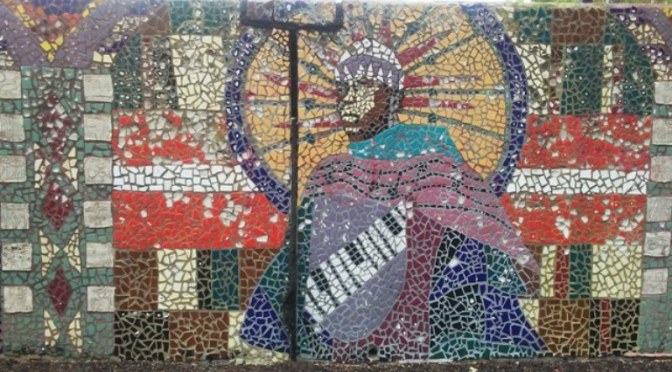
Sun Ra Mural

Memories from jazz educator and musician Paul Combs:

I had a couple of encounters with Sun Ra, who was a neighbor of mine, that I would like to share with you before finishing this memoir. I first met Sun Ra during an interview at WHUY-FM, where I was the music producer/announcer. A colleague of mine, Tom Lopez, was conducting the interview, but I got to sit in on it.

Now it is well documented that Herman Blount was born in Chicago, but when he, as Sun Ra, looked me in the eye and told me he was from Saturn, I could not question it. The man had such a presence; I knew that he knew that I knew it was a fantasy, and yet in his company there was also an undeniable truth to the fantasy.

A couple of years later I had the honor to precede him and the Arkestra in a concert. This was part of a series of concerts that a group of us musicians and artists used to organize on Sundays, in a big park in the middle of the Germantown district, where we all lived. On this particular Sunday the sky was full of menacing clouds. Just as we finished performing, a fine mist began and threatened to become rain. We all worried that Ra and company would have to cancel their performance. The sound crew covered all the equipment and disconnected the power. This was discussed with the Arkestra members who were beginning to assemble at the stage, but they said it would be OK, and proceeded to get ready for their set. Just as their preparations were almost complete a car drove up and Sun Ra stepped out. The rain and mist stopped. They played, sang and danced for the next two hours without interruption from the weather, and it was magnificent. When they finished Ra got back in the car and the mist and light rain resumed. Maybe it was a coincidence, maybe it wasn’t.

READ MORE

Pearl Theatre

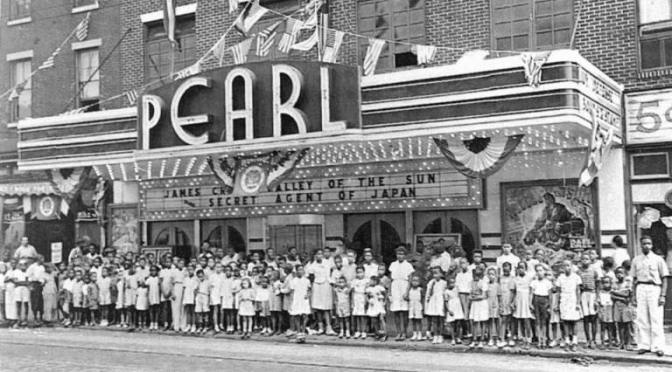
The Pearl Theatre opened in 1927. It closed in 1963 and was demolished circa 1970.  When the theater opened, an orchestra  seat cost fifty cents in the evening, thirty cents for a matinee.  Balcony seats were thirty-five cents in the evening, twenty cents for a matinee.

From: Wikipedia

The Pearl Theatre was a notable jazz and dance venue and had a glamorous reputation among the rich and famous. In 1931 the Nicholas Brothers played here. Duke Ellington, John Coltrane, and many other prominent jazz ensembles of the period performed here. Bennie Moten and the Kansas City Stompers’ featuring Count Basie on piano performed at the club in November 1931, and in December 1932 the audience raved all week about their “Moten Swing”; the doors of the theatre were let open to the public who came crammed into the theatre to hear the new sound, demanding seven encores on one night. Pearl Bailey was discovered at the theatre in which she entered the theatre’s amateur song and dance contest and was paid $35 a week to perform there for two weeks but the theatre closed during her engagement and she wasn’t paid.

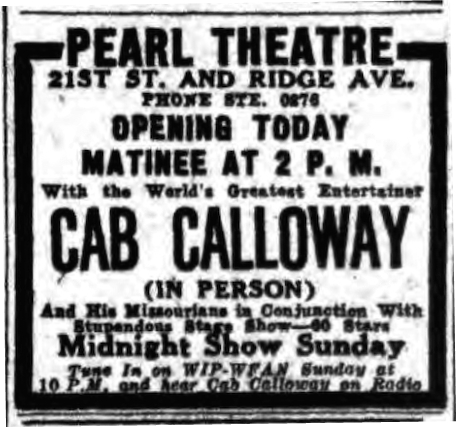
The “Hi De Ho Man,” singer and bandleader Cab Calloway, performed here on several occasions, including a long term residency from January to July 1931.

#TBT Cab Calloway - Pearl Theatre

Pearl Bailey House

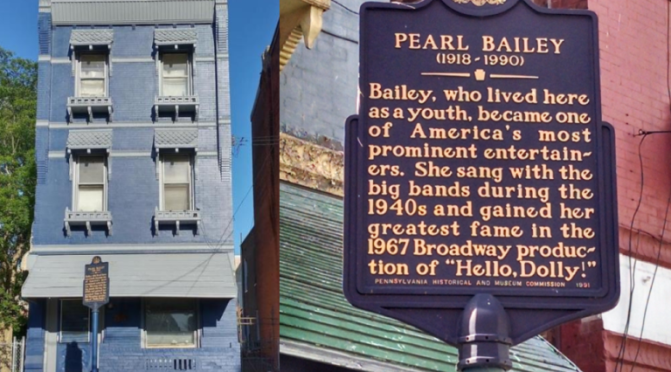
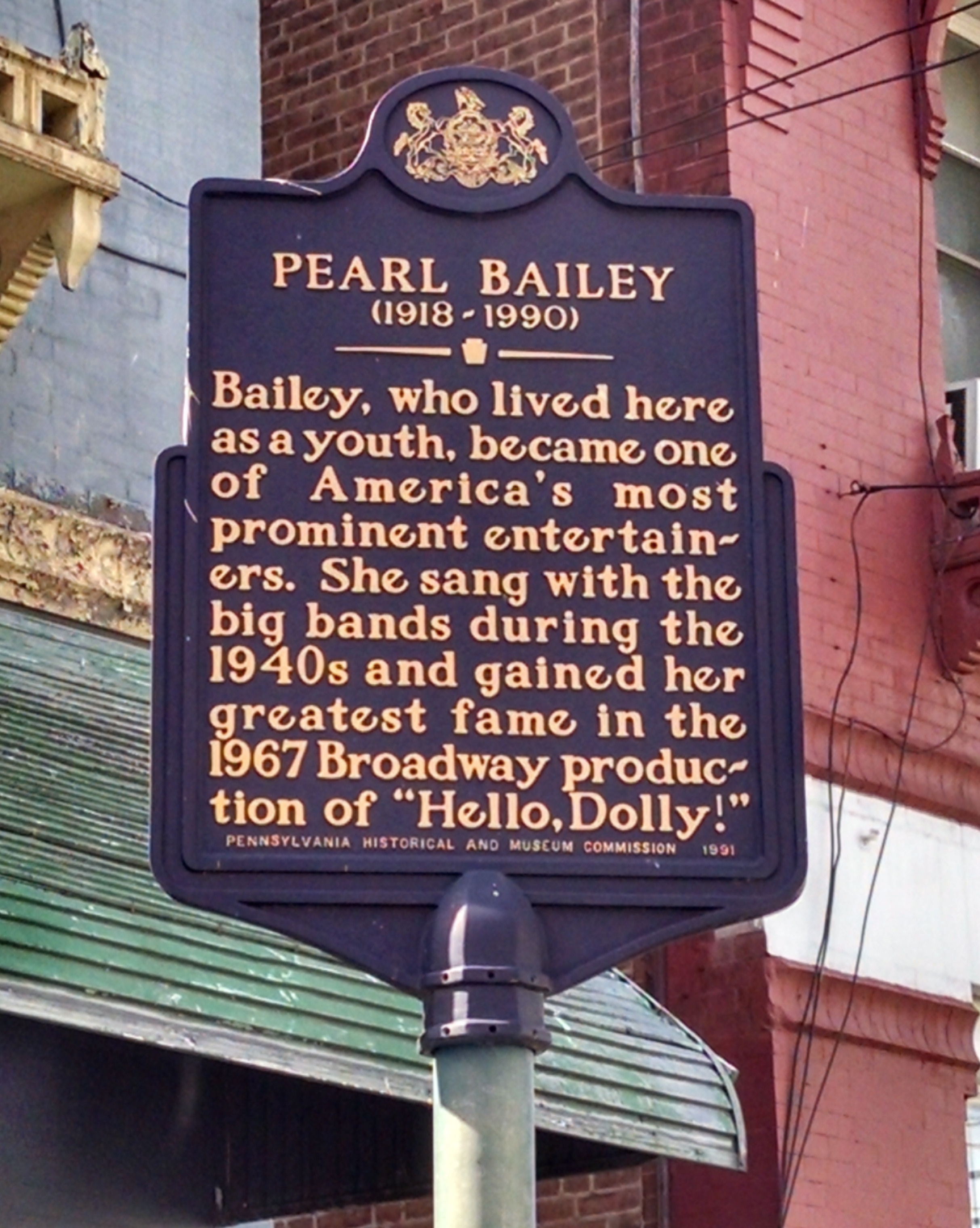
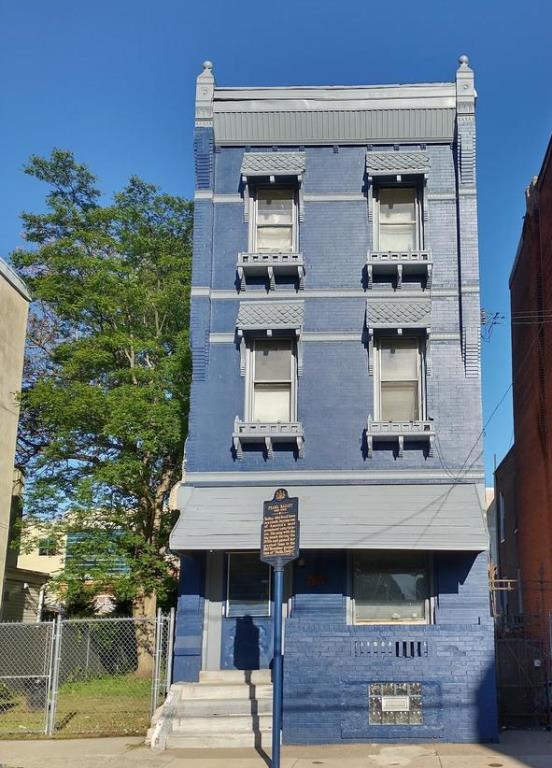
Pearl Bailey grew up in North Philadelphia in the 1920s and ’30s. Her family was part of the Great Migration from the South. She began her storied career by winning an amateur song and dance contest at the Pearl Theatre, which was located on the Ridge Avenue jazz corridor, a few blocks from the Golden Strip.

Pearl Bailey - 4.5.15

After she hit the big time, Bailey bought the house on N. 23rd Street for family members who had migrated from Newport News, Va., where she was born.

Pearl Bailey House

The current owner, William Sharrock, shared that overnight guests included comedians Redd Foxx and Slappy White, Bailey’s ex-husband. She opened the house to friends because African Americans were barred from hotels that catered to white guests.

The Pearl Bailey House has been visited by, among others, Bon Jovi and Bill Clinton (yes, that Bill Clinton).

Two Bit Club

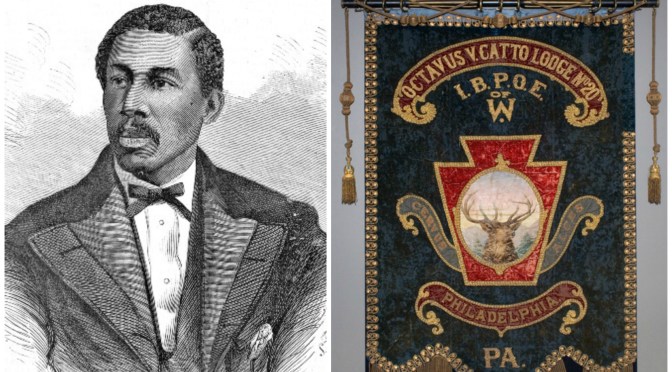
The Two Bit Club was located on the top floor of the O.V. Catto Elks Lodge, a cultural center for the African American community. The building was demolished in 1994.

O.V. Catto Lodge - Special Collections Research Center, Temple University Libraries

From a 1994 Philadelphia Inquirer article lamenting the loss of this landmark:

Lois Fernandez, who lives a few blocks away, was one of the mourners who stopped by last week to see the wrecking ball at work.

“Damn, we’re losing a big part of our history and nobody cares,” said Fernandez, co-founder and director of Odunde, the annual African American festival on South Street.

Back in the 1950s, when Fernandez was a teenager, the “O.V.,” as she called it, was the late-night place to be.

After dinner at the former Postal Card, at 15th and South, and drinks and jazz at the former Pep’s, at Broad and South, young African Americans told each other, “Meet you at the Two Bit” after all the other clubs had closed at 2 a.m.

They were referring to the nightclub that once was located on the top floor of the old Elks Lodge.

On weekend nights until 5 a.m., couples danced the stroll, the strand and the Philly bop. The men wore their hair in the close-cropped “hustler” style and dressed in suits of silk and sharkskin. And their dates did their hair in pageboys or poodle cuts and wore long flared dresses over crinoline slips, accompanied by high heels and white gloves.

It was at the Two Bit Club that then-19-year-old Fernandez held her breath as she waited to get past the man at the door. Once inside, she ordered a Tom Collins or a Canadian Club and ginger ale, and let it sit all night until it turned to water.

“You felt so adult when you went to the Two Bit Club,” Fernandez said. ”You were always trying to act so sophisticated.”

It was at the Two Bit Club that Fernandez listened to jazz bands and saw tap dancers, her first shake dance and her first striptease.

READ MORE

Spider Kelly’s

WRTI Jazz Host Bob Perkins recently wrote:

From North Philly, “Queen of the Organ” Shirley Scott was a dear friend of mine. Saxophonist Eddie “Lockjaw” Davis heard her play at the old Spider Kelly’s jazz spot in Center City, and didn’t have to persuade her to accompany him to New York City, where they would help Count Basie open a nightclub. They remained the featured attraction for several years. Scott married saxophonist Stanley Turrentine in 1960, and they toured and recorded together for the next 10 years.

Don Gardner, managing director of the Philadelphia Clef Club of Jazz & Performing Arts, played here. Don Gardner and his Sonotones included organist Jimmy Smith.

Spider Kelly’s is where legendary bandleader Louis Jordan discovered Dottie Smith. He hired her on the spot.

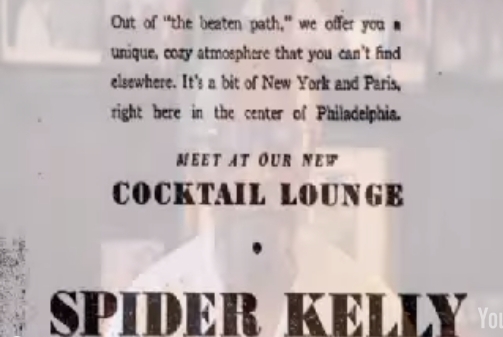
Spider Kelly Screenshot

In a 2005 interview with the West Philadelphia Music, a project of the University of Pennsylvania School of Arts and Sciences, jazz vocalist George Townes remembered:

There was a little place on Mole Street right between 15th and 16th. There’s no more Mole Street now, between Market and Ranstead, no more Mole St. And a place called Spider Kelly’s that was a club, and there was Kelly’s, um, fishery next door, but Spider Kelly’s was the place, where if you want to hide from someone, don’t go to Spider Kelly’s, ’cause they would see you there, and that was a good place.

READ MORE