Category Archives: Cultural Heritage Preservation

The Black Church in America

I am not a church-goer but I fight to save historic churches from demolition (here and here). Regardless of the denomination, the Black Church served as “the foundation for [our] freedom struggle.” Built with the blood, sweat and tears of the ancestors, these buildings hold stories of faith, resistance and triumph.

Most Sunday mornings, I listen to spirituals and old school gospel music.

In his remarks at the 22nd Annual Nancy Hanks Lecture on Arts & Public Policy, Managing and Artistic Director of Jazz at Lincoln Center Wynton Marsalis said:

Those spirituals were the first body of identifiable purely American music art. … Slaves reaching across time to connect the Old Testament and the New, and Moses and freedom, and Jesus and freedom and made it all be right now. They couldn’t even read. But they knew. And I’m telling you these songs brought people together because singing gives a community purpose. And they put everything in those songs. And that music made us believe and it called us home.

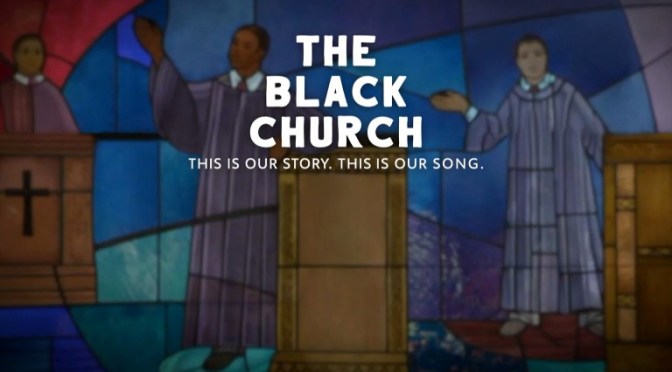
On Tuesdays, February 16-23, 9:00 p.m. ET, I will be called home to the church as PBS premieres the two-part series, The Black Church: This Is Our Story, This Is Our Song, which retraces 400 years of the Black Church in America.

The Black Church: This Is Our Story, This Is Our Song will be available on PBS, PBS.org and PBS Video App. Check your local listing here.
Martin Luther King Jr. Day

From the cries of the enslaved to George Floyd’s anguished cry for his mother, Black people have sung “sorrow songs” of suffering and oppression.

For African Americans freedom is a constant struggle. From slave songs to freedom songs music is the glue that binds African Americans together in the struggles for emancipation, civil rights and racial justice. In an interview, Dr. Martin Luther King Jr. said:

A Negro song anthology would include sorrow songs, shouts for joy, battle hymns, anthems. Since slavery, the Negro has sung throughout his struggle in America. “Steal Away” and “Go Down, Moses” were the songs of faith and inspiration which were sung on the plantations. For the same reasons the slaves sang, Negroes today sing freedom songs, for we, too, are in bondage.

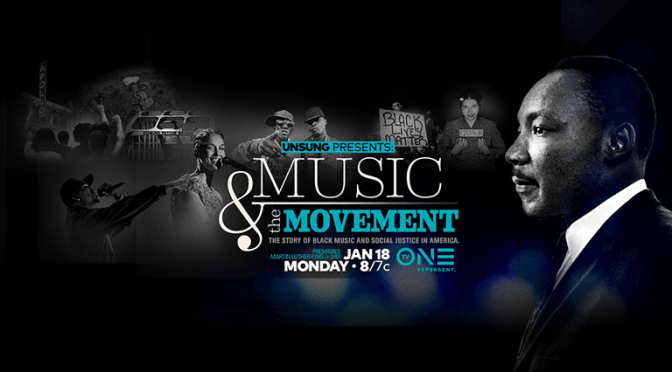
On Martin Luther King Jr. Day 2021, TV One will premiere UNSUNG PRESENTS: MUSIC & THE MOVEMENT, a two-part documentary of 400 years of “auditory dissent.” The film features interviews with artists, archival footage from memorable speeches, and live vocal performances.

Cathy Hughes, Chairwoman of Urban One Inc., said in a statement:

Music is the heart and soul of Black culture – giving life to our experiences, voice to our stories and growing power out of our pain. Every melody, lyric and rhythm artfully depicts the layers of Black diversity, scope of Black creativity, and depths of the complexity of our people. TV One’s Music & the Movement special pays homage to the music and music makers whose talents created a soundtrack of Black music during moments of political and social unrest throughout our history.

Robyn Greene Arrington, Vice President of Programming and Production, added:

Throughout history, Black music has been a clarion call to amplify the voice of our community and important social and political movements like the Civil Rights and Black Lives Matter movements. After an unprecedented year of social, economic, and political turmoil, we felt MLK Day was a great time to chronicle the ongoing struggles of Black Americans along with those who tirelessly lend their voices to protesting injustice and instigating positive changes for our community and social justice movements.

UNSUNG PRESENTS: MUSIC & THE MOVEMENT will air on TV One on Monday, January 18, 2021, at 8 p.m. ET.

American Masters: How It Feels To Be Free

In a 1969 interview, Nina Simone said, “An artist’s duty, as far as I’m concerned, is to reflect the times. I think that is true of painters, sculptors, poets, musicians.”

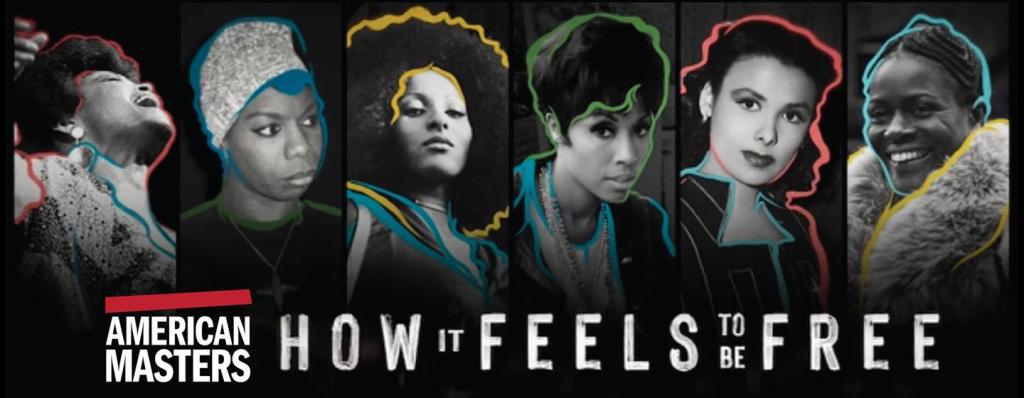
The upcoming PBS documentary How It Feels To Be Free tells the story of six Black artists who reflected the times – Abbey Lincoln, Nina Simone, Pam Grier, Diahann Carroll, Lena Horne and Cicely Tyson.

Michael Kantor, American Masters series executive producer, said:

These revolutionary Black women embody stories of courage, resilience and heroism. They fought for representation and economic, social and political equality through their artistry and activism. We are proud to share the stories of how each left an indelible mark on our culture and inspired a new generation.

Executive producer Alicia Keys added:

I am proud to be a part of such a meaningful, important project. Art is the most powerful medium on the planet, and I continue to be inspired by and learn from these powerful, brave and stereotype-shattering women who leveraged their success as artists to fearlessly stand up against racism, sexism, exclusion and harassment. I honor their courage by celebrating their stories and continuing the work they started.

How It Feels To Be Free premieres Monday, January 18, 2021 at 9 p.m. on PBS. Check your local listing here.

Help Preserve Historic Eden Cemetery

George Bernard Shaw famously said, “Youth is wasted on the young.” In my youth, I took the long way to my high school rather than the short-cut through the nearby cemetery. Fast forward to today, when I pass a burial ground, I often think of Johnny Taylor who sang “people in the cemetery, they’re not all alone.”

Eden Cemetery is a 53-acre historic district listed on the National Register of Historic Places. It is a site on the National Park Service’s Underground Railroad Network to Freedom, and a member of the Pennsylvania Hallowed Grounds Project. A stroll through Eden is “like walking through a book of Black history.” The lives of those interred span from 1721 to the present.

Under the CARES Act, taxpayers who don’t itemize their deductions are allowed to deduct an additional $300 for cash contributions to public charities this year. You can help protect Eden’s legacy and preserve African American memory by making an end-of-year donation here.

Your tax-deductible donation will ensure the graves of Father of the Underground Railroad William Still, Letitia Still, Henry Minton, Octavius V. Catto, Frances Ellen Watkins Harper, Marian Anderson, among others, will be kept clean.

New Billie Holiday Documentary Now Showing

Billie Holiday is an international icon. She also holds a special place in my heart. During a particularly rough patch, I started every day listening to “Good Morning Heartache.”

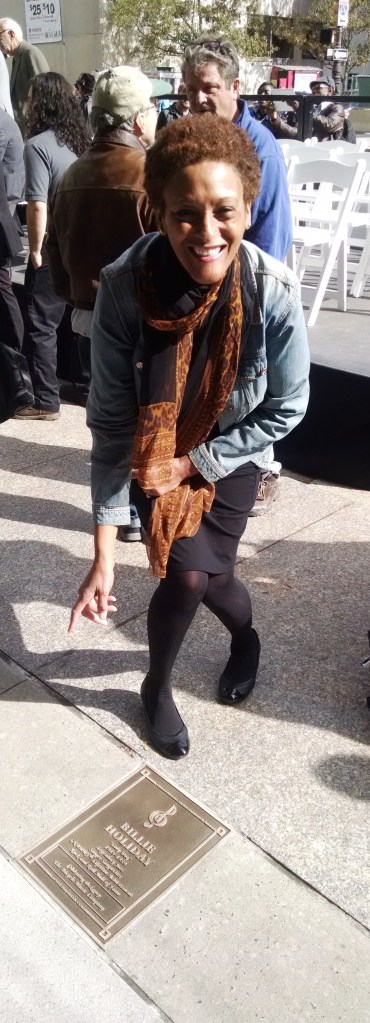
You can imagine my dismay when I moved to Philadelphia and noticed she didn’t have a plaque on the Walk of Fame. So I did what I do.

Months later, I was all smiles when Lady Day’s plaque was installed on Avenue of the Arts.

I recently watched the powerful new documentary Billie via an exclusive screening by the 92nd Street Y.

Billie breathes life into nearly 50-year-old audiotapes of the interviews journalist Linda Lipnack Kuehl conducted with Holiday’s contemporaries including Count Basie, Carmen McRae, Tony Bennett, singer Sylvia Syms and drummer Jo Jones. Archival materials and first-hand accounts shed light on systemic racism, racial segregation and the undertold story of her commitment to racial justice.

The civil rights pioneer said “Strange Fruit” was her personal protest. She performed the song at the end of every performance for 20 years despite FBI and police harassment. Bassist Charles Mingus said, “She was fighting equality before Martin Luther King. … That might be why the cops were against her too, not just junk.”

The special screening was followed by a Q&A with director James Erskine and executive producer Michele Smith, manager of the Billie Holiday Estate.

Billie is now showing in theaters and on virtual cinema. For updates, go here.

Keep Gloria Casarez Mural on 12th Street

Thirty years ago, now-Columbia Law School professor Kimberlé Crenshaw coined the term intersectionality, “a lens through which you can see where power comes and collides, where it interlocks and intersects. It’s not simply that there’s a race problem here, a gender problem here, and a class or LBGTQ problem there. Many times that framework erases what happens to people who are subject to all of these things.”

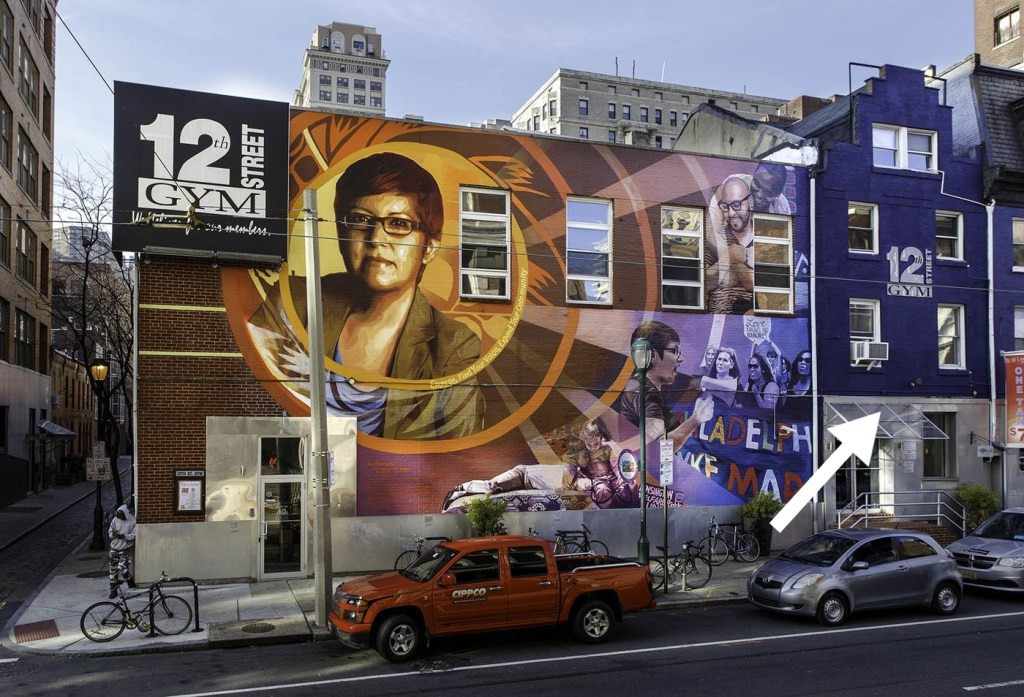
Midwood Investment & Development’s demolition of 204 South 12th Street will erase LBGTQ history and Black history from public memory. The fight to save the Gloria Casarez mural intersects with the fight to save one of the few extant buildings associated with the Underground Railroad.

Casarez was a civil rights leader, LGBTQ activist, and the first director of Philadelphia Mayor’s Office of LGBT Affairs. Her mural adorns one of the interconnected buildings owned by Midwood. The building to the right of the mural is the former residence and place of business of Henry Minton, a leading Black abolitionist and elite caterer whose guests included John Brown, Frederick Douglass and William Still, the Father of the Underground Railroad.

Midwood plans to demolish the property and build apartments for the “demographic moving to Philly” (read: white people). In an op-ed published in The Philadelphia Inquirer, Erme Maula, a lifelong activist for justice and equality, wrote:

The Gloria Casarez mural at 204 S. 12th St. is scheduled for imminent demolition by Midwood Development and Investment. Midwood plans to knock down the former 12th Street Gym and build a 31-story building in its place.

Anyone who knew Gloria and her impact on Philadelphia knows that the loss of the mural is a massive loss for our city. The mural was erected in 2015 to honor Gloria Casarez, a local Latina activist who died of breast cancer in 2014. Gloria dedicated her life to civil and economic rights. She brought communities together to find common ground and common vision. As a student, she organized other students to push for affordable housing and an end to homelessness. As the city’s first director of LGBT affairs, Gloria led Philadelphia to adopt the broadest protections for LGBT people in the nation.

On Monday, October 19, 2020, there will be a “Keep Gloria on 12th” vigil in front of the mural from 5pm to 6:30pm, followed by a Town Hall via Zoom at 7pm. The town hall meeting will provide a space to “plan further actions to stop the erasure of our lives, our achievements, and our history that Gloria fought to preserve.” The vigil and town hall are open to the public. To register, go here.

Driving While Black

From the moment the first enslaved Africans were brought to British colonial America in 1619, Black mobility has been policed. Frederick Douglass had to carry a pass as he traveled across the country to recruit Black troops for the Civil War.

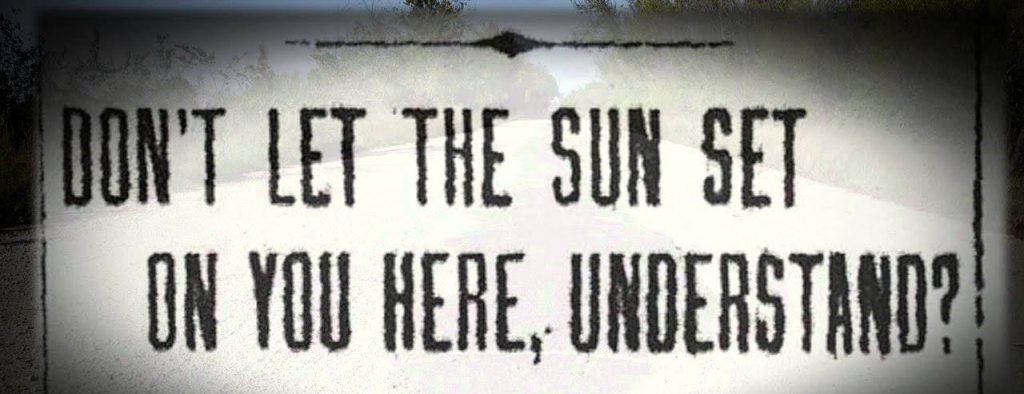
While white Americans were told to get their kicks on Route 66, African Americans had to put the pedal to the metal lest the sun go down on them in one of the sundown towns along the storied highway.

A two-hour documentary, “Driving While Black: Race, Space and Mobility in America,” aired on PBS on October 13, 2020.

Gretchen Sorin, director of the Cooperstown Graduate Program of the State University of New York, spent 20 years researching Black mobility. The documentary is based on her book, “Driving While Black: African-American Travel and the Road to Civil Rights.” Sorin, director Ric Burns, producer and editor Emir Lewis, and Spencer Crew, acting director of the National Museum of African American History and Culture, recently participated in a forum at the John F. Kennedy Presidential Library and Museum.

A travel guide, The Negro Motorist Green Book helped Black travelers navigate racialized public spaces. For information about the Green Book in Philadelphia, go here.

Indigenous Peoples’ Day 2020

It’s laughable to think that Christopher Columbus discovered a “New world.” Indigenous people occupied the land that Columbus stumbled upon.

Native Americans Discovered Columbus2

Gospel Music Heritage Month 2020

Since 2008, September has been designated Gospel Music Heritage Month. Rooted in the African American oral tradition, gospel music helped us get over.

On Wednesday, September 30, 2020, 2:00pm – 3:30pm ET, the Charles L. Blockson Afro-American Collection at Temple University will celebrate the Reverend Joseph Williams, Jr., an original member of the gospel quartet Sons of the Birds who will be inducted into the Black Music Hall of Fame later this year.

Rev. Williams was also a member of the legendary Dixie Hummingbirds from 1983 to 1987.

Rev. Williams and Dr. Mark Kelly Tyler, pastor of historic Mother Bethel African Methodist Episcopal Church will lead a virtual master class in the history and legacy of gospel music through word and song. To join the conversation, use this link: https://temple.zoom.us/j/91499000220.

The program is free and open but registration is encouraged.

New Foxhole Café

While an undergraduate at the University of Pennsylvania, Jon Hinck co-founded the New Foxhole Café in West Philly. Now a lawyer, environmentalist, and former member of the Maine House of Representatives, Hinck recounts:

The space in the basement of the parish hall of St. Mary’s Church hosted two jazz clubs. The one opened by Geno Barnhart [Geno’s Empty Foxhole] perhaps as described above. It closed by the end of 1972. In 1974 a club called the New Foxhole Café opened in the same space started up by a collective including Larry Abrams and myself, Andy Charnas, Rene Charnas, Jules Epstein, Michael Shivers and others.

New Foxhole Cafe, exterior view

Sam Rivers, Sun Ra, Hank Mobley, Philly Joe Jones, Rufus Harley, Dave Liebman, The Art Ensemble of Chicago, Pharaoh Sanders and Anthony Braxton all played there.

Foxhole concerts were broadcast over Penn’s radio station, WXPN-FM. Sun Ra & His Arkestra’s “The Antique Blacks” was recorded in the radio station’s studio on August 17, 1974 (the album was not released until 1978).