To commemorate International Jazz Day 2023 , I nominated Lee Morgan’s “The Sidewinder” for listing on the National Recording Registry of the Library of Congress. Established in 2002 as part of the National Recording Preservation Act of 2000, the National Recording Registry is a list of sound recordings that are “culturally, historically, or aesthetically significant.” The registry includes music, spoken word and historic speeches.
Librarian of Congress Carla Hayden announced the Class of 2024 on April 16, 2024. I scrolled the list with trepidation. When I saw Lee Morgan’s “The Sidewinder,” I jumped up in stunned disbelief.
A record 2,899 nominations were submitted for this year’s class. “The Sidewinder” is among the 25 audio recordings selected for preservation in the Library of Congress’ sound collection.
We will celebrate the listing on International Jazz Day 2024 when Edward Lee Morgan’s historical marker is unveiled.
The dedication ceremony is free and open to the public. To register for the unveiling, please go here.
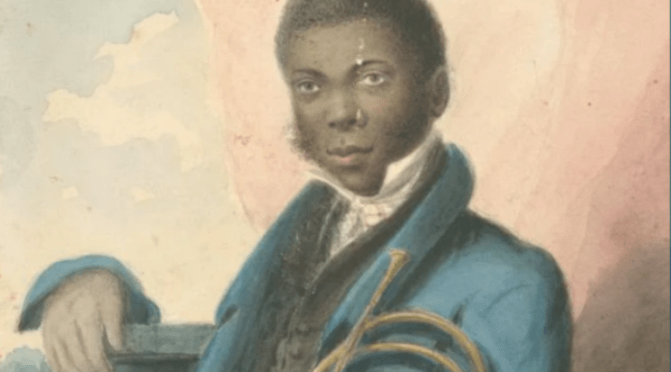
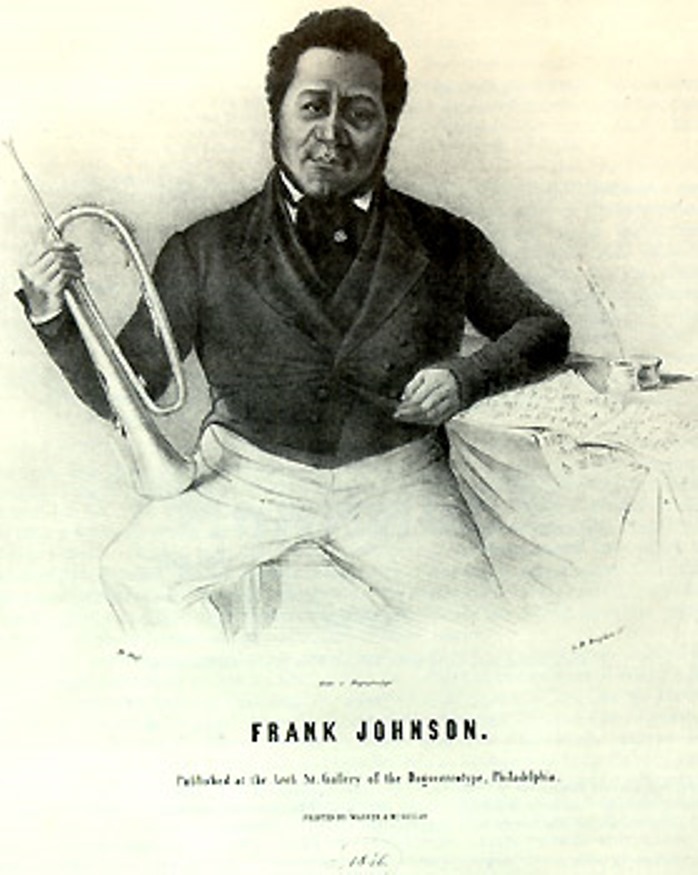
In an opinion piece published in the Philadelphia Inquirer for African American Music Month 2023, I noted that keyed bugle player, bandleader and composer Francis “Frank” Johnson toured the United States, and was the first Black musician to tour Europe.
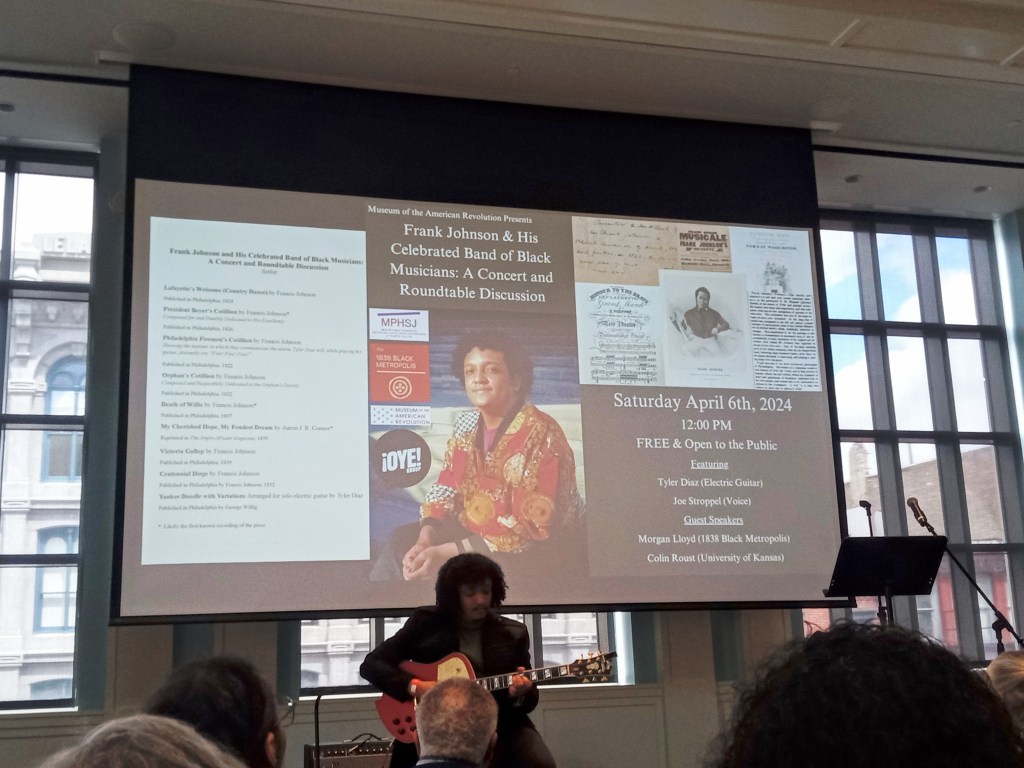
I stand corrected. As electric guitarist, music educator and musicologist Tyler Diaz made clear during a recent concert and roundtable discussion at the Museum of the American Revolution, Frank Johnson was the first American to travel to Europe as a working musician.
Sometime during the 1810s, Johnson was introduced to the Keyed Bugle, an immediate predecessor to the trumpet. With the mastery of this new instrument paired with his noted virtuosity on the violin, Johnson began his rise to national acclaim.
[…]
They [Johnson and band members] became the first Americans to travel to Europe as working musicians. The goal was to come back to Philadelphia with new music and increased musicality. After successful concerts in London and a possible trip to Paris, he returned stateside on May 16th, 1838, surpassing the goal he set out in his ad with great reception.
Johnson is sometimes referred to as the forefather of jazz and ragtime. I am struck by the similarities between Frank Johnson and Lee Morgan.
Both musicians were born in Philadelphia and masters of their chosen instrument. The keyed bugle is an early version of the modern trumpet. Johnson and Morgan were “universally respected” and “celebrated personages of Philadelphia.” Frank and Lee oozed confidence and cool.
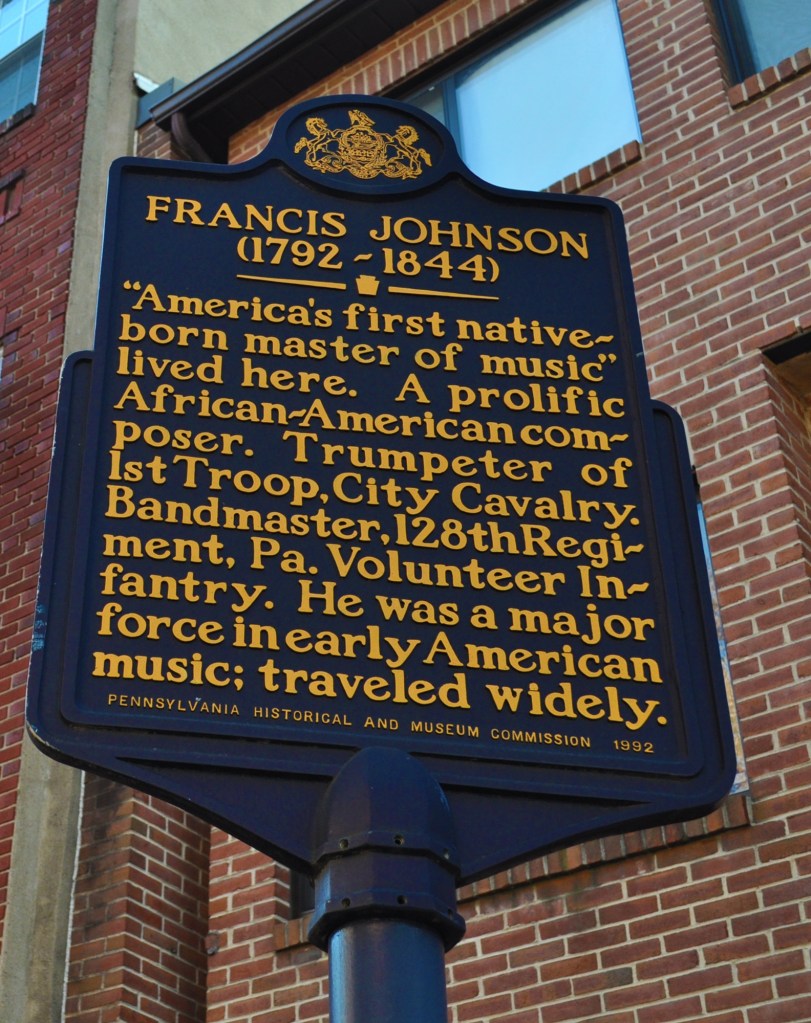
They will soon have a historical marker in common. Frank Johnson’s historical marker was installed in 1992.
Lee Morgan’s historical marker will be unveiled on April 30, 2024, International Jazz Day. The dedication ceremony is free and open to the public. To register for the unveiling, please go here.
Augusta Savage was a sculptor and arts educator, and an important figure in the Harlem Renaissance. She founded the Savage Studio of Arts and Crafts in Harlem, where she mentored and inspired many well-known Harlem Renaissance artists including Ernest Crichlow and Jacob Lawrence.
Like her monumental work, Savage’s story was almost lost to history. “The Harp” was created for the 1939 New York World’s Fair. The design was inspired by James Weldon Johnson’s poem “Lift Every Voice and Sing,” also known as the Black National Anthem. Viewed by more than five million people, Savage’s sculpture was destroyed during the cleanup after the fair ended.
American Masters Shorts‘ documentary, Searching for Augusta Savage, recently premiered on PBS. The filmmakers said they “‘wanted to investigate why evidence of Savage’s accomplishments and her work appear to be erased. We wanted to know how someone so accomplished, so enterprising and so celebrated during her lifetime, could be missing from the annals of American history and the museum landscape.”
Monumental Women has launched a campaign to recreate “The Harp.” For more information, go here.
Philadelphia is a city of neighborhoods. Legendary trumpeter Lee Morgan grew up on Madison Street in the Nicetown/Tioga neighborhood in North Philly. Lee’s block is a 20-minute walk from the intersection of Broad, Germantown and Erie (BGE).
In conjunction with traffic safety and beautification improvements to the iconic intersection, the Office of Arts, Culture, and the Creative Economy (OACCE) issued a Call for Artists to compete for a site-specific public artwork. During an information meeting, Rachel Schwartzman, Percent for Art Rebuild Project Manager, shared the goals of the BGE Public Art Project.
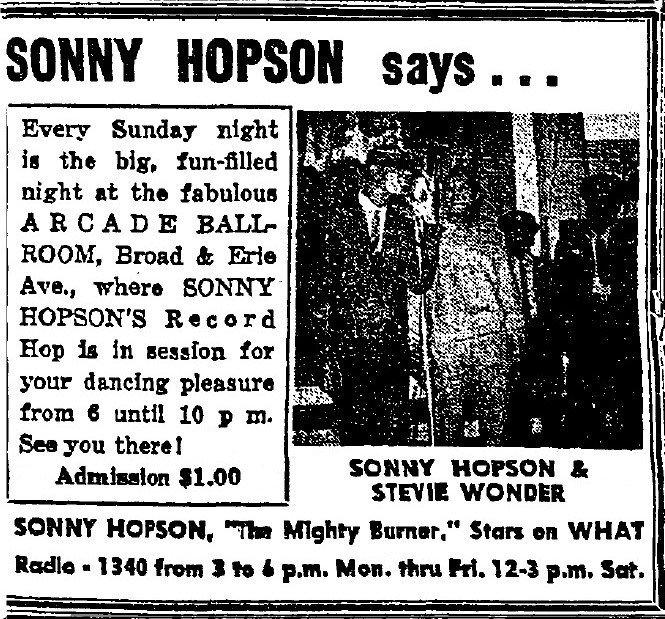
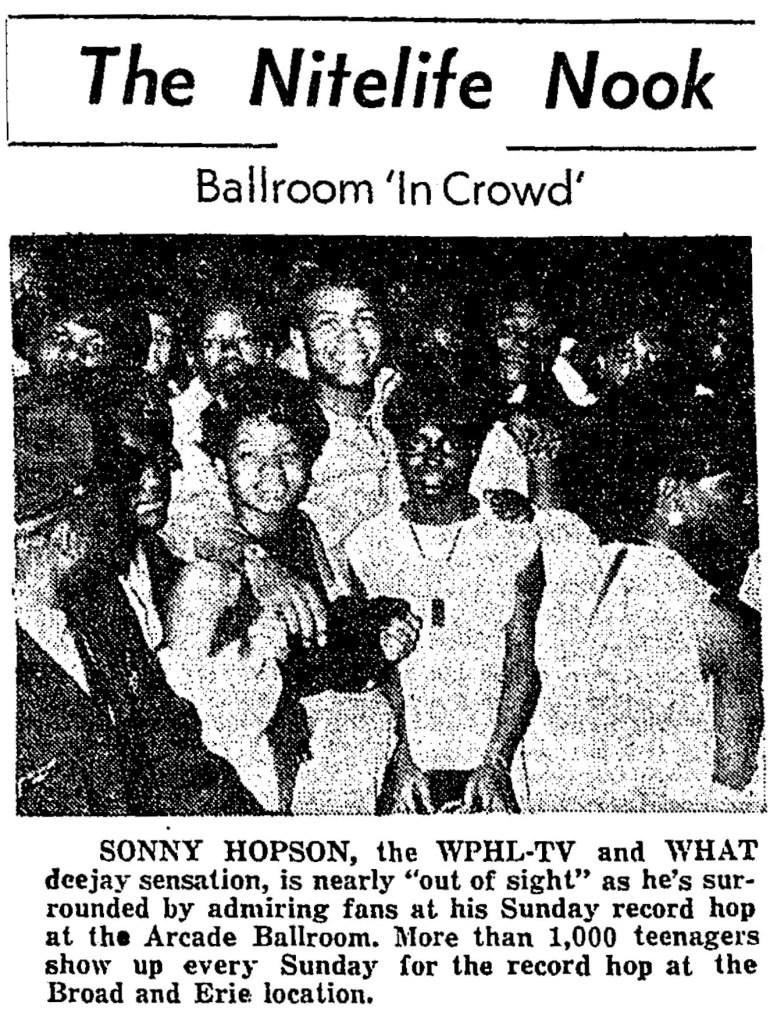
Sundays were for teenagers. The record hops were promoted as “wholesome affairs that will help keep youngsters off the streets and out of trouble.”
The Arcade Ballroom was located in a two-story building constructed in 1920. There were retail stores on the ground floor and a dance hall on the second floor. The entrance to the dance hall was on Erie. The building and entrance sign are still there.
The finalists competing for the Percent For Art commission have been selected. OACCE invites the public to meet the artists and share their ideas for the BGE project. I plan to attend the community meeting to share this neighborhood history with the artists.
To reserve a spot for the community meeting, go here.
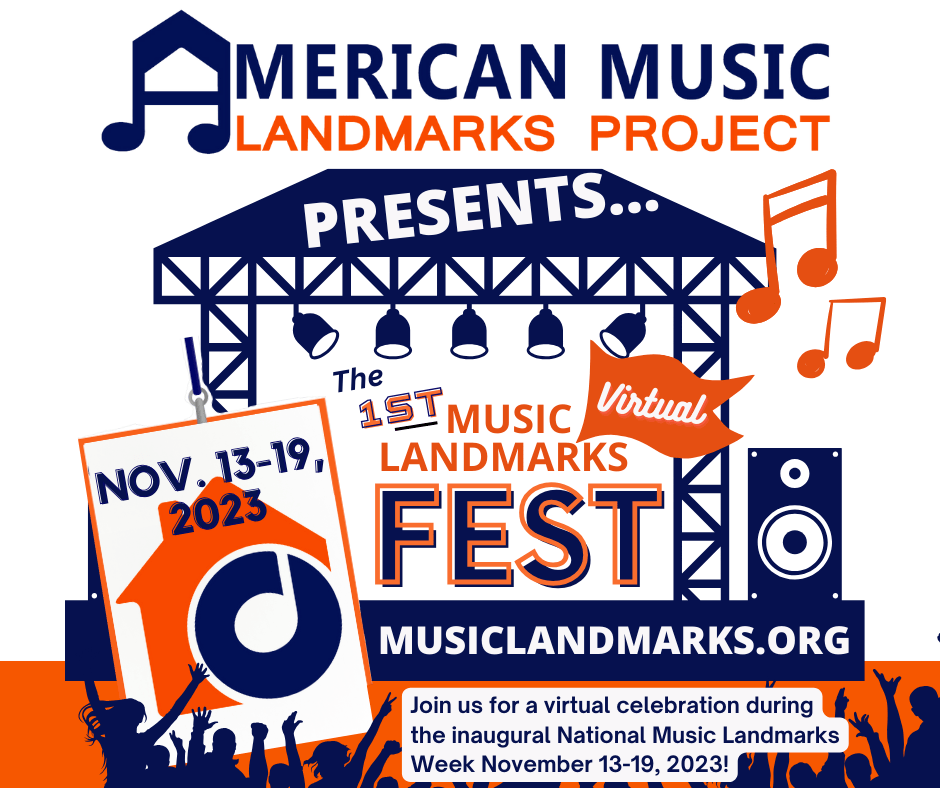
All That Philly Jazz was an official partner of the 1st Annual Music Landmarks Virtual Fest, organized by the American Music Landmarks Project. The virtual event celebrated the architectural legacy of American popular music.
The Douglass Hotel, former home of the Cotton Club, Show Boat and Bijou Café, was featured on Day 2.
The Aqua Lounge, future location of Lee Morgan’s historical marker, was featured on Day 4.
Ticket holders have access to all Fest content through November 30, 2023.
Black sacred places matter. From Bishop Richard Allen preaching at Mother Bethel, Denmark Vesey planning a slave rebellion at Mother Emanuel, and Minister Malcolm X teaching at Muhammad’s Temple of Islam No. 12, Black sacred places have been the heart and soul of the African American community.
Dr. Henry Louis Gates Jr., an advisor to the African American Cultural Heritage Action Fund, observed: “No pillar of the African American community has been more central to its history, identity, and social justice vision than the ‘Black Church.’”
Preserving Black Churches is a project of the African American Cultural Heritage Action Fund which is led by National Trust for Historic Preservation Senior Vice President Brent Leggs. In an interview with Robin Givhan of the Washington Post, Leggs said:
It’s critically important that we preserve the physical evidence of our past, that we preserve the historic buildings that are imbued with legacy and memory, that we preserve the profound stories that are embodied in the walls, landscapes, and cemeteries stewarded by African American churches.
Rooted in the Black experience, jazz both has been a sanctuary and found sanctuary in the church. Now a jazz standard, Duke Ellington’s “Come Sunday” is a celebration of the African American religious tradition.
The Ku Klux Klan’s bombing of Birmingham’s 16th Street Baptist Church which killed four Black children moved John Coltrane, the grandson of a prominent African Methodist Episcopal minister, to compose “Alabama.”
Partners for Sacred Places and the Preservation Alliance for Greater Philadelphia recently launched the Philadelphia Fund for Black Sacred Places (PFBSP). The three-year project will expand public access to purpose-built religious properties of architectural, historical or cultural significance, regardless of denomination, that are operated and owned by an active community of faith. PFBSP will provide planning and programming grants, as well as capital grants to support Black congregations’ efforts to maintain their properties.
The public’s response to the murder of George Floyd in June 2020 gave focus to the unanswered needs of our city’s Black communities. Religious properties have space that can be developed to respond to these needs in creative and innovative ways after worship. The houses of worship that are selected to participate in this grant program will provide welcoming and affirming space to the public that will benefit all of our communities.
PFBSP will provide up to $10,000 in planning grants and up to $250,000 in 1:2 matching grants ($2 granted for each $1 raised) for the planning and execution of projects that expand equitable access to Black-led historic sacred places. Eligibility guidelines are available here. The application deadline is January 31, 2024.
Register here for the November 17 info session on completing the application. If you have any questions, contact PFBSP Director Betsy Ivey by email or by phone at (215) 567-3234 x29.
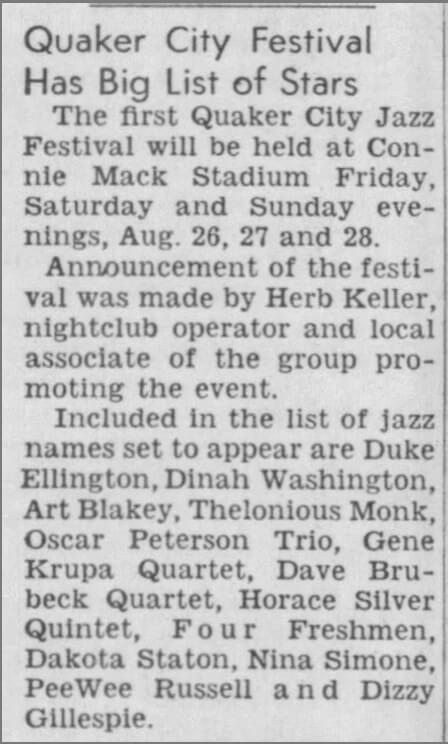
Thelonious Sphere Monk was born on October 10, 1917 in Rocky Mount, North Carolina. The legendary pianist and composer performed at several Philadelphia jazz clubs, including Emerson’s Tavern and the Showboat. He was a headliner at the 1st Quaker City Music Festival.
The bebop pioneer joined the ancestors on February 17, 1982. He bequeathed musicians a list of tips to make them better performers.
One of my most memorable experiences was attending Monk’s funeral service. The homegoing was held at Saint Peter’s Church in New York City. Musicians played version-after-version of “’Round Midnight.” With over 1000 versions of the jazz standard, Monk’s is still my favorite.
WKCR has a special 24-hour broadcast celebrating Monk’s heavenly birthday.
The 2023 festival is history but if I could go back in time, it would be to the 1966 Newport Jazz Festival. The lineup included Count Basie, Dave Brubeck, John Coltrane, Miles Davis, Duke Ellington, Ella Fitzgerald, Jimmy Rushing, Esther Phillips and Joe Williams. Verve Records has issued a newly discovered recording of Nina Simone’s set on July 2, 1966, packaged as the album, “You’ve Got to Learn.”
The release of this magnificent album, recorded live at the Newport Jazz Festival in 1966, is headline news for fans of Nina Simone. None of the material, all of it high grade, has been made available before. Newport promoter George Wein donated the tapes of Simone’s performance to the US Library of Congress, where they lay forgotten until, following Wein’s passing in 2021, Simone historian Nadine Cohodas unearthed them. Simone is in peak form, accompanied by guitarist Rudy Stevenson, bassist Lisle Atkinson and drummer Bobby Hamilton, and audio quality is very good. The album is killer.
The tracklist includes “You’ve Got to Learn,” “I Loves You, Porgy,” “Blues For Mama,” “Be My Husband” and “Mississippi Goddam.”
To order or listen to “You’ve Got to Learn,” go here.
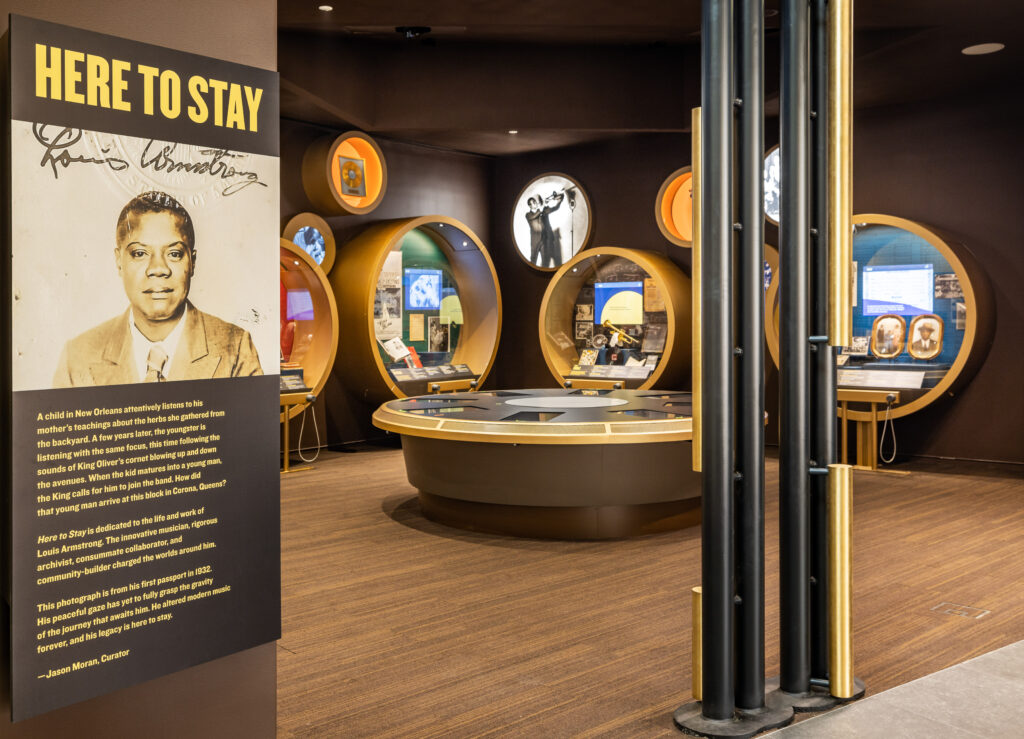
With over 60,000 items, the Louis Armstrong Archive is the largest for one jazz musician. On July 6, the Louis Armstrong Center opened across from the house in Corona, Queens where Pops lived from 1943 until his death on July 6, 1971.
Check out CBS Sunday Morning’s tour of the Louis Armstrong Center.
During Black Music Month, Herb Spivak, co-owner of two of Philadelphia’s legendary jazz clubs, the Showboat and Bijou Café, and I lamented how the annual celebration is increasingly focusing on today’s popular music while ignoring the roots. Like all Black music genres, hip-hop flows from a tree with very deep roots.
I’m a doer so I suggested that we write an opinion piece. We did. Our op-ed was published online and in the print edition of the Philadelphia Inquirer.
Here’s an excerpt:
There was a place outside in Washington Square known as Congo Square, where free and enslaved Black people would gather to sing and dance to the music of West African cultures. Bandleader, composer, and Philly native Francis Johnson performed across the United States and was the first Black musician to tour Europe with a band in the 1800s. Soon after, he was followed by singer Elizabeth Taylor Greenfield, who also lived in Philadelphia.
The flood of Black music out of Philadelphia continued into the 1900s, as Dizzy Gillespie and Charlie Parker improvised bebop at the Down Beat on South 11th Street, Kenneth Gamble and Leon Huff founded Philadelphia International Records, and the Roots played hip-hop on South Street.
[…]
Black music history matters. As Marcus Garvey, founder of the Universal Negro Improvement Association, said, “A people without the knowledge of their past history, origin and culture is like a tree without roots.” Black music has always been more than entertainment. From the “sorrow songs” of the enslaved to the protest songs of the Black Lives Matter movement, Black music is a first draft of history.















 All That Philly Jazz