
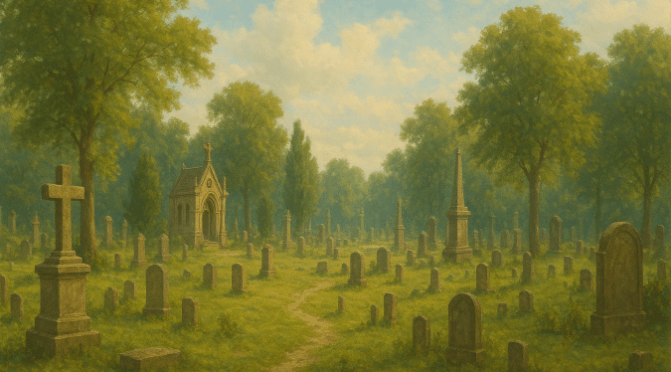
The last Sunday in October is Visit a Cemetery Day. It’s an annual observance to promote a connection with the past, honor the memories of those who came before us, and appreciate the historical and cultural significance of cemeteries.
Before cities built public parks, cemeteries were the first green spaces open to everyone. In the 19th century, rural cemeteries were designed as peaceful, landscaped grounds where people could walk, picnic and reflect. Their winding paths, trees, and gardens offered an escape from crowded urban life. These “cities of the dead” influenced the design of public parks. Historic cemeteries like Laurel Hill in Philadelphia and Green-Wood in New York City remain vital, beautiful green spaces.
That history was lost on me in my youth. When I was in high school, I avoided taking the shortcut to school because I did not want to walk through a cemetery. Fast forward to today, St. Peter’s Churchyard is a stop on my Moses Williams’ Philadelphia walking tour. St. Peter’s is the final resting place of Moses’ enslaver, Charles Willson Peale.

Master silhouette artist Moses Williams was interred in Northwest Burial Ground on December 20, 1830.

At the time, the cemetery was located at 16th and Fairmount. Sometime between 1860 and 1875, the Northwest Burial Ground was sold, the bodies disinterred, and the land developed. The bodies were reinterred in Mount Moriah Cemetery in West Philadelphia. So presumably that’s where Moses’ remains are located.
I’m digging in the archives to confirm that Mount Moriah is indeed Moses’ final resting place. I want to find his remains so that I can see that Moses’ grave is kept clean.
 All That Philly Jazz