Category Archives: Jazz Venues

Women’s History Month: U.S. Postal Service

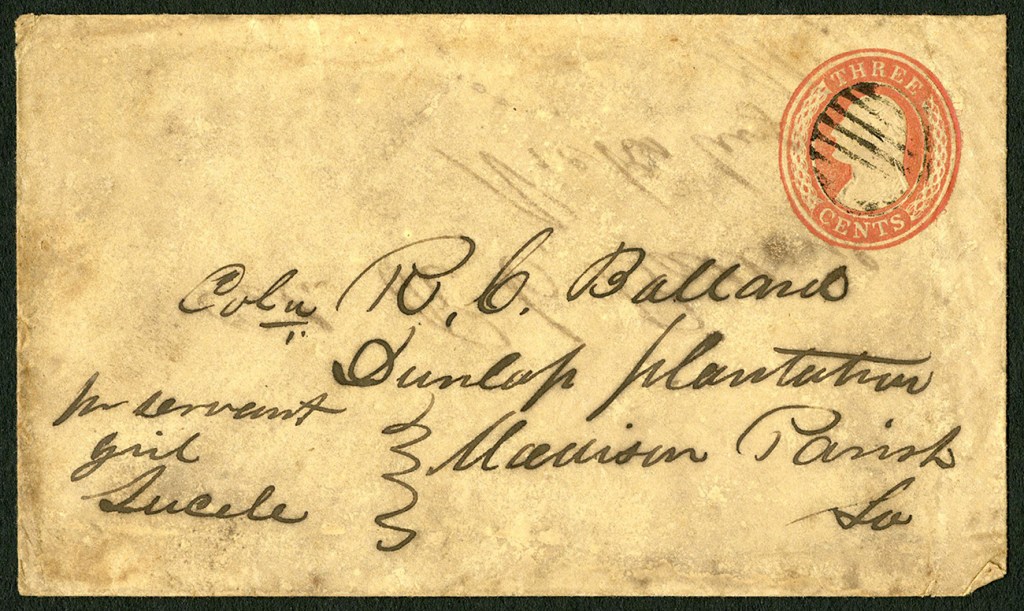
President Trump has floated a plan to privatize the U.S. Postal Service. The United States Post Office Department was established in 1792. Enslaved Africans delivered mail and packages between plantations and towns. Before the introduction of home mail delivery in 1863, enslaved Africans often carried mail to and from the post office.
Mary Fields, aka Stagecoach Mary, was the first African American to carry mail on a Star Route for the Post Office Department.

Minnie M. Cox was the first Black female postmaster.
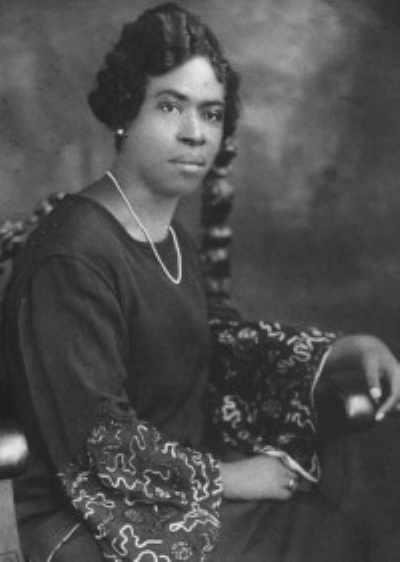
Mrs. Cox definitely earned it. Still, the white citizens of Indianola, Mississippi petitioned President Theodore Roosevelt to remove her from office. Roosevelt refused:

Initially, very few complaints were raised about Mrs. Cox’s appointment as postmaster. As time passed, however, concerns arose from the citizens of Indianola. During this time, Republican politics were being restructured by President Theodore Roosevelt, and the new party stance shifted so that it no longer continued the Reconstruction policy of placing African Americans to political appointments. The white citizens of Indianola called for the elimination of African Americans from leadership positions, and specifically for the removal of Mrs. Cox. In doing so, they hoped to create an opening for a white postmaster.

[…]

These threats concerned postal inspector Charles Fitzgerald, who suggested that “as a bona fide federal officer, Mrs. Cox should be protected, by federal troops if necessary, in the discharge of her duties.” However, President Roosevelt made it clear that there would be no need for federal troops and refused to accept Mrs. Cox’s resignation. Instead, he suspended the Indianola post office on January 2, 1903. Through this suspension, Roosevelt effectively showed Indianola citizens that mail would be rerouted until Mrs. Cox could resume her duties. The atmosphere, however, became so hostile that Mrs. Cox left Indianola for her own safety on January 5, 1903.

In response to the town’s actions against Mrs. Cox, President Roosevelt ordered the Attorney General to prosecute any citizens who had violently threatened Mrs. Cox. Furthermore, the Postmaster General decided to reduce the rank of the Indianola Post Office from a third-class to a fourth-class office on the grounds that the year’s lower postal receipts did not warrant third-class status.

A jazz club in South Philly paid homage to postal workers and the role of the Postal Service in building the Black middle class.
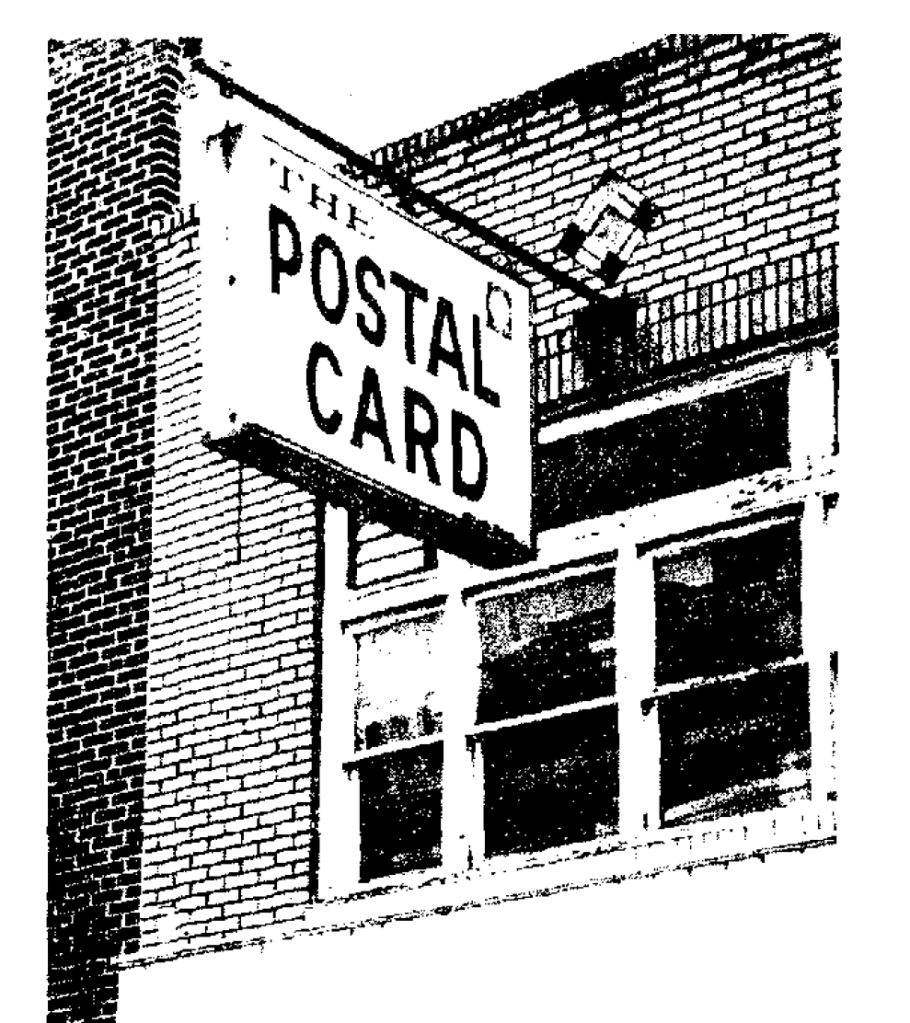
The Postal Service offered opportunities for Black high school graduates, as well as those with undergraduate and post-graduate degrees. In 1940, approximately 14 percent of all middle-class African Americans worked for the Postal Service; 28 percent had at least some college education compared to 4.9 percent of the Black population in general.

Today, African Americans represent approximately 29 percent of the postal workforce.

The Postal Service also preserves African American history and culture in public memory.

A complete list of the phenomenal Black women who have been honored with a postage stamp is available here.

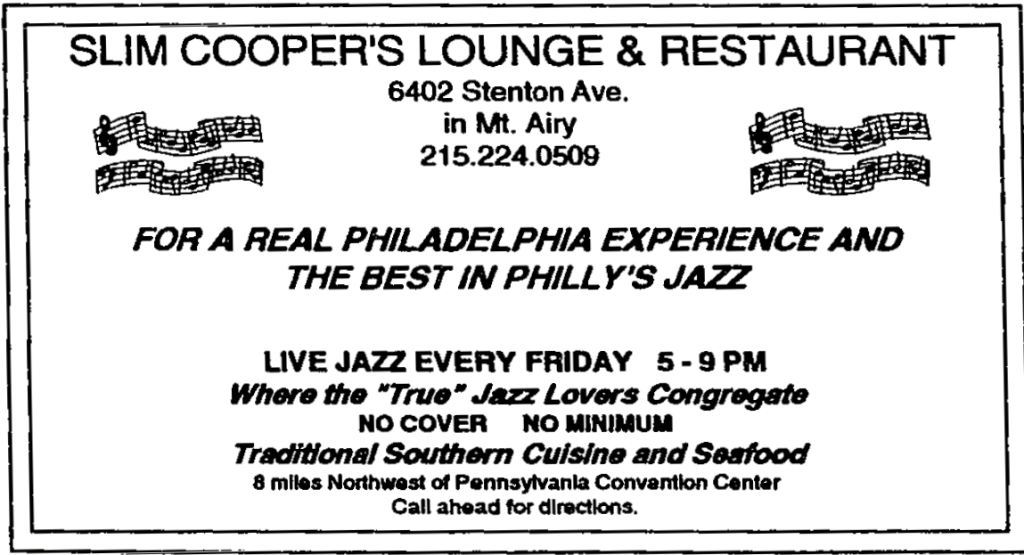
Slim Cooper’s

Slim and Barbara Cooper were the proprietors of Slim Cooper’s Lounge & Restaurant. The Philadelphia Tribune described it as “one of the nicer neighborhood jazz clubs.”

In a post on X/Twitter, Christian McBride recalled the Monday night jam sessions:

When I was in high school, [saxophonist] Tony Williams led a Monday night jam session at Slim Cooper’s in Mt. Airy. I lived in West Philly, Joey DeFrancesco lived in the Glenolden/Folcroft area. We both went to high school in South Philly. In other words, it took EFFORT to get to Mt. Airy and still be home at a respectable hour.

Mr. Williams’ group with Eddie Green on piano, Tyrone Brown on bass and Al Jackson on drums were swinging so hard, the walls would sweat in that place! We knew they would have a jam session later in the evening, but we were too young to be there that late on a school night. Mr. Williams said that maybe if we get there early, like right when the gig starts, he might consider letting us sit in. But because we were underage and not allowed in bars, we had to sneak in. If I remember correctly, they started early. 6? Maybe 7? Joey, Antonio Parker, Fred Goodson and myself would all be waiting by the door.

Mr. Williams would see us and be so excited that so many young cats cared about playing jazz. He would say, “Ok, we’ll play one song, then we’ll let you guys come up and play one – but then you gotta get outta here!” He ALWAYS looked out for us and every young musician that ever came across his radar.

The jazz spot closed in 2000 following the death of Slim Cooper.

Durham’s Casbah

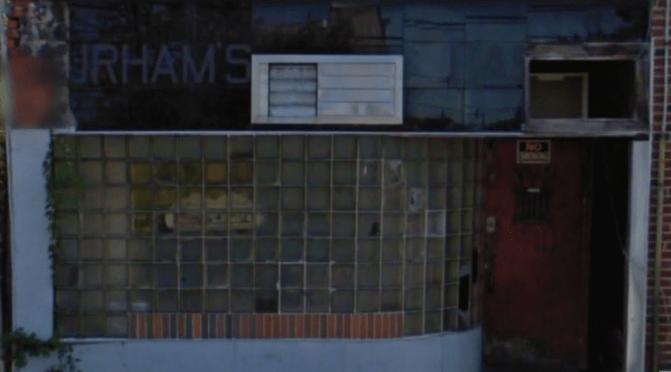
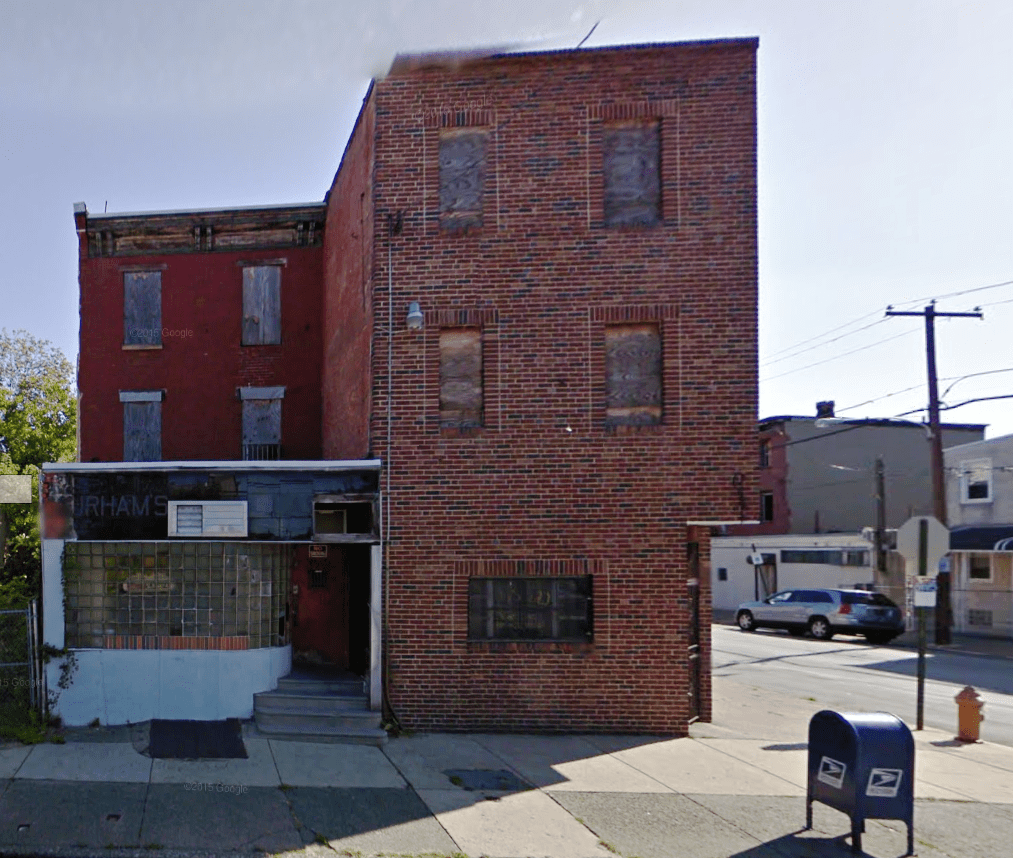
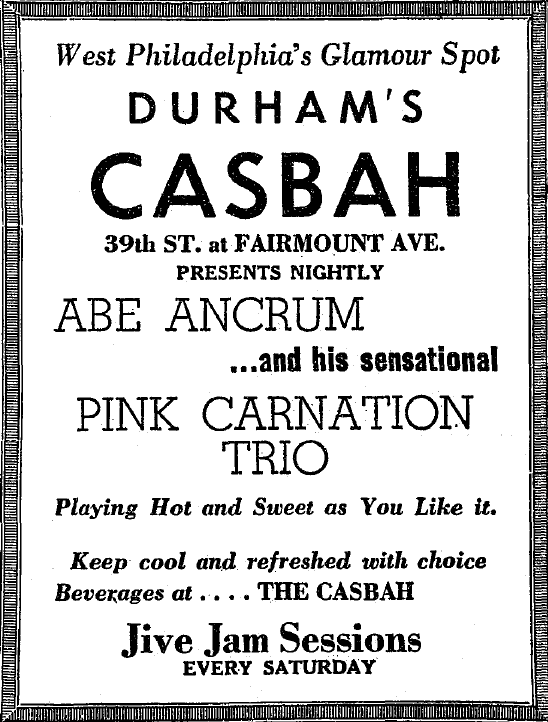
Brothers Charlie Lee and Willie Durham opened Durham’s Casbah on May 7, 1946. It was one of the few Black-owned taprooms in the city.

The jazz club was “West Philadelphia’s Glamour Spot” with live music and Saturday jam sessions.

The building was demolished around 2010.

East End Club

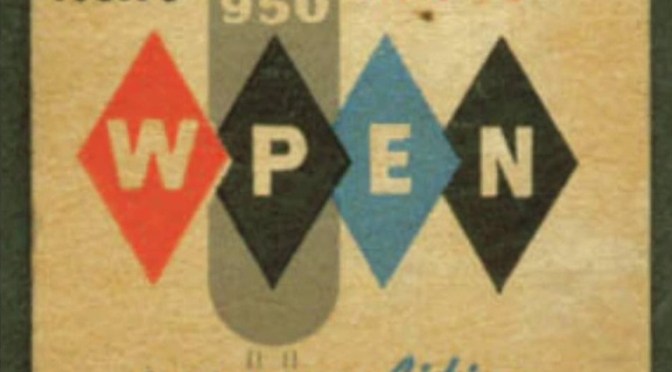
Serial entrepreneur and jazz promoter Ben Bynum opened the East End Club in 1966 after his Cadillac Club burned to the ground. The club was located on the second floor of the former headquarters of WPEN radio station. The 250-seat auditorium was one of the largest jazz venues in the city.

Bynum told the Philadelphia Tribune:

They used to say that Philly is a dead town entertainment-wise. But today we know entertainers who pass up New York City and other big towns in order to work in Philly. The secret is knowing how to give people what they want at a reasonable price and in an attractive atmosphere with class.”

Chuck Jackson and Nina Simone are among the artists who performed here.

Benny The Bum’s

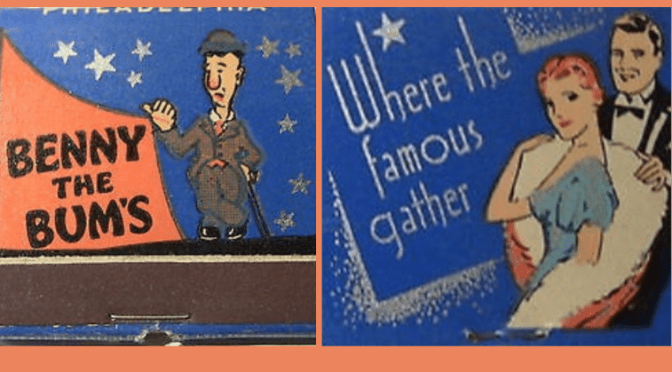
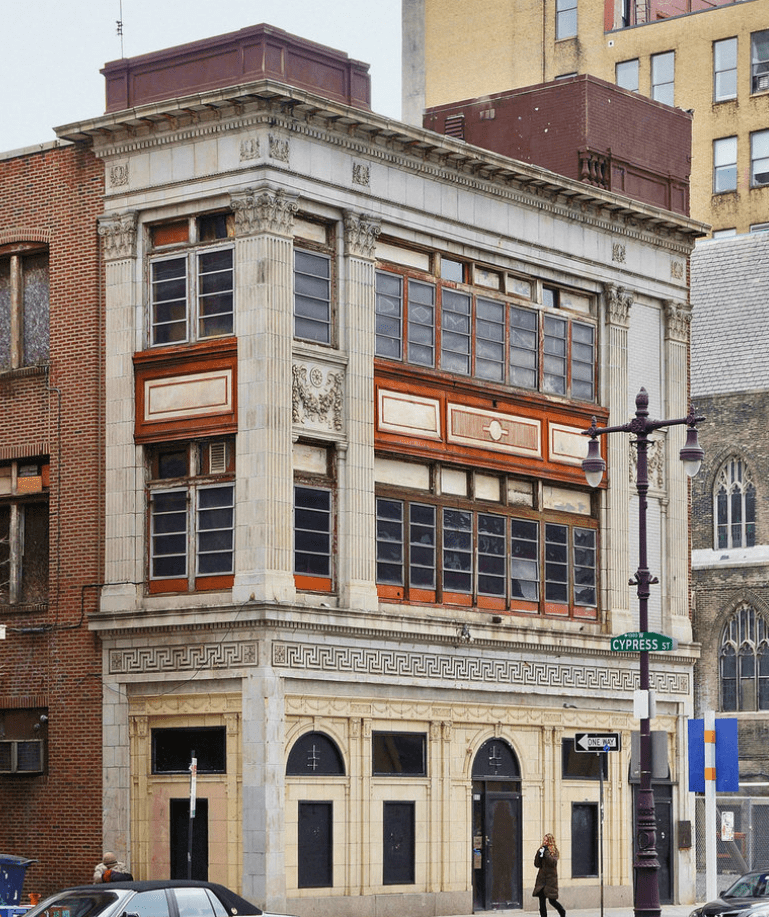
Benjamin Fogelman opened the original Benny The Bum’s (“Where the famous gather”) on the ground floor of the Regency Ballroom circa 1936.

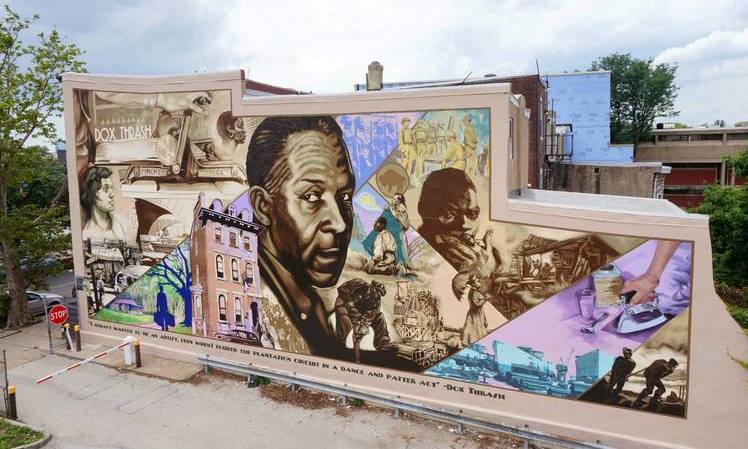
On the second floor of the Regency Ballroom, internationally acclaimed African American artist Dox Thrash developed his influential carborundum printmaking technique while working at the Philadelphia Fine Print Workshop. The jobs for visual artists program was funded by the Federal Art Project of the Works Progress Administration.

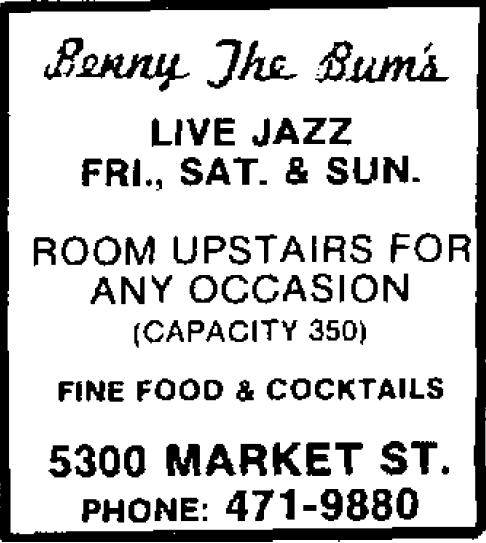
At some point under the ownership of Alvin Fogelman, Benny The Bum’s moved to West Philly. The nightspot had jazz on the weekends.

The space was previously the home of the Red Rooster Café, the jazz club where John Coltrane met McCoy Tyner in 1957. The building is still there. It’s a bonus stop on All That Philly Jazz walking tour, Stroll Along the Strip.

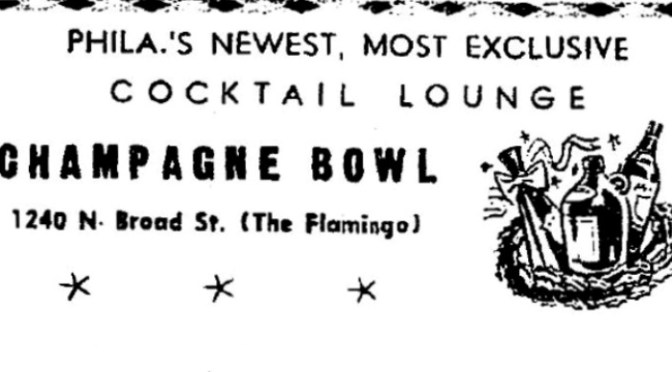
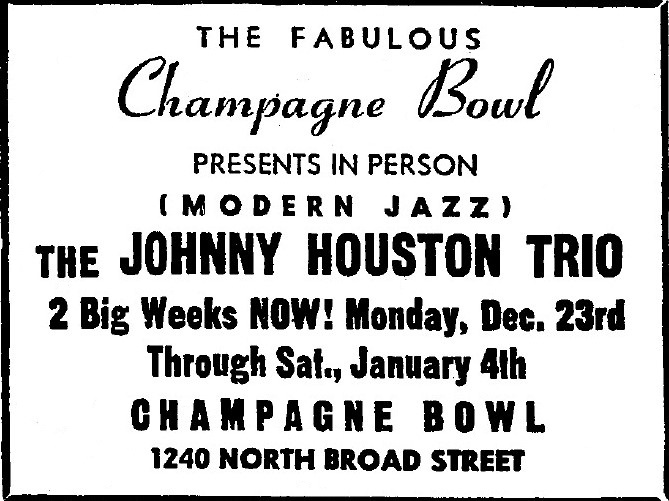
The Champagne Bowl opened May 28, 1957. It was located on the ground floor of the Flamingo Apartments. Pianist and composer Johnny Houston, who later joined Art Blakey’s Jazz Messengers, began a two-week gig at the “Bowl” in December 1957.

Hundreds attended a star-studded salute to R&B legend Little Willie John at the Bowl in December 1959. The singer’s 1956 hit, “Fever,” was later covered by Peggy Lee.

Singer and saxophonist Bull Moose Jackson was among the performers at the Little Willie John gala. In the 1960s, the bandleader lived in Ivy Hall Apartments (formerly Flamingo Apartments) and was a “mixologist” at the Champagne Bowl.

1st Annual Music Landmarks Virtual Fest

All That Philly Jazz was an official partner of the 1st Annual Music Landmarks Virtual Fest, organized by the American Music Landmarks Project. The virtual event celebrated the architectural legacy of American popular music.

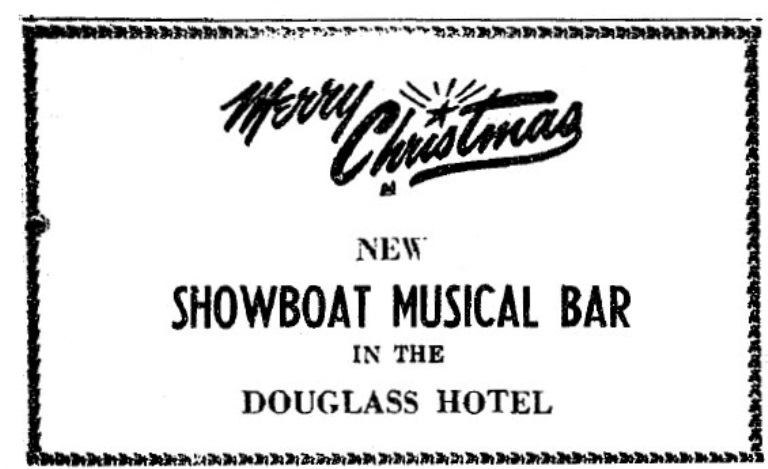
The Douglass Hotel, former home of the Cotton Club, Show Boat and Bijou Café, was featured on Day 2.

The Aqua Lounge, future location of Lee Morgan’s historical marker, was featured on Day 4.

Ticket holders have access to all Fest content through November 30, 2023.

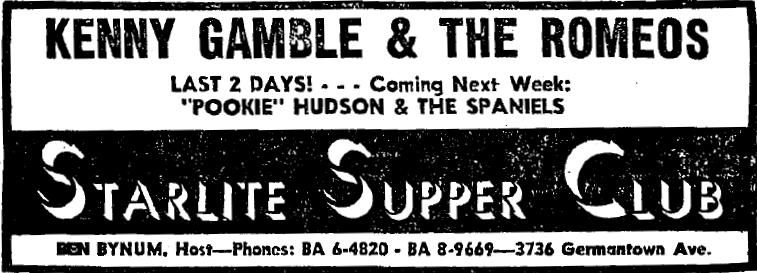
Opened in the 1960s, the Starlite Supper Club was one of several nightspots owned by serial jazz club owner Benjamin Bynum Sr. Kenny Gamble and the Romeos, Ben E. King, Lou “Philly Dog” Lawton, Nina Simone, Jimmy Smith, Kim Weston and Randy Weston were among the up and coming and established artists who performed here.

Fittingly, the purveyor of soul food played host to Latin jazz percussionist Willie Bobo.

Prince’s Total Experience

Prince Artis Gilliard Jr., a former investigator with the Philadelphia Police Department, opened Prince’s Total Experience in the 1970s.

In the mid-70s, Sun Ra and the Arkestra had a weekly engagement at the North Philly jazz spot.

Prince’s Total Experienced played host to soul and jazz legends, including Harold Melvin & the Blue Notes, Billy Paul, Bootsie Barnes, Sonny Fortune, Arthur Prysock and the Delfonics.

Prince’s Total Experience closed in the 1980s. It’s now the site of a beer distributor.