

Moses Williams (1776-1830) was born into slavery in Philadelphia, one month after the signing of the Declaration of Independence.

Williams was enslaved by “Portrait Painter of the Revolution” Charles Willson Peale who, as a member of the Pennsylvania General Assembly, voted for the Gradual Abolition of Slavery Act of 1780.
While enslaved, Williams was a factotum at Peale’s Museum. He participated in the first paleontological expedition in the new republic. As a skilled taxidermist, Williams was instrumental in the reconstruction of Peale’s exhumed mastodon.

Manumitted in 1802, Williams operated a physiognotrace (face tracing) machine “every day and evening” at Peale’s Museum which was located on the second floor of the building now known as Independence Hall.

Working in anonymity, Williams became a master silhouette artist and contributed to the success of Peale’s Museum.
Williams’ silhouettes are on view at, among other places, Philadelphia Museum of Art, Philadelphia Academy of the Fine Arts, Portrait Gallery in the Second Bank of the United States, The Peale Museum, Yale University Art Gallery, and in the archives of the American Philosophical Society.

Thomas Jefferson, president of the American Philosophical Society from 1797 to 1814, likely crossed paths with Williams whose silhouettes are on display in the Jefferson Library at Monticello.


Williams was the nation’s first Black museum professional. He excelled as a “cutter of profiles” and earned a place in history.
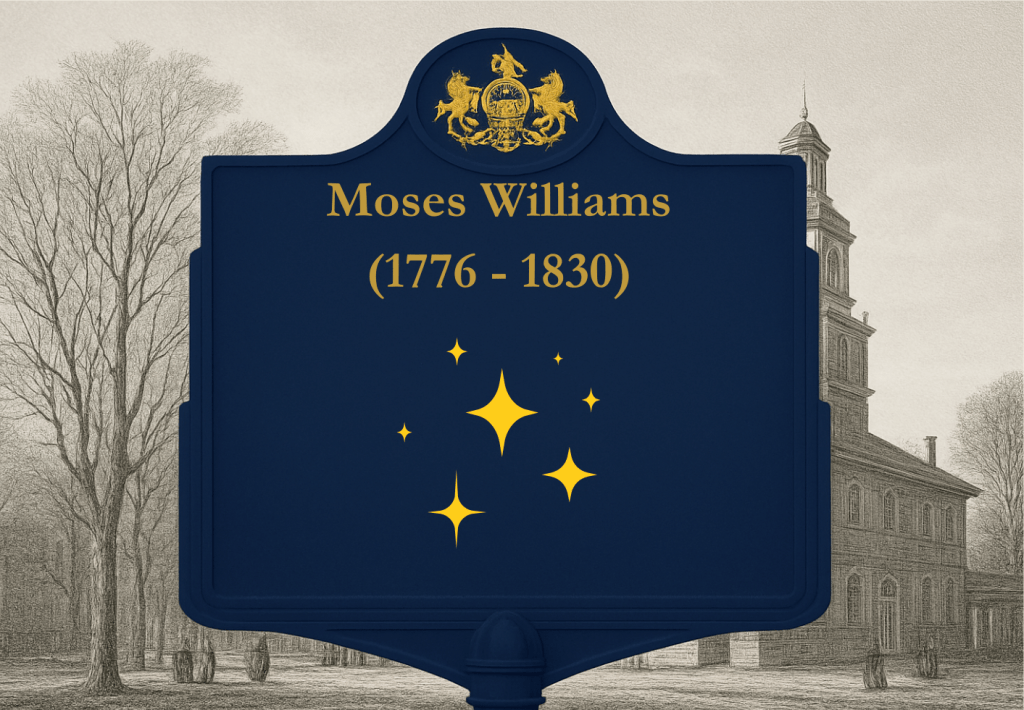
To recognize his impact on 19th century visual culture, All That Philly Founding Director Faye Anderson nominated Moses Williams for a Pennsylvania historical marker. If the nomination is approved, Williams’ marker will be dedicated in 2026, which is the 250th anniversary of both Williams’ birth and the Declaration of Independence.
Moses Williams will not be celebrated by President Trump’s Task Force 250, but we the people will say his name.
UPDATE: The nomination was approved. In 2026, the 250th anniversary of his birth, Moses Williams will be recognized with a Pennsylvania historical marker.
For too long, history remembered only his enslaver, Charles Willson Peale. This marker is a step toward telling the full story, reclaiming Williams’ legacy, and giving voice to the enslaved whose contributions shaped American art and culture.
In the meantime, Faye Anderson will lead a walking tour of Moses Williams’ Philadelphia.

 All That Philly Jazz